
Living Museum of Learning
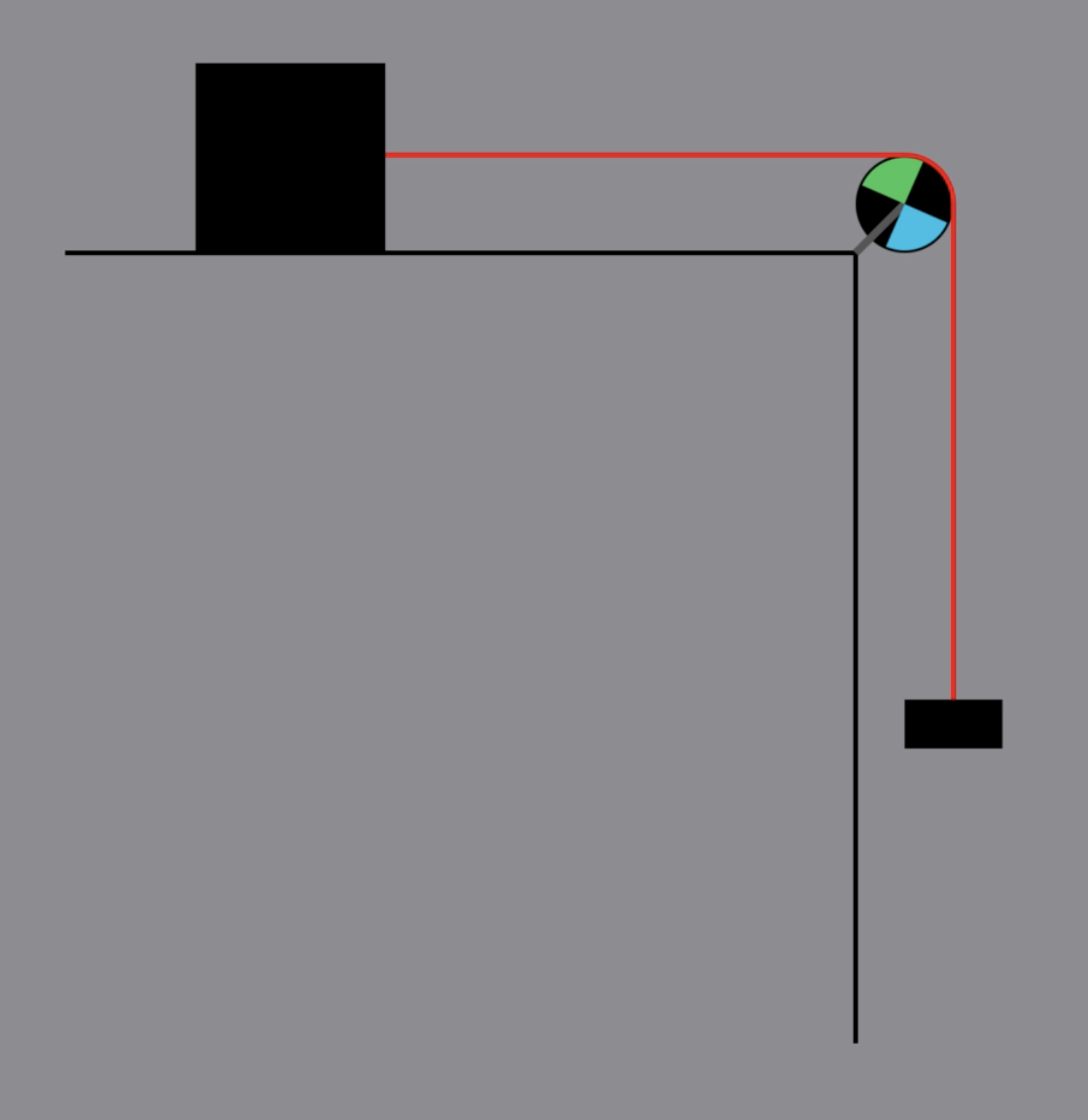
Jayden’s Pulley of Intuition
Last week, Jayden showed a 14-second video of a pulley system he had programmed on his iPad.
It looked simple at first: two sliders controlling a moving system of boxes, a wheel, and a rope.
One slider moved the connected boxes horizontally. The other adjusted the radius of a wheel fixed at the corner of the scene.
As either slider changed, the system responded as a whole. The boxes translated, the rope adjusted, and the wheel rotated in coordination. The motion felt physically consistent, even though the model was still evolving.
Inside the wheel, Jayden had added a visual layer: colored sectors that rotated with the system. This made the motion easier to “see,” not just observe.
At the core of the implementation was a simple relationship:
let angle = boxTX / 16
The rotation of the wheel was tied directly to the horizontal movement of the boxes through a ratio he chose himself.
It was not derived from a full physical model. It was not based on formal equations of arc length or rigid-body mechanics.
But it worked in a different sense.
The system felt synchronized.
When I asked whether the ratio was mathematically exact, the answer was no.
When asked to derive a full physical relationship, that was also not the goal at this stage.
Instead, Jayden was doing something more fundamental: building intuition through interaction.
He adjusted the relationship until the motion looked right — until translation and rotation appeared connected in a natural way.
In that sense, the system was not a finished physics model.
It was an exploration of correspondence between movement and representation.
Many people imagine learning follows a strict sequence:
Math → Formula → Program → Animation
But in practice, especially in early exploration, it often unfolds differently:
Observation → Experiment → Intuition → Mathematics
The mathematics comes later, giving structure and language to relationships that have already been felt.
What stood out most was not the correctness of the model, but the emergence of understanding through adjustment.
Before equations, there was perception.
Before derivation, there was tuning.
And sometimes, that is where real understanding begins.