
Living Museum of Learning
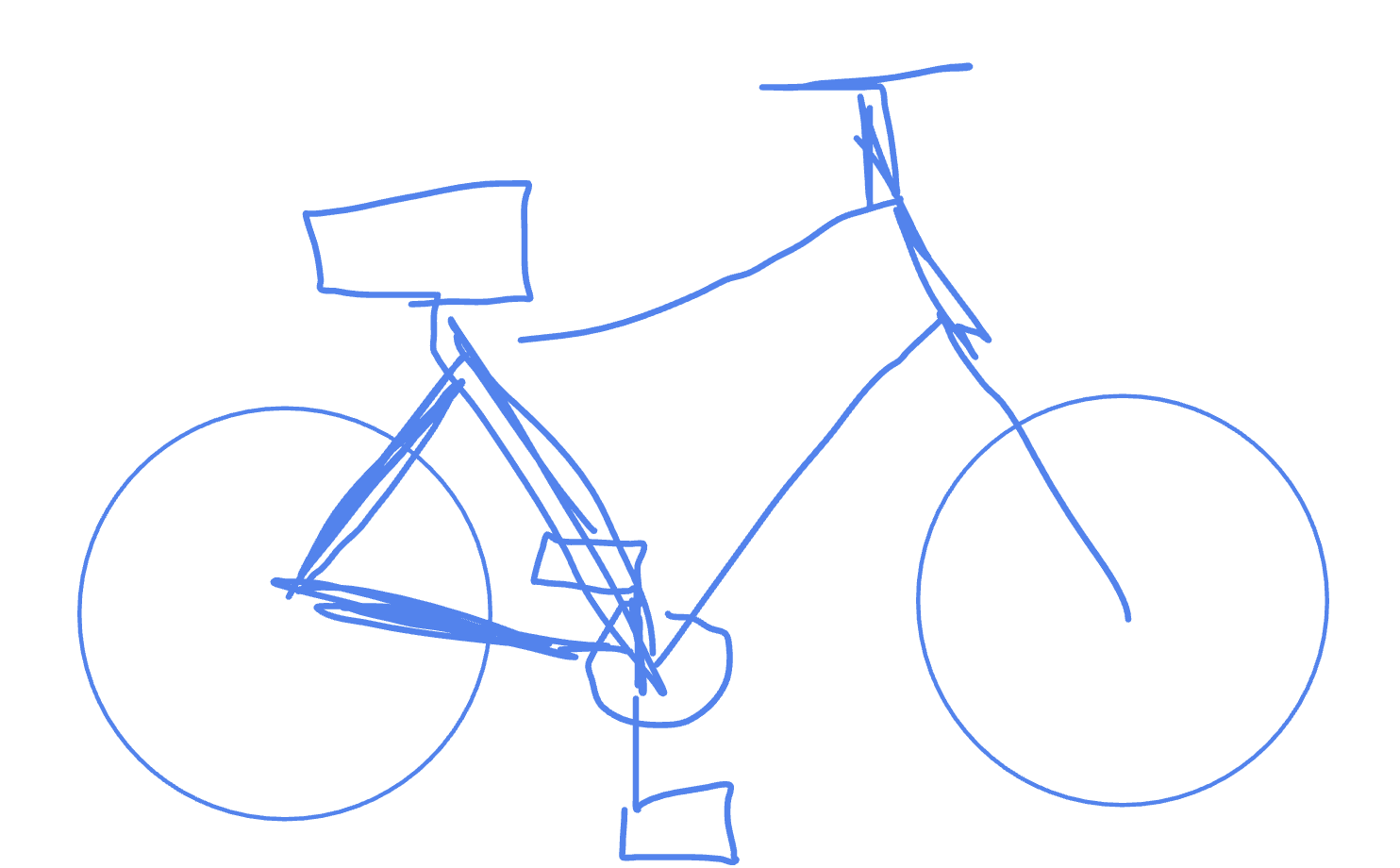
Nicole’s Bicycle in Motion
This project began with a sketch.
Nicole drew the bicycle without changing a single line of the design afterward. She simply said: “I like sketching.” That quiet decision became the foundation of everything that followed.
nicole_bike_sketch.png shows the original idea — still, unanimated, but already complete in structure. At this stage, the bicycle existed as a thought about form: wheels, frame, seat, and pedals all fixed in place like a diagram waiting to wake up.
The first transformation came when the model was brought into P5JS.
In nicole_p5js_bike_wip.mp4, the bicycle is still static. Nothing moves yet, but the structure is translated into code — a full digital reconstruction of the sketch. This is the moment where geometry becomes programmable.
Then came isolation.
In nicole_p5js_bike_model_seat.mp4, only the seat was explored as a geometric object. It is no longer “part of a bike,” but a standalone shape. This step matters because it breaks the whole into independent components that can later behave differently.
Next, motion begins.
nicole_p5js_bike_model_padel.mp4 focuses on a single pedal system. One side rotates, tested in isolation. This is where rotation logic is first understood — not as an abstract formula, but as something visible and controllable.
Finally, integration.
nicole_p5js_bike_done.mp4 brings everything together: two wheels, synchronized rotation, pedals driving motion, and mechanical relationships aligning into a single system. Nothing is decorative anymore — every part affects another.
This is no longer a drawing and no longer a set of experiments.
It is a working miniature world where geometry, motion, and code agree with each other.