Living Museum of Learning
The Circle Girl Was Mom
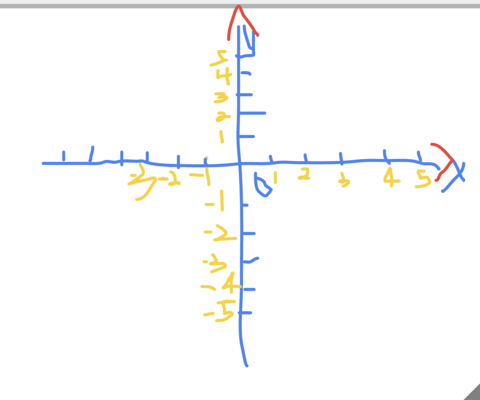
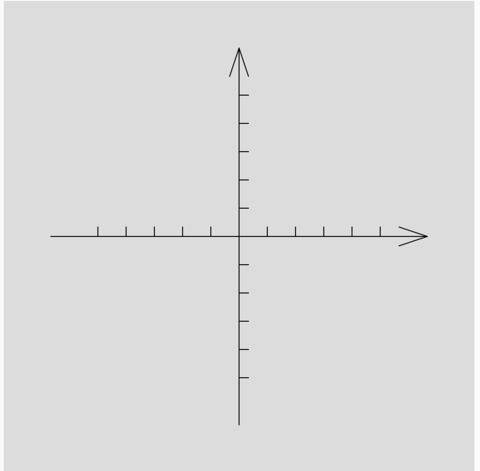
In today's class, Enning and I began with something ordinary: a coordinate system.
She drew the X and Y axes, but flipped them. I asked, “When did you learn this thing in school?”
“This year?”
“In England?”
“Oh, no. Then 1 year ago, in China.”
She connected the time and the country.
Her drawing still had plenty of imperfections: the arrows were missing, the ticks were not evenly distributed, and the negative ticks had no minus signs. Then we switched to P5.js and drew the same coordinate system with code.
That was the story.
Then came the epic.
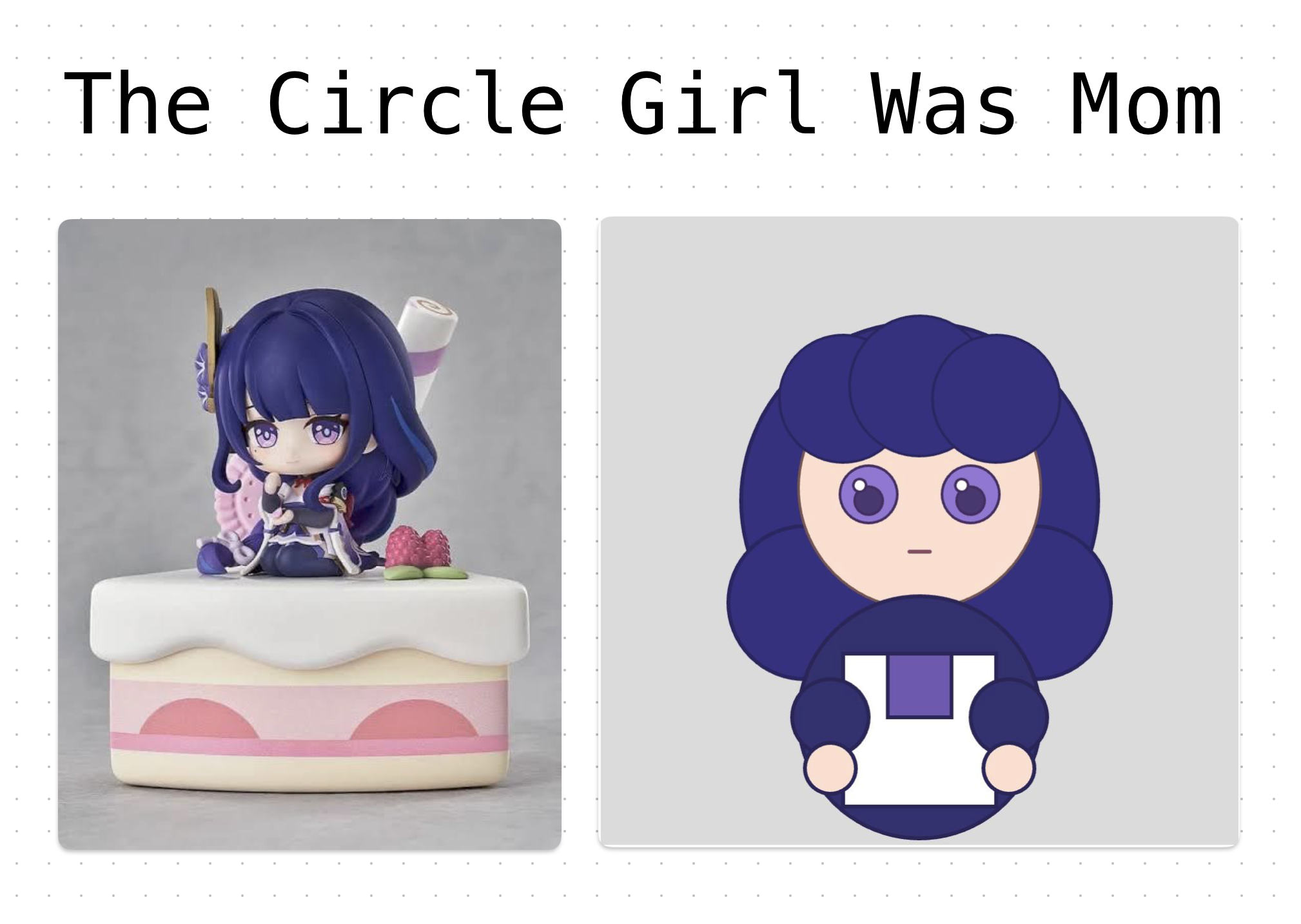
I asked Enning about her mindset when she created the “circle girl” yesterday. She showed me an image that was still sitting on the Mac's desktop: a complicated cartoon girl sitting on top of a huge cake.
“It's too complicated. So I had to simplify,” she explained.
I looked at her source image.
Almost nothing matched her creation except the dark blue color.
There was no circle in the original.
Yet somehow, from that complicated image, Enning had created her beautiful, remarkably simple “circle girl.”
“How could you abstract such a beautiful circle girl? Unbelievable,” I told her.
She simply replied:
“Too complicated. It (mine) is so ugly.”
Then she added something that electrified me:
“My mom said it looks like herself.”
I immediately realized that this was no longer simply a story about artistic abstraction.
Enning had not decided to draw her mother.
She had not said, “I am going to make a picture of Mom.”
She was simply looking at a complicated image, trying to simplify it.
And somehow, without realizing it, she drew her mother.
I asked her to install WhatsApp so she could share the original and her work directly.
But WhatsApp was already installed.
So I sent the message:
“Enning told me that it looks like you 😀”
At 05:42, her mother, June, answered:
“yes🤭”
Verified.
The girl had drawn her mother without knowing she was drawing her.
This is the moment that stopped me.
A young artist looked at something complicated and instinctively searched for its essence. She removed almost everything: details, complexity, literal resemblance.
What remained was a simple, beautiful figure.
And somehow, hidden inside that abstraction, was her mother.
Enning thought her own creation was ugly.
Her mother recognized herself in it.
The artist didn't know.
The subject did.
That is what makes this more than an art story.
Children carry their parents inside them in ways they often cannot see themselves.
Sometimes that hidden connection appears in a drawing, a gesture, a phrase, a smile—or in an unexpected circle girl.
Enning did not consciously draw her mother.
She simply simplified the world.
And her mother emerged.
Learning is not always about reproducing what we have been taught.
Sometimes it is about discovering what our minds already know how to see.
Enning's coordinate-system exercise showed ordinary learning in progress: mistakes, correction, memory, translation into code.
But the circle girl revealed something deeper.
She demonstrated abstraction: facing something too complicated, removing what is unnecessary, and preserving something essential.
And then came the mystery of human learning itself.
What else do we carry without realizing it?
What do we inherit from the people we love?
What can emerge when a child is given the freedom to simplify, create, and see?
The most moving answer from this class was not in the code.
It was in a mother's reaction:
“yes🤭”
A daughter created something without intending to draw her mother.
Her mother saw herself.
That is love in one of its purest forms.
A child can transform a complicated visual world into an original abstraction—and unknowingly reveal someone she loves.
Through observation, simplification, imagination, and the mysterious things children carry inside themselves.
Because learning is not only the acquisition of knowledge. Sometimes it reveals who we are, whom we carry with us, and how deeply we are connected to the people we love.