Living Museum of Learning
Why an Icosahedron?
Our 2026 World Cup summer project had just begun.
The goal was simple:
Model a soccer ball with p5.js.
But a soccer ball is not simply a sphere.
It is made of 12 pentagons and 20 hexagons.
That immediately raised a question.
Chinese
为什么偏偏是二十面体?
English
Why an icosahedron?
Neither Ethan nor I wanted to memorize the answer.
We wanted to understand it.
We started collecting clues.
A soccer ball.
Pentagons.
Hexagons.
Euler's famous equation.
Chinese
V − E + F = 2
English
V − E + F = 2
Still, the picture was incomplete.
Then I remembered something unexpected.
A friend of Leonardo da Vinci.
Golden rectangles.
The golden ratio.
Ethan immediately became curious.
We drew one golden rectangle.
Then another.
Then a third.
How should the third rectangle fit?
Suddenly the answer appeared.
From the top.
The three rectangles passed through one another perfectly.
A while earlier, I had asked Ethan two strange questions.
Chinese
二十面体有多少个顶点?
English
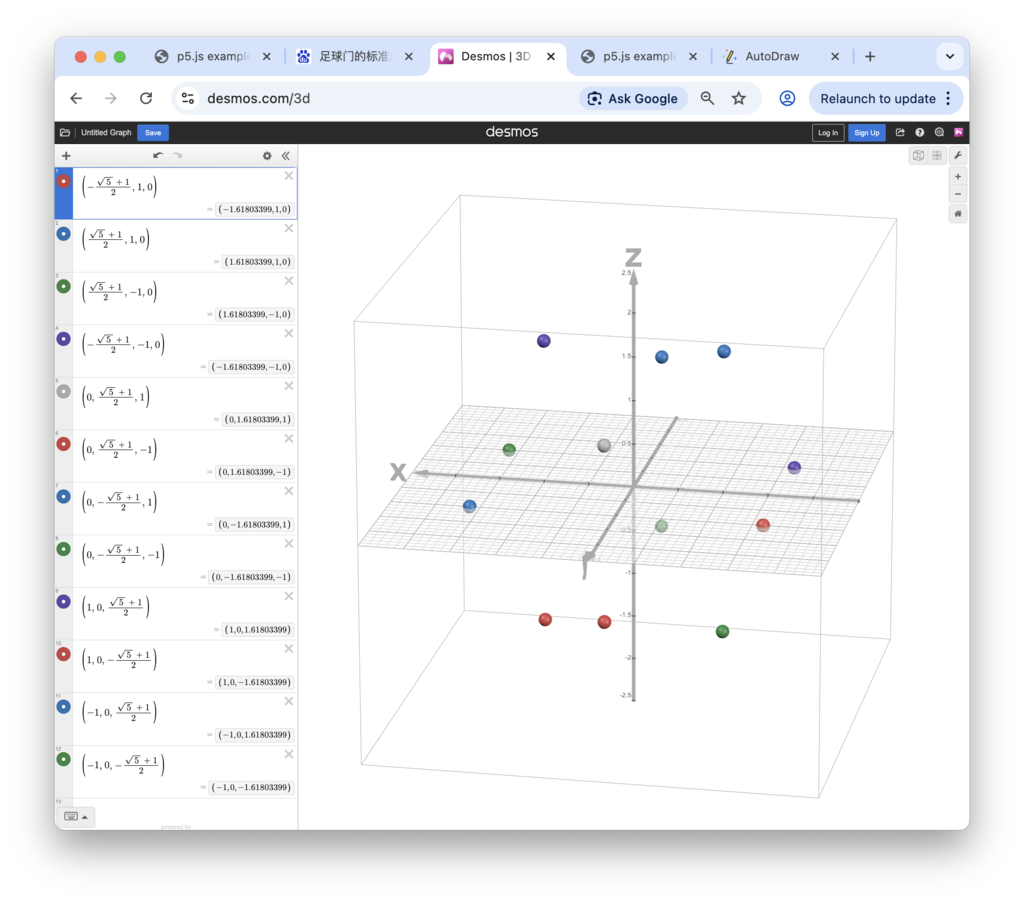
How many vertices does an icosahedron have?
Chinese
三个黄金矩形放在一起,一共有多少个顶点?
English
How many vertices do three golden rectangles have altogether?
Now both questions had the same answer.
Twelve.
I smiled.
Chinese
把这些点连起来。
English
Connect the points.
Ethan did.
An icosahedron appeared.
Then came the final step.
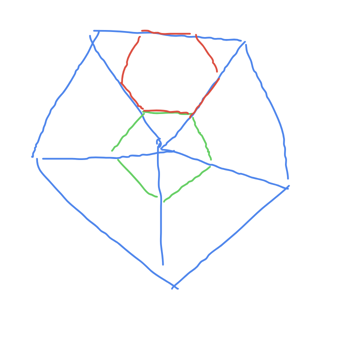
Imagine cutting off all twelve corners.
One by one.
Each original vertex became a pentagon.
Each original triangular face became a hexagon.
We looked at the picture.
Then almost at the same moment—
WOW!
There it was.
A soccer ball.
Twelve pentagons.
Twenty hexagons.
The greatest geometric mystery in Ethan's sixteen-year life—and in my sixty-year life—had suddenly become obvious.
Beautiful mathematics is rarely a collection of isolated facts.
One good question naturally leads to another.
A soccer ball leads to an icosahedron.
An icosahedron leads to three golden rectangles.
Three golden rectangles reveal twelve remarkable points.
Connecting those points creates the solid.
Truncating the solid creates the soccer ball.
Understanding replaced memorization.
Wonder replaced mystery.
A World Cup project can become a journey through geometry, art, history, and mathematical beauty.
By following one meaningful question after another, allowing each discovery to unlock the next.
The deepest learning happens when teacher and student genuinely explore together, celebrating discoveries that belong to both.