Living Museum of Learning
The Third Lesson: Watching a Mind at Work
Our third lesson began with something completely new for Cloud.
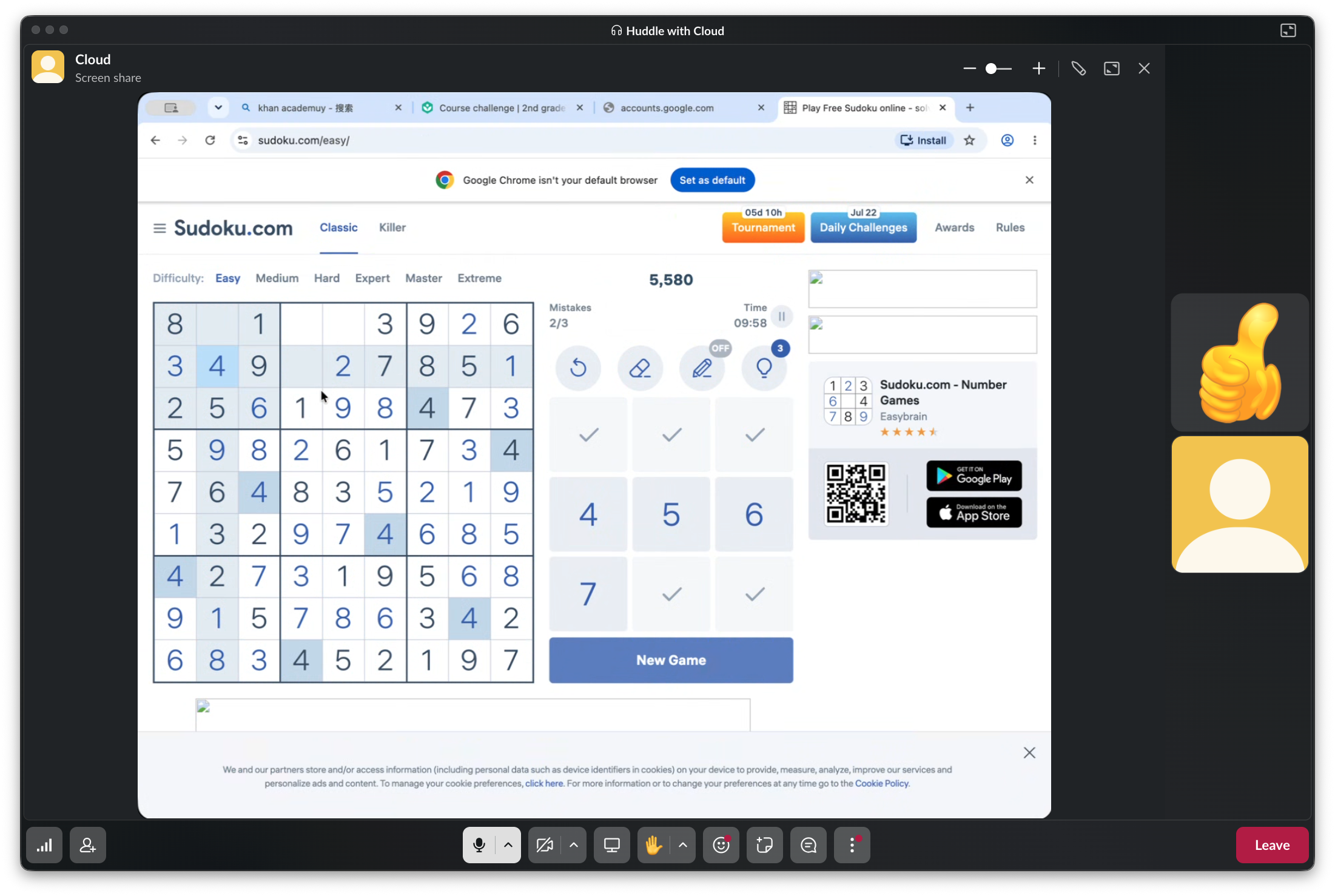
Sudoku.
He finished his very first Classic Sudoku on the easy level.
No hints.
No guessing.
Just reasoning.
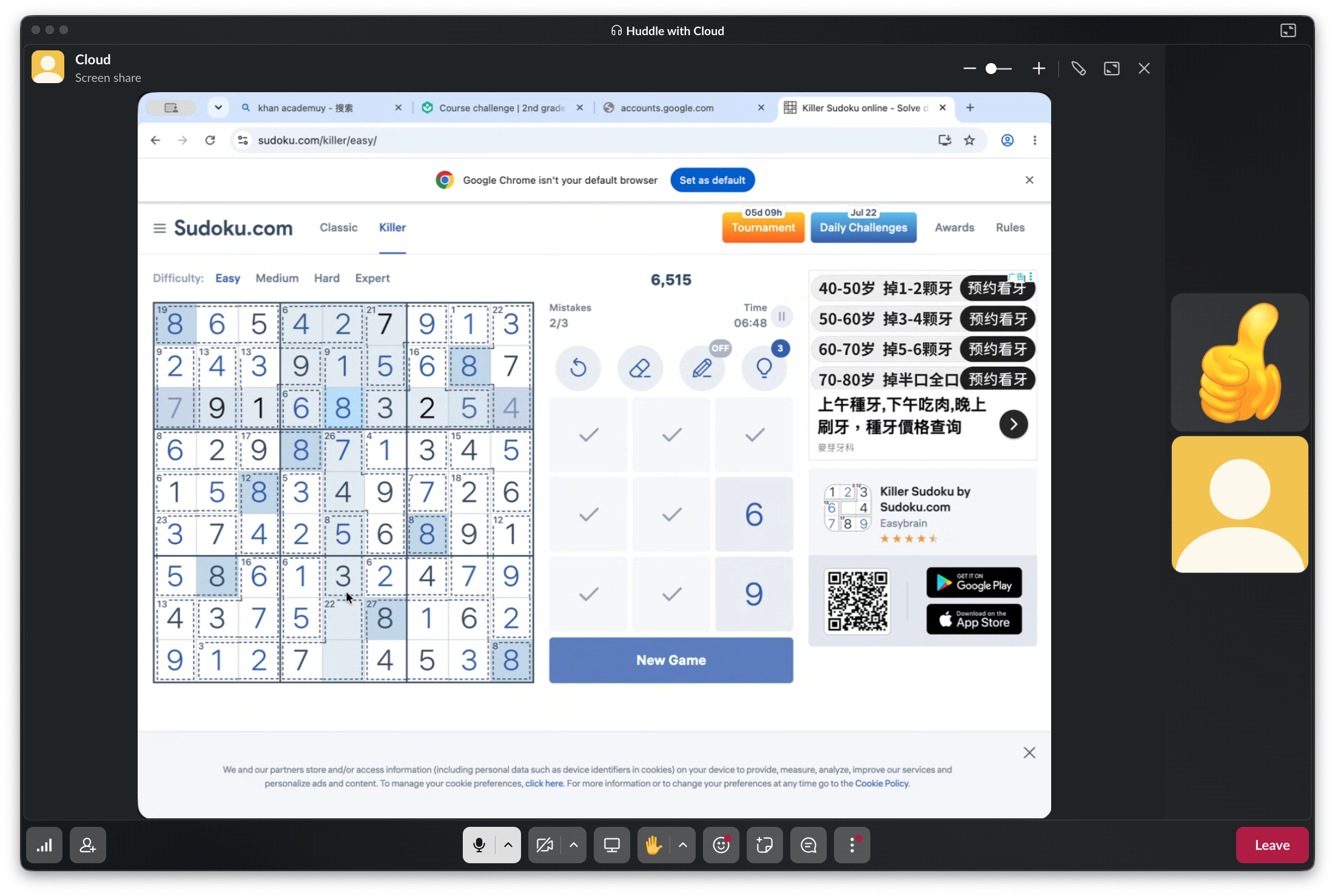
When we switched to Killer Sudoku, he immediately asked,
"How does it work?"
I smiled and replied,
"Figure it out."
After looking at the cages for a few seconds, he said,
"Oh... sum, right?"
Exactly.
His first attempt ended badly. After a few mistakes, all three lives were gone while advertisements kept interrupting us.
"Start a new one," I suggested.
This time, he calmly solved it within a reasonable time.
I applauded loudly.
While waiting for an online IQ test to load through the Great Firewall, we switched to Xcode.
Cloud had already drawn his first triangle.
Then another.
Now I challenged him:
"Can you make a parallelogram?"
Everything in front of him was still unfamiliar.
A Mac.
A trackpad.
Swift.
Xcode.
The iOS coordinate system.
Every symbol on the screen.
After a minute, he proudly announced,
"Done!"
It was...
a square.
I had to stop myself from laughing.
Instead, I gently asked,
"If we push this corner a little to the right, and that one a little to the left, would it become a real parallelogram?"
He followed.
Not quite equally.
We produced a trapezoid.
Closer.
A few adjustments later, the parallelogram finally appeared.
Then we practiced translating the entire shape downward without changing its form.
An hour disappeared without either of us noticing.
I suggested taking our scheduled break.
Cloud looked surprised.
"Has it already been an hour?"
Then he asked,
"Can we postpone the break until after the IQ test?"
That question made me smile.
Children rarely ask to delay a break.
They ask to start one.
Unfortunately, the website still wasn't ready.
Technology won that round.
We finally took our fifteen-minute break.
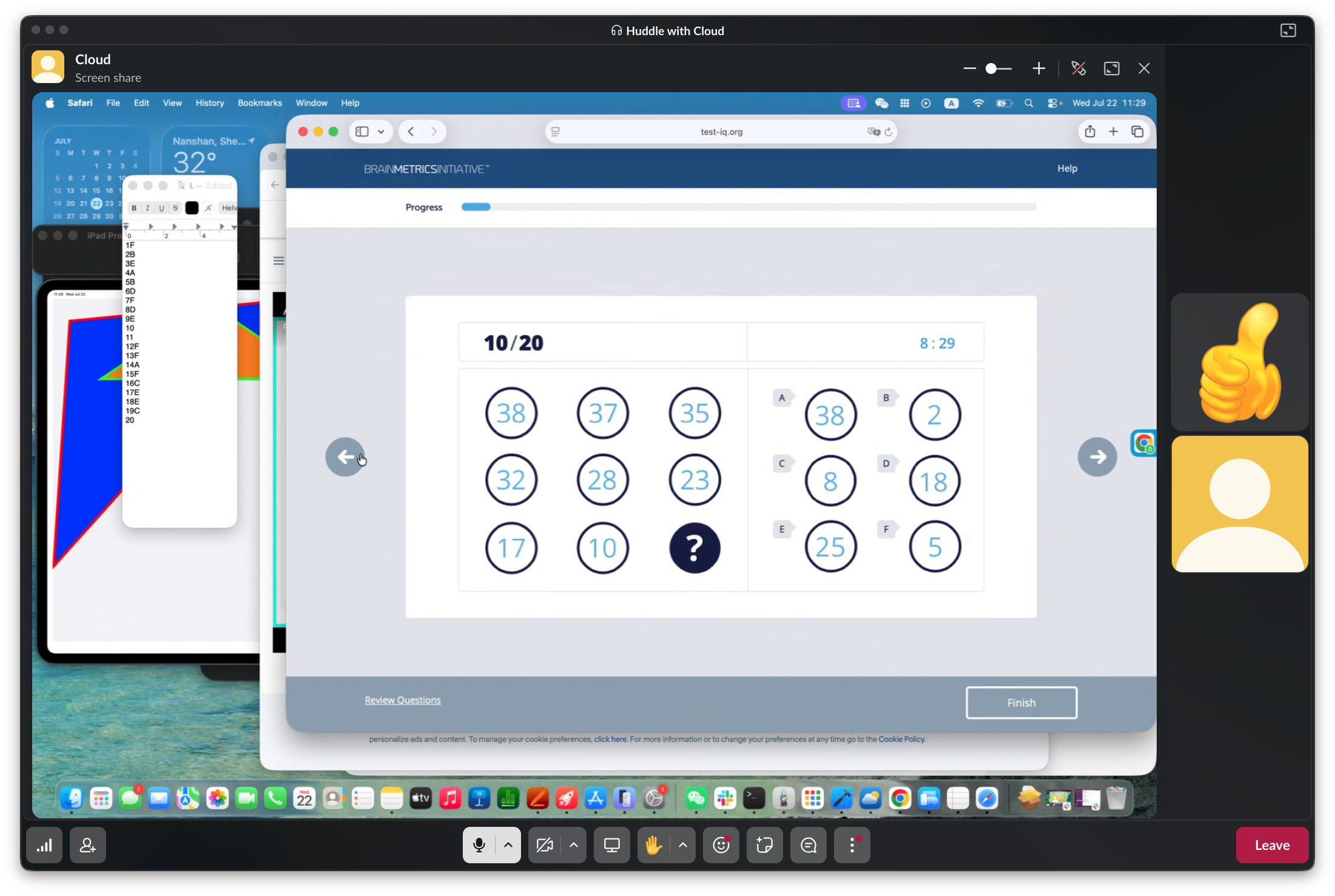
The IQ test contained three mathematics questions.
Cloud solved the first independently.
On the second, he asked,
"Can you help?"
"No," I answered.
"It's a test."
He thought for a moment.
"Then I have to guess."
"That's actually a reasonable strategy. Make your best guess."
His answer was correct.
I don't think it was luck.
I think he already had an intuition but lacked confidence.
The third problem was different.
He stared at it for several minutes before making another guess.
This one was wrong.
When the test ended, he surprised me one more time.
The first thing he asked was not his score.
It was:
"You took a screenshot of my answers, right?"
He wanted to know how he had thought.
Not just how many he had gotten right.
Later, after class, I sent him the result:
13 out of 19.
An honest score.
A starting point.
Exactly what a diagnostic assessment is meant to be.
Every new activity revealed a different side of Cloud's mind.
Sudoku showed logical reasoning.
Programming revealed an instinct for finding the shortest path—even when it produced a square instead of a parallelogram.
The IQ test revealed something even more valuable.
When he didn't know, he admitted it.
When guessing became the best available strategy, he accepted it honestly.
Teachers often evaluate students.
But the best lessons also allow teachers to observe something deeper:
how a young mind explores the unknown.