
Living Museum of Learning
Learning Has No Boundaries
Schools divide learning into grades, semesters, textbooks, and exams. Those boundaries help organize education—but children don't naturally learn that way. Curiosity doesn't know when one unit ends and the next begins.
Over the years, I've watched students follow their interests beyond the curriculum.
Leo became fluent in English within a remarkably short time.
Peter read a calculus book as a ninth grader.
Twin brothers Marius and Lucas learned thousands of Chinese characters years ahead of their peers, discussed ideas in English, and wrote programs implementing chess rules.
Kenneth, in Grade 8, wandered far beyond school mathematics into Conway's Game of Life, P5JS 3D modeling, and elliptic curve addition.
Each journey was different. None followed the boundaries of a textbook.
The pattern wasn't that these children learned the same things. It was that they kept learning whenever curiosity found something worth exploring.
Educational systems need boundaries. Learners do not. The teacher's role is not to confine curiosity within a curriculum, but to help it travel safely beyond one.
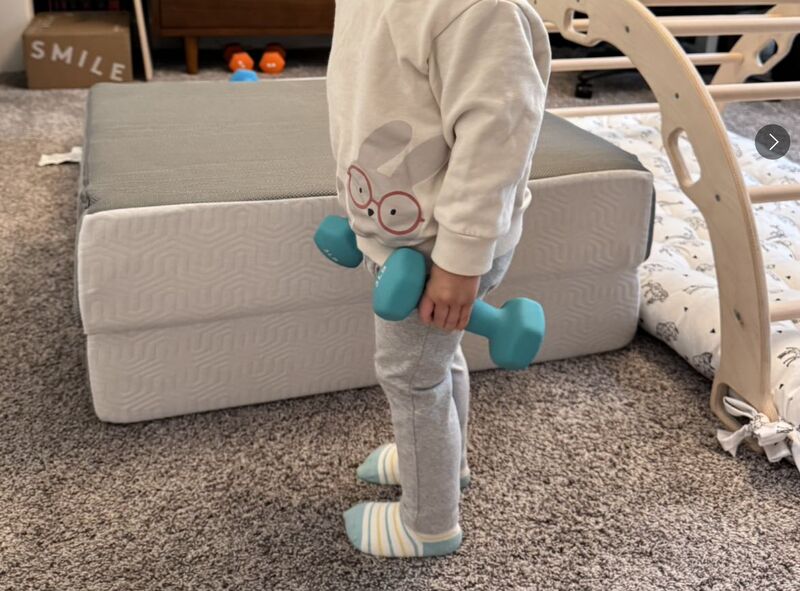
Rhea holding two dumbbells works as a metaphor: muscles don't grow because a calendar says they should—they grow through steady effort. Learning is much the same. That's a subtle, memorable image.