
Living Museum of Learning
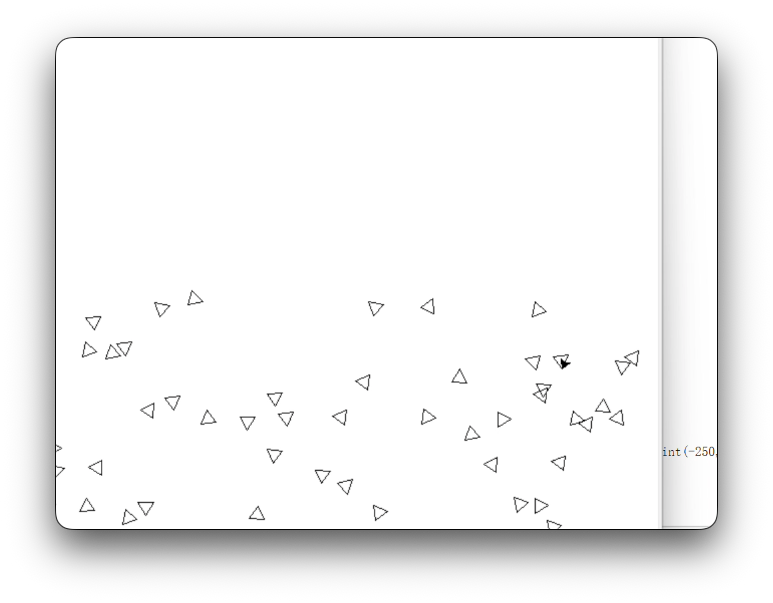
Oliver's Explosion
Oliver's explosion project did not happen quickly.
For several weeks, the program remained unfinished. The project simply sat there, waiting.
There was no pressure and no deadline.
Then one day, he returned and completed it.
On the surface, the project was a Python turtle animation featuring rotating fragments, expanding structures, and scattered particles.
But the most important part turned out to be a very small detail.
At first, every triangular fragment pointed in exactly the same direction.
The animation worked, but something felt wrong.
Oliver looked at the screen and quickly said:
"That's easy. Just rotate them randomly."
He added:
rt(random.randint(0,360))
The problem disappeared immediately.
There was no hesitation and no lengthy trial and error. He simply recognized that the system needed variation.
The explosion became believable because symmetry was broken.
What appeared to be a simple animation became something larger.
Oliver moved:
from symmetry to broken symmetry
from uniformity to randomness
from static objects to a dynamic system
The fragments no longer behaved as identical objects. Each piece developed its own direction and motion.
A visual effect became an emergent system.
Oliver discovered that correctness is not always enough.
A program can be technically accurate while still feeling incomplete.
By introducing randomness, he learned how variation creates realism, motion, and complexity.
Equally important, he experienced a slower form of learning. The project paused for weeks, yet his thinking continued in the background. When he returned, the solution appeared naturally.
The experience reinforced an important belief: if you continue working, answers often emerge over time.