
Living Museum of Learning
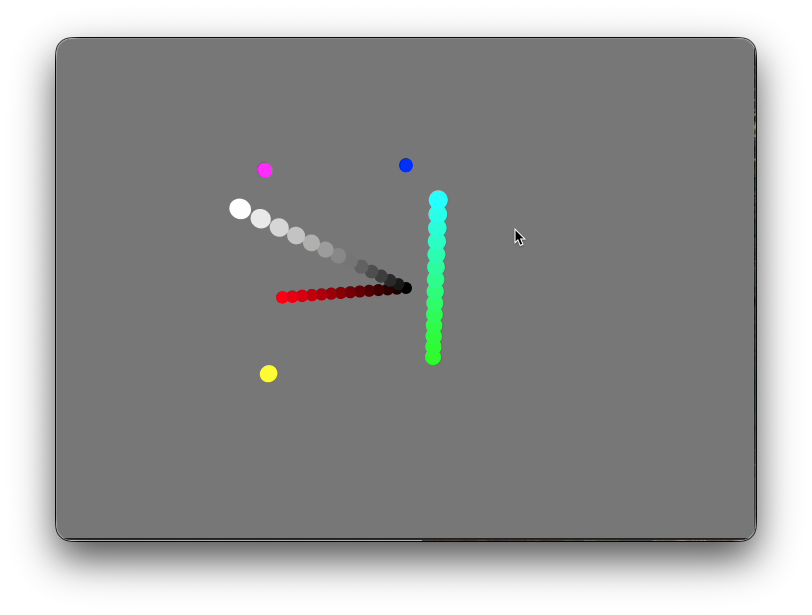
Albert's Color Cube
Albert began with a single point.
At the origin sat a small black sphere.
Then he added red.
Then green.
Then blue.
He was not trying to draw a cube. Instead, he was gradually building color inside a three-dimensional space.
Using p5.js in WEBGL mode, he placed colors as coordinates:
Red → (1, 0, 0)
Green → (0, 1, 0)
Blue → (0, 0, 1)
The RGB cube began to emerge one point at a time.
When Albert placed the eighth vertex at (1,1,1), the white point disappeared.
The problem was simple: the background was also white.
Rather than getting stuck, he quickly changed the background to gray.
The white point became visible again.
This small adjustment revealed something important: mathematics, code, and visual perception are deeply connected.
Albert did not stop after placing the eight corners.
He began filling the interior.
Along the diagonal from (0,0,0) to (1,1,1), he added a sequence of gray spheres:
(t, t, t)
The colors changed smoothly from black to white.
No one had asked him to do this.
No lesson on parametric equations had been given.
The idea emerged naturally.
Within a short sequence, his thinking moved:
from point to vertex
from vertex to structure
from structure to continuity
Albert began to experience the idea of a vector space through direct construction.
Without formulas, he explored coordinates, dimensions, color relationships, and continuous change.
The project demonstrated that mathematical understanding can emerge through programming, visualization, and experimentation long before formal notation is introduced.