Living Museum of Learning
Nicole’s First Real Use of Trigonometry
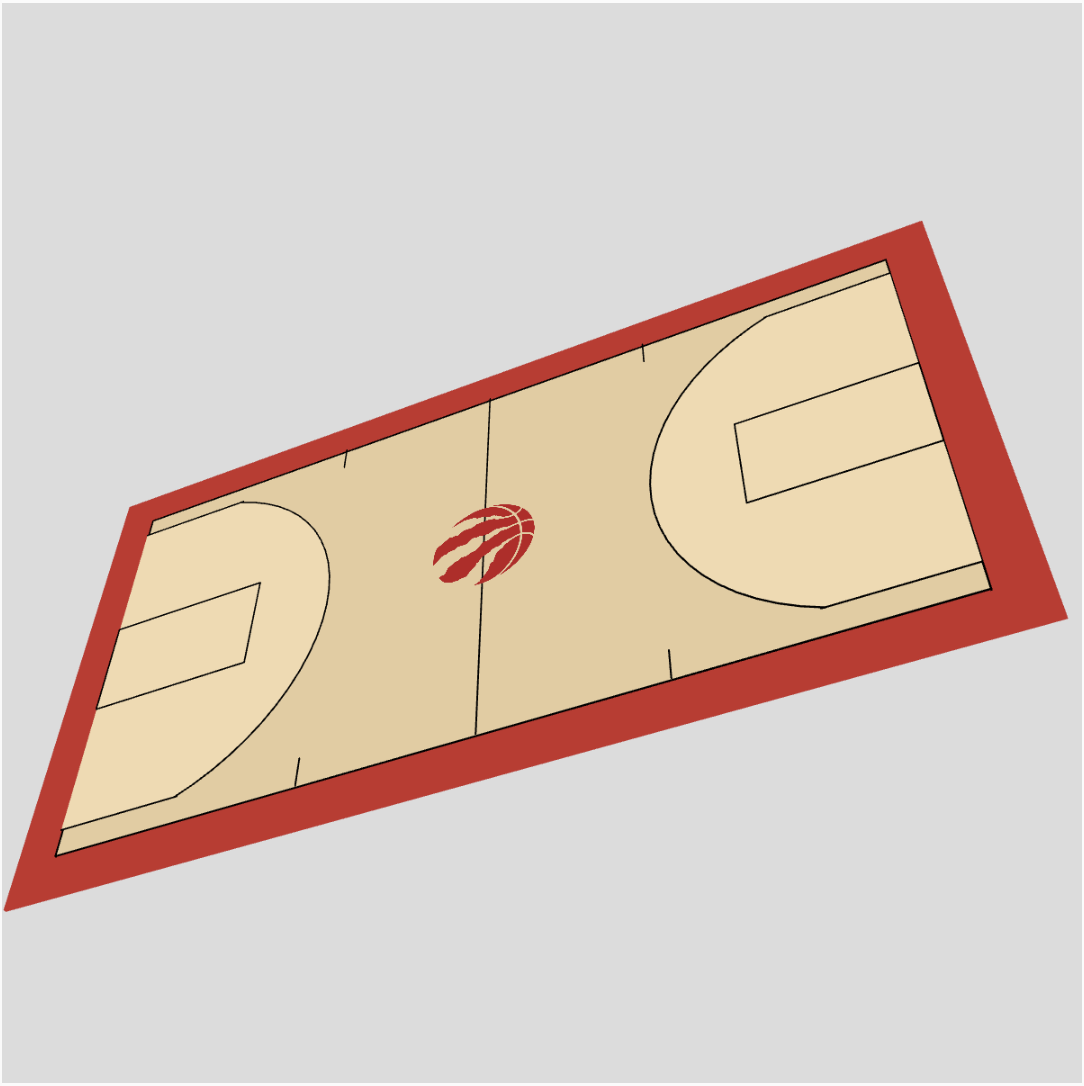
During a 3D NBA court project, we were working on generating the three-point line projection using angles and distances.
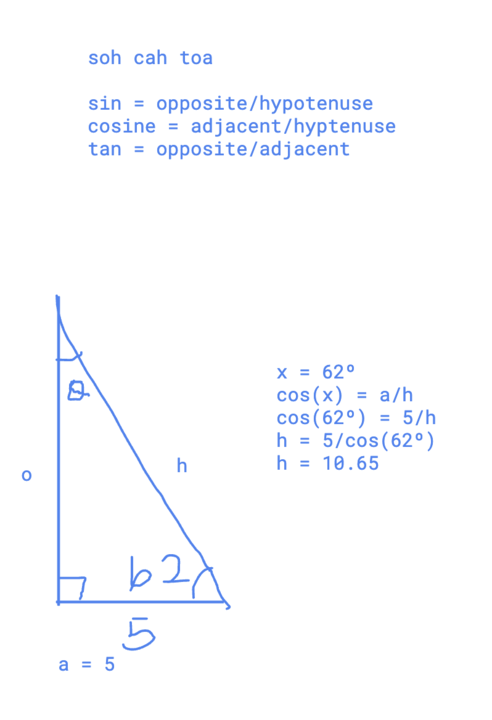
Nicole mentioned that she had not formally learned trigonometry at school yet, but she already knew SOH CAH TOA and could confidently write:
cos(x) = a / h
She even applied it to a simple example (62° angle, adjacent side = 5) and computed it correctly.
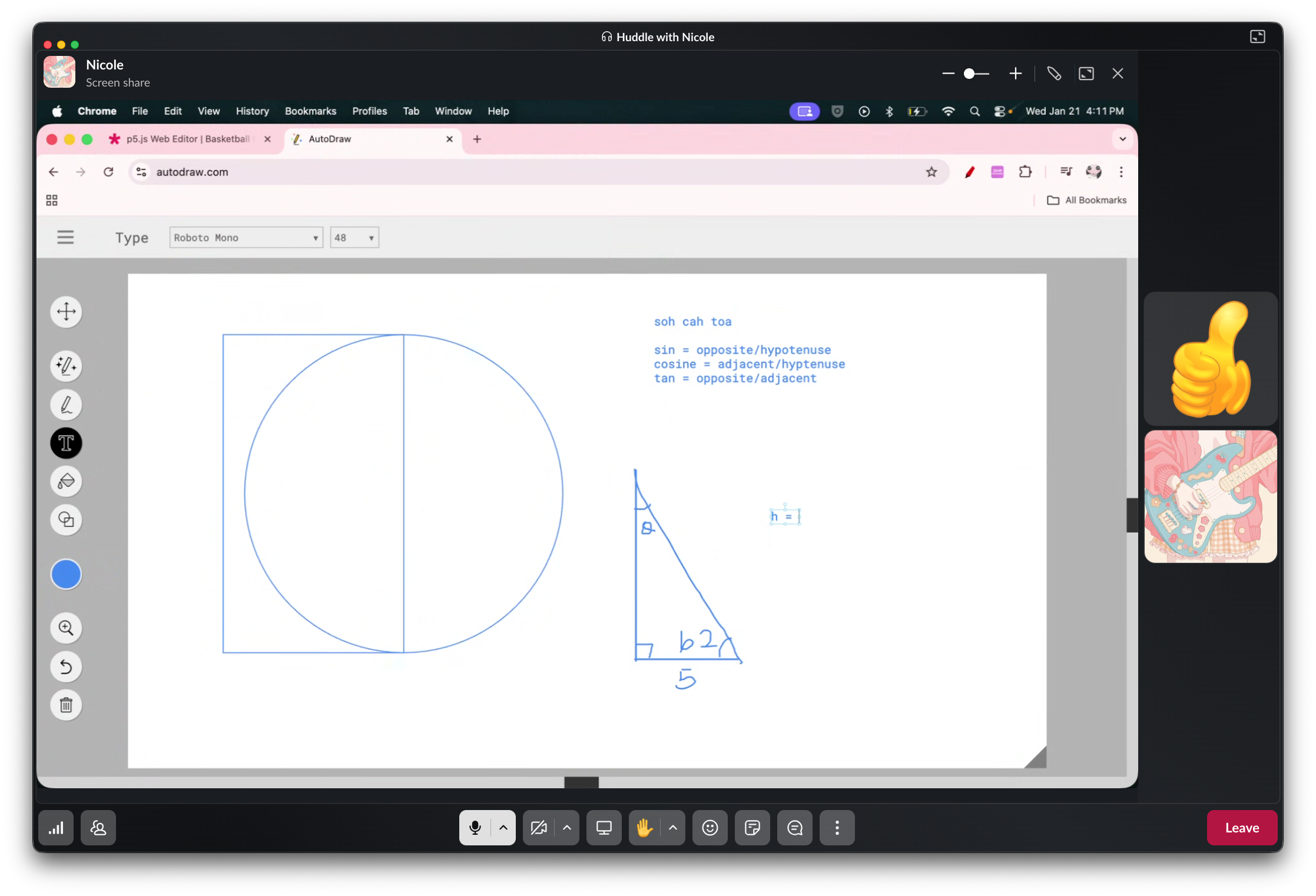
When we moved from whiteboard math to the actual 3D scene, her first instinct was not mathematical but practical:
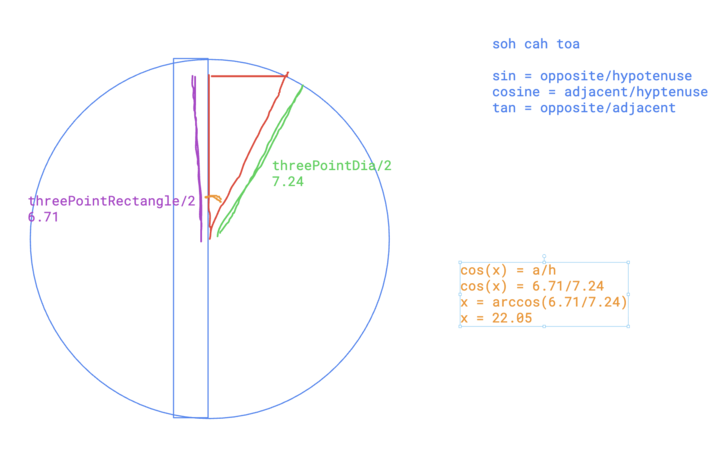
She suggested a workaround — drawing a rectangle to “mask” the extra region outside the valid arc.
It was fast, clever, and engineering-minded.
But I realized this was a key moment: she already had enough knowledge to compute the real solution.
So I asked:
“Can we try calculating it instead?”
She estimated the angle as 20° and directly plugged it into the program. The result looked surprisingly close.
We returned to the whiteboard and formalized the computation:
cos(x) = a / h
There was an initial mistake in the calculation, but while reviewing the geometry, she noticed that one side length did not make sense and corrected it herself.
After fixing it, we arrived at the correct value:
22.05°
This was the first time she completed a full loop from estimation → modeling → correction → exact computation inside a real project.
Her initial instinct was:
“How do we work around this?”
Not:
“How do we calculate this?”
But during this process, she shifted her thinking:
From workaround thinking → mathematical thinking
She realized something fundamental:
Math is not a future subject — it is a present tool for shaping reality.