
Living Museum of Learning
Peter and the Living Grid
Peter was one of the earliest students in this teaching journey, first encountered in Grade 4.
At that time, he was still a young child with curiosity and focus just beginning to take shape.
Years later, as a middle school student in Toronto, he independently worked on a programming project based on John Conway’s Game of Life.
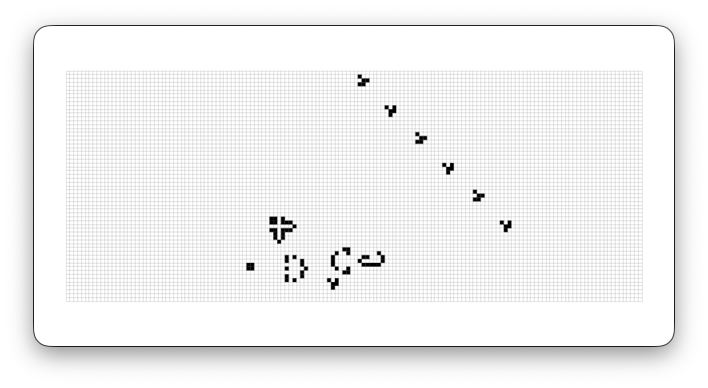
He implemented classic structures such as the Gosper Glider Gun and eater patterns.
The moment of transition was not learning the concept itself, but moving from understanding rules to constructing systems.
Instead of treating the Game of Life as a simulation to observe, Peter began to treat it as a design space.
Simple rules:
birth
survival
death
became a canvas for intentional construction.
The shift was from:
watching patterns
to
building patterns that produce patterns
Within the grid, complexity emerged from simplicity.
Gliders propagated across space.
Eaters stabilized chaotic motion.
The Gosper Glider Gun continuously generated moving structures from a fixed configuration.
What appears random at first glance is actually the result of precise, local rule interactions.
Peter’s implementation captured this dynamic system faithfully, revealing both mathematical structure and aesthetic rhythm.
The Game of Life is not just a programming exercise.
It is a model of how complexity can arise from simple rules.
Through this work, Peter engaged with several deep ideas:
emergent systems
computational rulesets
constructive mathematics
simulation as expression
More importantly, he moved from learning algorithms to designing them as creative objects.