Albert — Wandering Into Deeper Structures
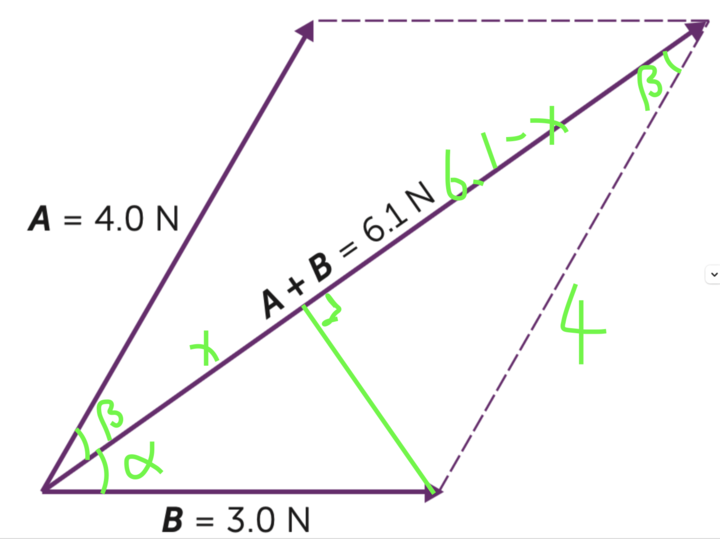
The original problem was straightforward.
Two forces: 4.0 N and 3.0 N. The resultant force was 6.1 N. Find the angle between them.
Most students would immediately apply a trigonometric formula. Albert did not.
Instead, he introduced a variable and built his own geometric relationship. He worked symbolically, simplified the expression, and obtained an exact fraction.
Even after reaching the answer, he chose to continue with exact arithmetic rather than switching to decimals.
The problem was solved. His curiosity was not.
During the discussion, the number 1007 appeared. A brief mention of Fermat's factorization method immediately caught his attention.
Before long, he was experimenting with difference-of-squares factorizations and discovered:
1007 = 19 × 53
The exploration continued.
He investigated a linear Diophantine equation, applied the Euclidean algorithm, and derived a complete family of solutions.
Then, purely out of curiosity, he selected a very large parameter value and generated seven-digit numbers.
Not because the problem required it. Not because anyone asked him to. Simply because he wanted to verify the result himself.
Some students become distracted. Others wander into deeper structures.
What began as a lesson about forces and angles evolved into a journey through algebra, trigonometry, number theory, and algorithms.
This was not a loss of focus. It was curiosity discovering a larger landscape.
Learning Insight
Deep learning often begins when a student stops asking, "How do I solve this problem?"
and starts asking, "What else is hiding behind it?"