
Living Museum of Learning
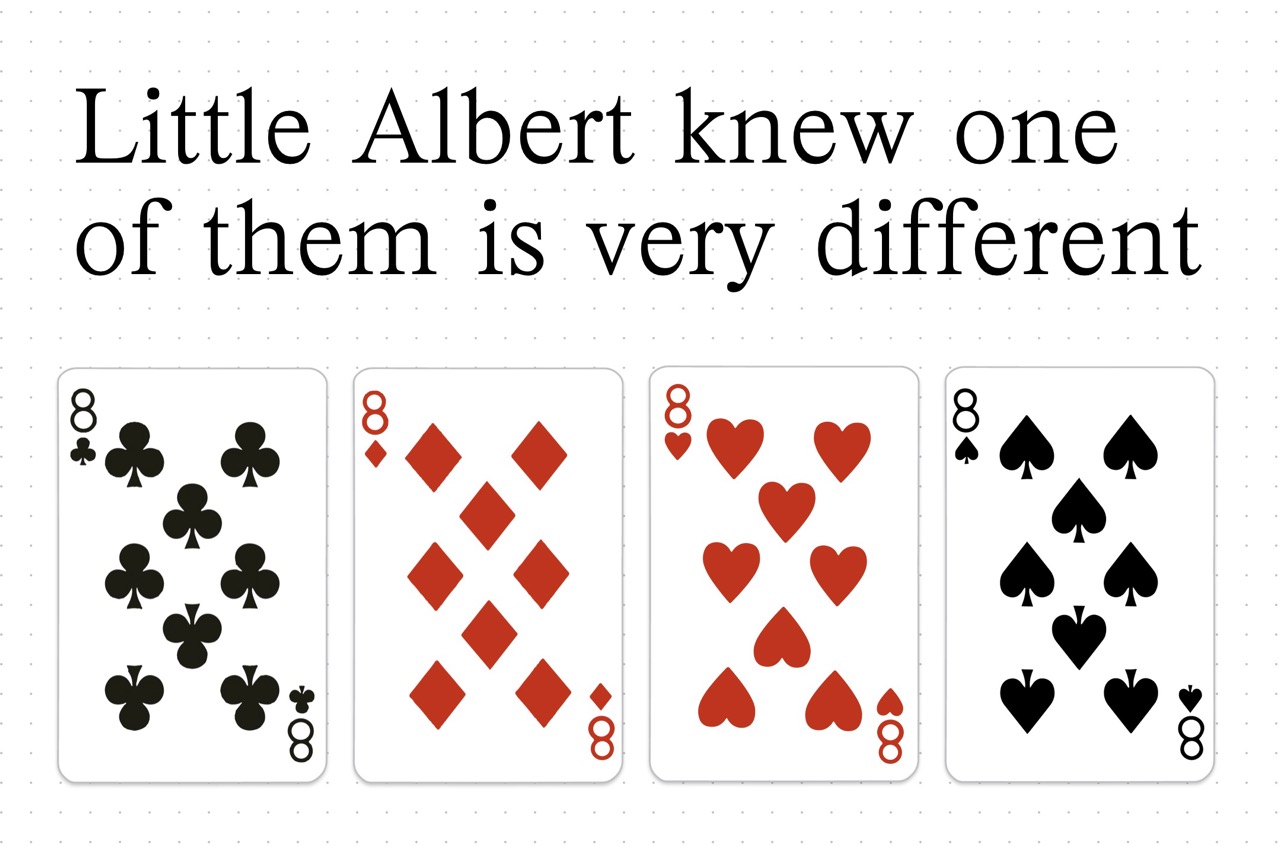
Albert and the Great Poker Escape
Situation
Five cards are randomly drawn from a standard deck of 52.
Two friends are trapped in separate rooms. One of them can see the five cards, but must hide one and show the other four to the second friend.
The second friend gets only one guess to identify the hidden card.
Before the game begins, the two friends may agree on a secret communication strategy. Once the game starts, no further communication is allowed.
Can they guarantee that the hidden card will be identified?
Donald began exploring the puzzle from the perspective of information and possibilities. Four displayed cards can be arranged in 4! = 24 different orders. But the cards themselves can only be placed vertically. Could their visual features provide additional information?
Albert had a different way into the problem.
Turning Point
Albert explained the classic solution.
There are four suits but five cards. By the pigeonhole principle, at least two cards must share a suit.
The first friend hides one of those two cards and places the other one first. That first card becomes the reference card.
Now comes the clever part.
The two friends agree on a cyclic order of the thirteen ranks. The hidden card can be identified by its distance from the reference card, counting around the ranks and wrapping from King back to Ace.
The remaining three cards can be arranged in 3! = 6 different orders. Those six arrangements encode six possible distances.
For example, the orders
123, 132, 213, 231, 312, 321
can represent distances +1 through +6.
Five cards. One hidden. Four displayed. One guaranteed answer.
No magic. Just a carefully designed communication protocol.
Emergence
But Albert wasn't finished.
He had read the original puzzle and its solution. Instead of stopping there, he asked what would happen if the deck contained two Jokers.
The original strategy was no longer enough in every situation.
Albert noticed an opportunity in something most people would overlook: playing cards are not all visually identical in their symmetry.
He proposed using the orientation of a Joker as an additional signal. An upright Joker could indicate the ordinary case; an upside-down Joker could signal a special case.
In that special case, the four visible cards could be arranged in 4! = 24 ways — enough to encode the thirteen ordinary ranks and the two Jokers.
He was turning a visual detail into an extra communication channel.
And when Donald asked how he had noticed the asymmetry of playing cards, Albert answered:
"Oh, I spot that when I was very young."
That was the moment the puzzle became a story about Albert himself.
Learning
Albert didn't just solve a puzzle. He connected three kinds of thinking:
Combinatorics: counting possibilities and using permutations.
Information theory: designing a code that carries enough information.
Observation: noticing a physical feature that others might ignore.
His Joker extension also showed an important habit of mathematical thinking: after understanding a solution, change the conditions and see whether the idea still works.
Theme
An observation made in childhood may become a powerful tool years later.
Sometimes the most valuable thing a learner brings to a difficult problem is not a formula or a technique.
It's a pair of eyes trained to notice what other people miss.
What else in an ordinary deck of cards could carry information?
Could the same idea work with more cards, more hidden possibilities, or a different set of symbols?
And what might Albert notice next?
After all, he has been looking at the world with those different eyes for a long time. 😁