
Living Museum of Learning
Bye-Bye, “Math Weak, Logic Weak”!
Situation
Enning had been described as “math weak, logic weak.”
But labels are not explanations. They tell us what someone thinks a student can do; they don't tell us what the student might learn next.
In our lessons, Enning explores mathematics through Khan Academy and builds interactive 3D models with code. The goal isn't simply to finish exercises or copy working examples. It's to understand, create, experiment, and discover.
Turning Point
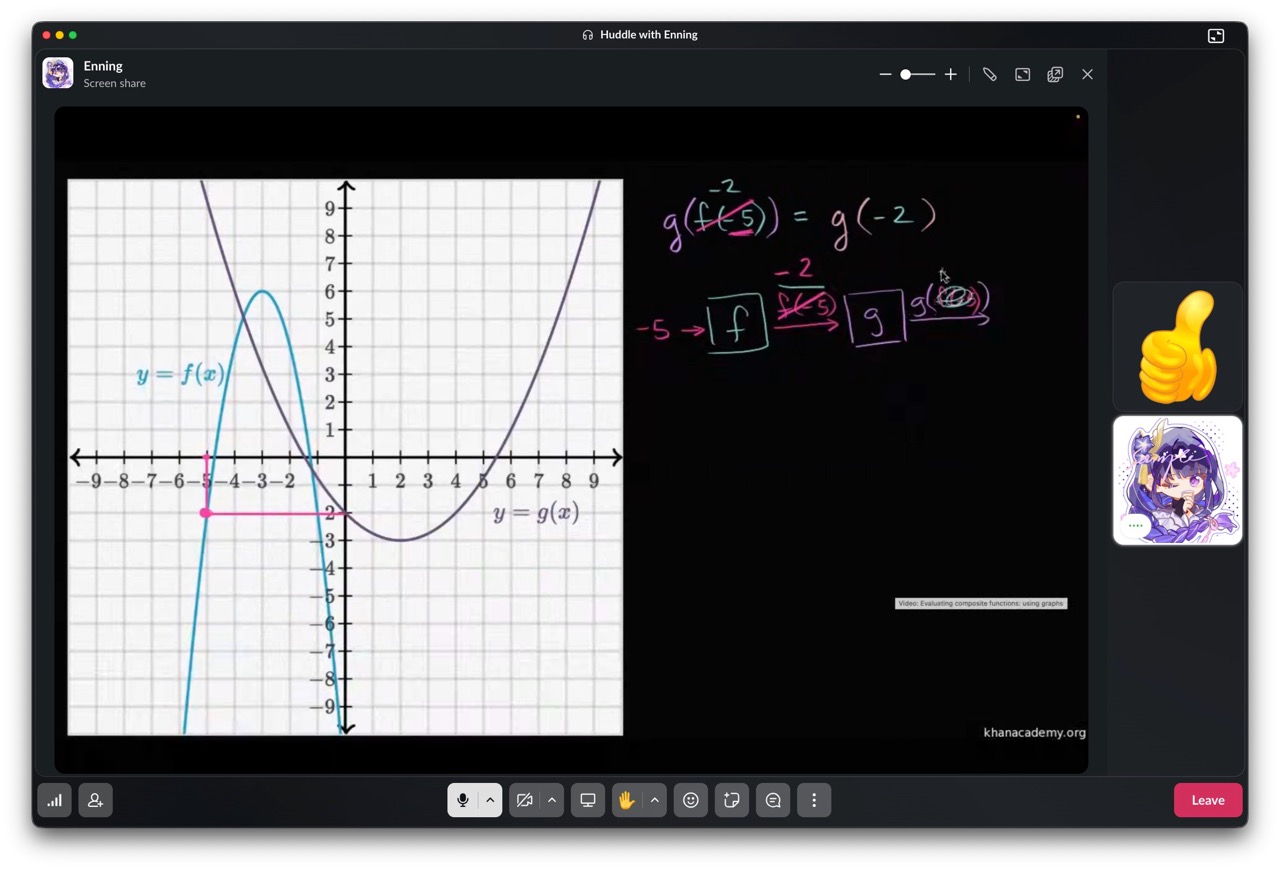
Today, Enning encountered a brand-new mathematical concept: composite functions.
She worked through the Khan Academy practices, earning 4/4, then 4/4 again, conquering them one by one.
I asked her:
“If you earn 4/4 again and again, you are saying Bye Bye to carelessness, right?”
She laughed. Loudly!
No lecture about being careful. No argument about whether she was good at mathematics. Just a playful challenge, backed by her own growing evidence of success.
Emergence
There was another surprise.
Enning had been building a 3D pulley system in p5.js. With only a few minutes left in class, she added a box that moved with the rope. She recorded a short clip demonstrating the movement.
Look at the programming idea behind this seemingly simple addition: the box's position and the rope's endpoint both depend on the same variable, boxOffset.
Change one value, and two objects move together.
That's more than drawing a box. It's modeling a relationship.
For homework, she would add another box on the tabletop and continue improving her typing speed by anticipating the next key.
A new mathematical concept. A working 3D model. A demonstration video. Better typing.
And a loud laugh at the idea of saying goodbye to carelessness.
Learning
Learning is not about proving that a label was right or wrong. It's about creating opportunities for students to grow beyond what the label predicts.
A perfect score is encouraging, but the deeper achievement is learning to apply a new concept repeatedly. A moving box is a small accomplishment, but the deeper idea is coordinating different parts of a model through a shared variable.
The next step is to keep building, checking, experimenting, and learning from mistakes — without turning any single result into a judgment of the student.
Theme
Don't label the learner. Watch the learning emerge.
Doors
Mathematics: composite functions and repeated practice
Programming: shared variables, coordinates, and 3D modeling
Learning habits: accuracy, attention, and typing fluency
Education: replacing fixed judgments with opportunities to demonstrate growth