Living Museum of Learning
No Equation, No Trigonometry — Just Heron’s Formula
The Situation
Leo had recently completed a p5.js project exploring a parabola, using its geometric definition: a point is equally distant from a fixed point and a fixed line.
Then came a new question.
What if the sum of the distances from a moving point to two fixed points remains constant? What shape would the point trace?
“A circle?” Leo guessed.
I didn't tell him the answer.
The Turning Point
Leo was in Grade 9. He hadn't learned trigonometry, and he didn't know the equation of an ellipse. I wondered how he would calculate the coordinates of points satisfying the condition.
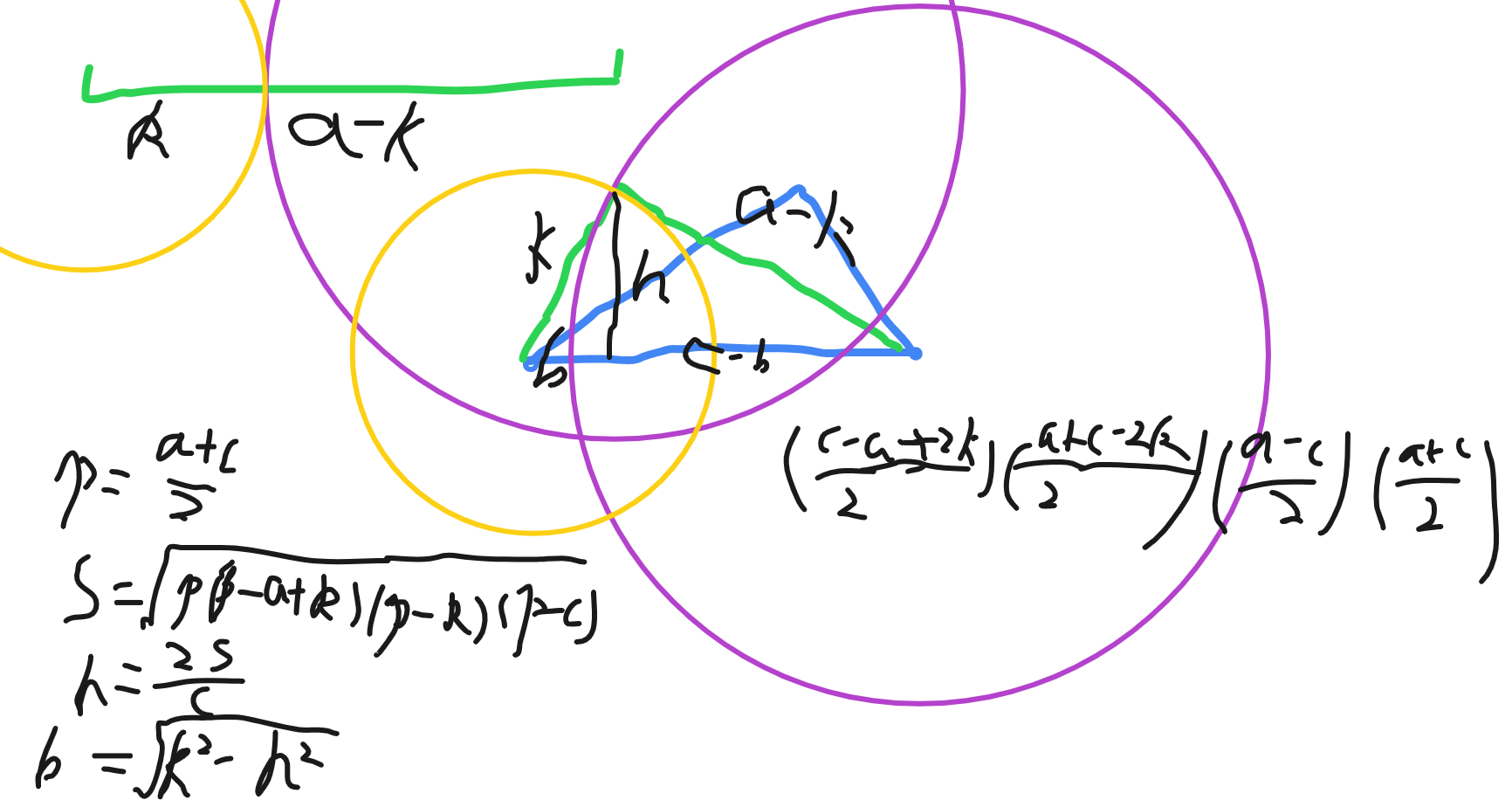
Then I noticed that his diagram already had the three sides of a triangle marked.
“Do you know Heron's formula?”
“Yes,” Leo replied quietly.
Heron's formula calculates a triangle's area from its three side lengths:
(A=\sqrt{s(s-a)(s-b)(s-c)})
where (s) is half the perimeter.
That changed everything.
Once Leo had the area, he could calculate the triangle's height using its base. From the height, he could work out the horizontal offset. And from that, he could calculate coordinates for the points he wanted to plot.
No trigonometry needed. No ellipse equation needed.
Just geometry, a formula he already knew, and a chain of reasoning.
When the Dots Looked Wrong
Leo carefully worked through the calculations and translated them into JavaScript. I helped correct a few small typos, but the mathematical approach was his.
I suggested combining the new experiment with his existing parabola project instead of starting another sketch from scratch.
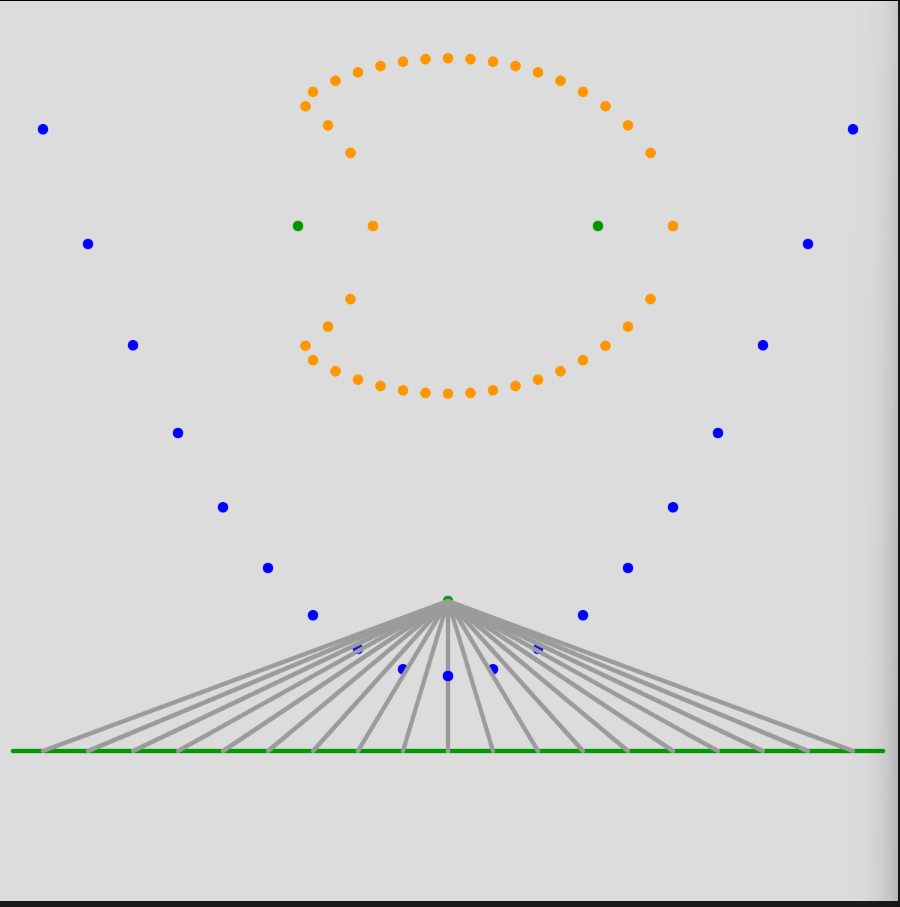
At first, the new dots looked strange. Around the left end of the emerging curve, they formed something like a > shape. It looked so unlike an ellipse that we nearly wasted a lot of time debugging Leo's calculation.
Then Leo asked:
“Can we add more points?”
I wasn't expecting much. But as more points appeared, a recognizable curve began to emerge. To me, it looked like an ellipse. Leo initially thought it looked like a circle. LOL!
We added still more points. The curve wasn't perfect, and that odd shape at the left end remained. We didn't solve every plotting issue that day.
But the essential result was there: Leo's solution worked.
I asked the boy who had guessed “circle” at the beginning:
“What is this now?”
“Ellipse.”
His voice was still low and firm. So Leo.
The Emergence
Two students can reach the same mathematical destination by very different routes.
Years ago, another student, Ethan, began by drawing circles and manually adjusting coordinates to find useful intersections. Later, in Grade 11, after learning the ellipse equation, he implemented a locus using that equation.
Leo took another route. In Grade 9, without trigonometry, without the ellipse equation, and without anyone even mentioning the word ellipse, he connected triangle geometry, Heron's formula, coordinate calculations, and programming to explore a new curve.
His sketch brought his earlier parabola and his new ellipse together in one program.
He didn't begin with the equation of an ellipse. He began with a question and built his own way to investigate it.
The Learning
Mathematical learning is more than remembering formulas or applying equations taught in class. Sometimes, the most important ability is recognizing that a tool learned for one purpose can unlock a completely different problem.
Heron's formula gave Leo the area of a triangle. Leo turned that area into a height, the height into coordinates, and the coordinates into a curve.
The formula was old. The discovery was new to him.
And perhaps the best part was that I never had to tell him what the curve was called. He found out for himself.