
Living Museum of Learning
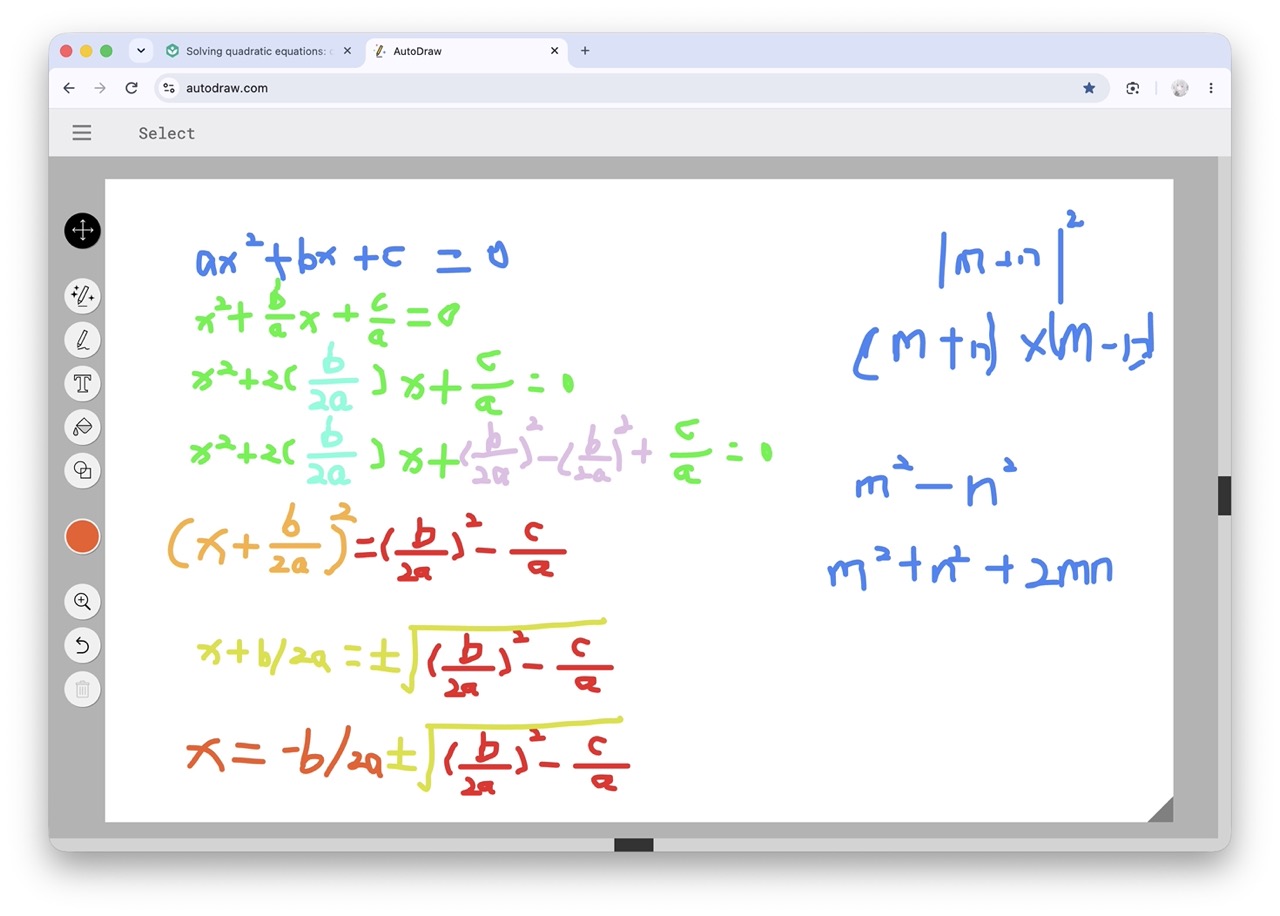
The Three Red Square Roots and One Elegant Line
October 18, 2026
Situation
The class began with complex numbers.
Tianjing was practicing multiplication such as (a + bi)(c + di). The mathematics was advanced, but our immediate goal was surprisingly elementary: improve the accuracy of her arithmetic, especially when expanding parentheses.
She made several small mistakes. In one problem, she repeatedly checked her work from the second step, overlooking an error in the first: 5i × (−3i) = −15.
I told her about a cartoon I remembered: an old professor had filled an enormous blackboard with complicated expressions. Just as he finished, someone at the far end pointed out a mistake near the beginning.
“You are that poor professor because you had a mistake in step one!”
She laughed.
Tianjing later described her mistakes as “粗心大意加马虎” — careless and sloppy. But the lesson was not to become afraid of making mistakes. It was to learn how to prevent them and check one's reasoning from the beginning.
After improving her work, she completed three consecutive problems correctly and earned a bonus question.
“What a pity if I fail on this one,” she said.
I couldn't help smiling.
Turning Point
Khan Academy suddenly presented quadratic equations with negative numbers under the square-root sign.
I asked Tianjing whether she knew the quadratic formula.
“No.”
Wonderful!
She wasn't even familiar with (m + n)² or (m + n)(m − n). I was delighted. So many students learn to memorize the famous formula before understanding the algebra that makes it work.
We went to our whiteboard.
First, she expanded (m + n)(m + n) and (m + n)(m − n) herself. Then I asked why people loved memorizing these identities.
“Why?” she asked, treating them as just two more expressions.
“Because we need to view them in the opposite direction.”
If we recognize the factors of an expression, we can sometimes simplify it or divide by a common factor. The identities were not magic formulas to memorize. They were patterns worth recognizing.
“Ohhhhh,” Tianjing said.
Now we were ready to attack the general quadratic equation:
ax² + bx + c = 0
Emergence
I divided both sides by a and drew a long marker line connecting x in the equation to m in our familiar pattern:
m² + 2mn + n²
“Look here. Let's match them one by one. x is this m. Now we need something to look like 2mn.”
We needed the middle term to have the form 2xn.
Tianjing struggled to arrange the coefficient. There were a few attempts, and a few of my “No”s, before she found the right expression.
Then I asked:
“Now what is n?”
“b/(2a),” she answered.
We changed colors and moved the new term to the right-hand side, preparing to insert +n² − n². She completed the square.
The remaining algebra followed. Tianjing derived the quadratic formula from the general equation rather than starting with the formula itself.
She color-coded her work beautifully.
“You just solved a generic quadratic equation! a, b, and c can be any number. Your handwriting is so cool. Share it, share it!”
I was excited to see how much she loved her own expressions.
“Yep, all three copies under the square-root sign are red,” she said proudly.
That was her highlight.
Not merely getting the answer right, but admiring the beauty of something she had created.
A Second Discovery
The class was already ten minutes over when I was about to leave our Slack call.
Tianjing still had something to show me.
“嗯,那个中国象棋。我已经把轮到谁走的功能做出来了……”
She had implemented the turn-switching feature in her Chinese chess app as homework before class.
“Here, here is how it works:
whoseTurn = 1 - whoseTurn
I was electrified.
“How could you find such an elegant algorithm?”
“I forgot ...”
LOL!
The code was beautifully simple. If whoseTurn was 0, then 1 − 0 = 1. If it was 1, then 1 − 1 = 0.
One line. Two states. Every execution switched the turn.
“Wow, soooooo cool!”
“Yep!”
She was ready to end the class. I wasn't letting her go just yet.
“Share this very function with that great line!”
Learning
That morning, Tianjing made two discoveries in two different languages.
In mathematics, she learned to recognize a pattern and work backward from it. She derived the quadratic formula instead of merely memorizing it.
In programming, she independently produced an elegant algorithm that switched between two states with one line of arithmetic.
Both discoveries shared the same essential quality: she could see the beauty in her own thinking.
Earlier, she had made small mistakes and laughed at her own carelessness. By the end, she was proudly sharing her mathematical expressions and her code.
The goal is not to make students who never make mistakes. It is to help them become people who can reason carefully, discover patterns, appreciate elegance, and take ownership of what they create.
Sometimes the best reward for learning is not a score or a finished assignment.
It is a student looking at her own work and saying, “Yep!”
Mathematics: Complex numbers, algebraic identities, completing the square, and the quadratic formula.
Programming: Binary states, arithmetic transformations, and elegant algorithms.
Learning: Why understanding a pattern is more powerful than memorizing a formula.
Creativity: The joy of making something that is genuinely one's own.
One whiteboard. One Chinese chess app. Three red square roots. One elegant line.
And a teacher who almost left ten minutes earlier.