
Living Museum of Learning
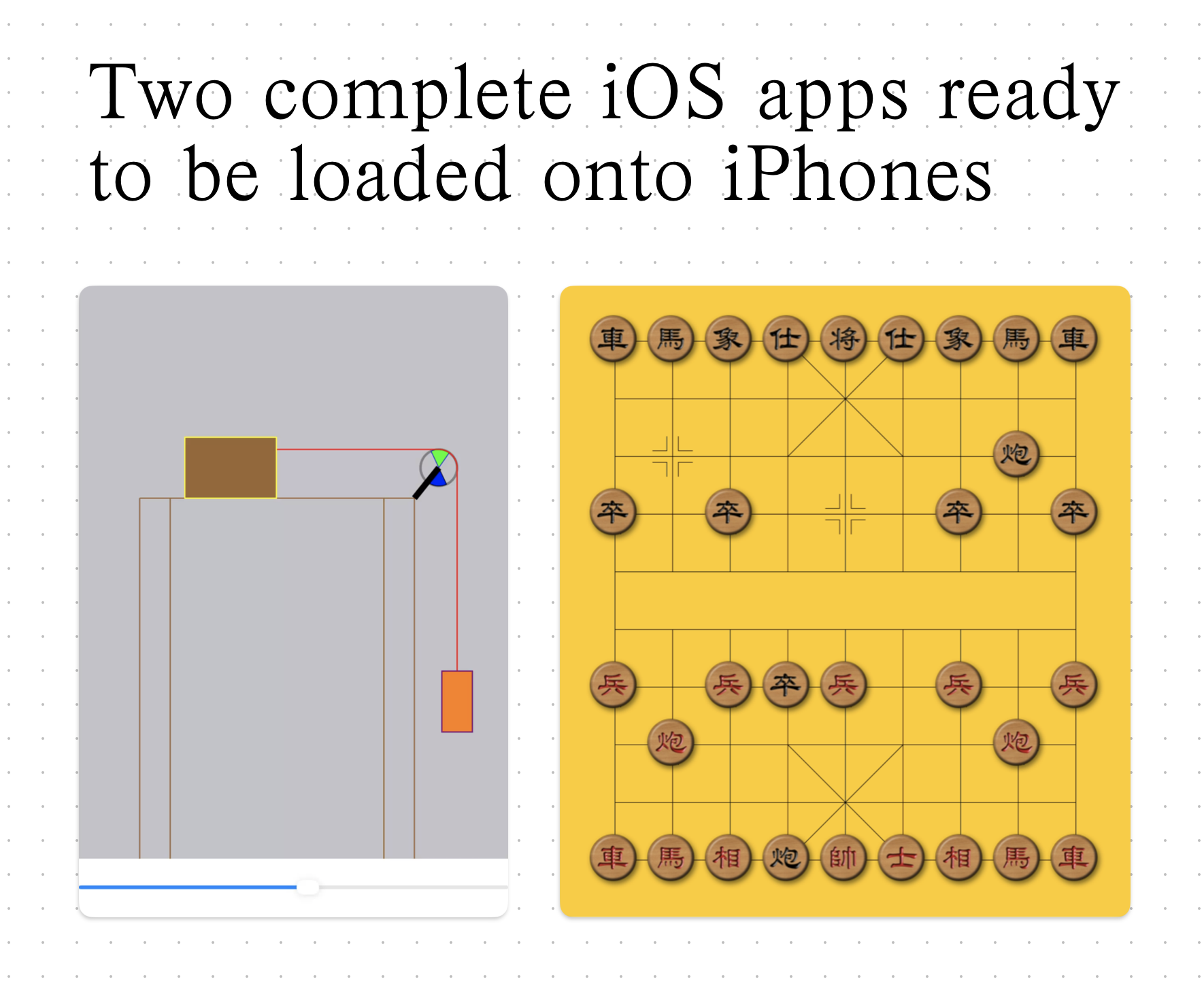
Every Creator Deserves an App Icon
Situation
Two sisters were turning their interests into software.
Tianjing was implementing the rules of Chinese chess in an iOS app. She already enjoyed playing chess herself, including in Duolingo. Now she was translating that familiarity into code, teaching a computer how the game should work.
Enning was exploring pulleys through two different projects: a 2D iOS simulation and a 3D experiment in p5.js. In her recent 3D work, she had been adjusting the center and angle of an arc to match the geometry of a wheel and the path of a rope.
Both sisters were doing real programming, but their projects were at different stages.
Turning Point
On October 16, Tianjing finished implementing all the Chinese chess rules except checkmate.
Her dad explained that Tianjing liked chess and often played it herself. That made perfect sense: she was not merely copying rules from a specification. She already had an intuitive understanding of the game she was programming.
Then came the next milestone: making an app icon.
Donald would help Tianjing create one the following day. Her chess game was becoming more than a collection of source files. It was becoming an application that could have its own identity on a device.
But wait!
What about Enning?
She had been working on her pulley projects, too. It would be terribly unfair if Tianjing got a proper app icon while Enning did not!
Emergence
And so, a new educational principle emerged:
Every creator deserves an app icon!
Of course, the sisters' projects were not identical. One was building a playable Chinese chess game; the other was exploring the geometry and mechanics of pulleys through interactive simulations.
But both were learning something important: programming allows an idea to become an object that other people can actually use, explore, and appreciate.
There is a special moment when a student sees a project on a phone or tablet, taps its icon, and watches something they created come to life.
It is no longer just an exercise completed for a teacher. It is their app.
Learning
A successful build is one milestone. A working application is another. Installing it on a device, giving it an icon, and showing it to someone else adds a new dimension to the experience.
These steps help students discover the many parts of making software:
Understanding a problem.
Translating ideas into precise rules and algorithms.
Testing and improving a working program.
Giving the finished product an identity.
Sharing something they created with the world.
And perhaps the best part is that the two sisters do not have to learn these things in exactly the same order.
Tianjing's chess app and Enning's pulley simulations are different expressions of the same idea: learning becomes especially powerful when students create something real.
A Little More Human
Donald joked that if he got his first app onto his own phone, he would laugh for a whole day and show it to everyone he met on the street.
That may sound like an exaggeration. But anyone who has created something for the first time knows the feeling.
Now imagine the sisters doing the same thing.
One opens a Chinese chess game she programmed herself. The other demonstrates a pulley simulation she designed.
And Donald stands nearby, making sure neither app suffers from the terrible injustice of having no icon.
Some educational principles are worth taking very seriously.
Others are worth laughing about.
This one happens to be both.