
Living Museum of Learning
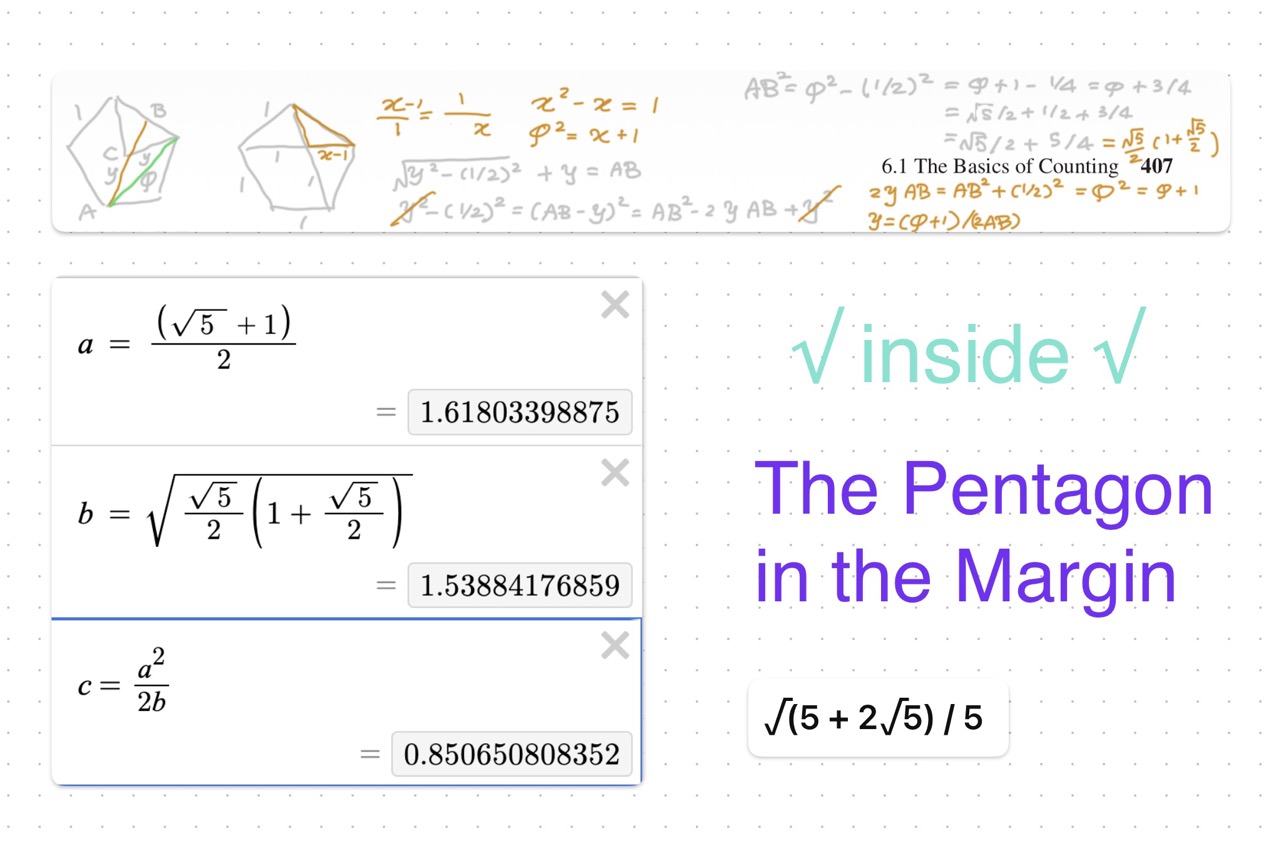
The Pentagon in the Margin
Situation
Three months before turning 60, Donald was preparing a geometry problem for Leo.
He wanted Leo to find the center of a pentagon—and then, eventually, the center of a pentagon in 3D.
It sounded simple.
Donald had seen pentagons thousands of times. But when he actually calculated the radius from the center to a vertex, something unexpected appeared:
a square root inside another square root.
√(5 + 2√5) / 5
"Wait. I've lived for almost 60 years, and this is the first time I've noticed this hiding inside such a familiar shape."
Turning Point
The calculation wasn't done in a computer algebra system.
Donald was reminded of Albert, who often uses Desmos simply as an evaluator for mathematical expressions.
But Donald did something even more old-fashioned.
He opened Discrete Mathematics and Its Applications, 8th edition, by Kenneth H. Rosen, and calculated in the narrow margin of the book.
Two small pentagons appeared there.
One was drawn with one color of his Apple Pencil. The other with another color.
The Apple Pencil was a gift from Gavin.
A familiar shape.
A mathematical surprise.
A book margin.
A gift from a grandson's father.
Suddenly, the calculation had become a little piece of life.
Emergence
Donald put the two pentagons and the calculation into Freeform and made them into a cover image.
He was preparing a lesson for Leo.
But somewhere along the way, the lesson changed.
The question was no longer simply:
"How do you find the center of a pentagon?"
It became:
"What can still surprise you after almost 60 years?"
The answer was sitting quietly in the margin of a mathematics textbook.
A pentagon.
Learning
The center of a pentagon is not just a point to be calculated.
It is a bridge.
From the pentagon to the icosahedron.
From the icosahedron to the dodecahedron.
From 2D geometry to 3D geometry.
And from a student's mathematical habit to a teacher's own curiosity.
Albert taught Donald something without intending to: sometimes Desmos is not just a graphing tool. It is a wonderfully convenient place to ask, "What does this expression actually give me?"
And Donald rediscovered something even older:
Sometimes the best mathematical tool is a pencil in the margin of a book.
Theme
Learning does not have an age limit.
A 60-year-old teacher can still look at a familiar pentagon and say:
"OMG. I didn't know there was a square root inside another square root."
And perhaps that is exactly what Leo needs to see.
Not an expert who already knows everything.
A curious kid who is still discovering things.
What Is Possible?
A familiar shape can still contain something you've never seen before.
How Does It Happen?
A student teaches a teacher a habit. A book margin becomes a laboratory. A pencil becomes a mathematical instrument.
Why Does It Matter?
Because curiosity is not something we finish learning.
It keeps going.
Even three months before 60.