
Living Museum of Learning
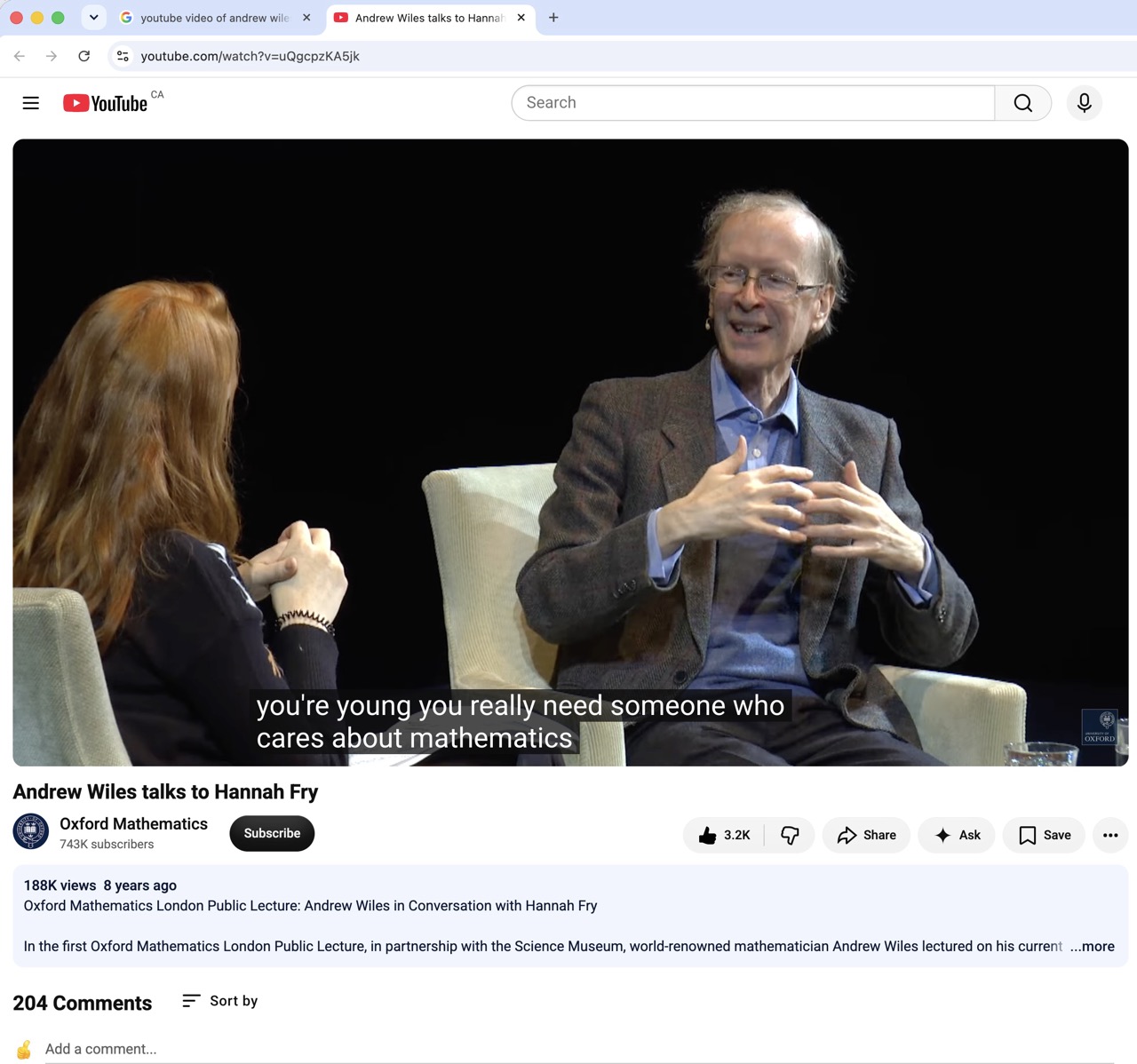
A Bookmark for Andrew Wiles
Situation
Nearly three years ago, I finally heard an authoritative voice saying something about learning mathematics that I had been waiting to hear for a very long time.
It was the voice of Andrew Wiles, the British mathematician who proved Fermat's Last Theorem after the problem had remained unsolved for 358 years.
I had been tutoring young learners for years. I already knew, from experience, how much the first steps can matter. But hearing Wiles talk about those first steps was different.
He said that when you are young, you really need someone who cares about mathematics, someone who likes it, and someone who can teach you those first steps.
That hit me.
So I sent his words to the families of all my students.
Turning Point
I didn't just send the quotation once.
I kept it.
I copied or transcribed the passage, translated it into Chinese, and shared it with family after family.
The words became one of those small things I carried around with me as a tutor.
Wiles went further.
He said that young learners need to learn from someone who enjoys mathematics and shows that enjoyment. He talked about how rare it can be for young children to encounter teachers who are actually trained in mathematics and want to teach mathematics.
And then he made an even stronger comparison:
Learning from someone who knows the subject and knows how to teach it is better.
One-on-one is best.
A small seminar is second best.
Learning from a book or journal is the worst way.
Those words stayed with me.
Emergence
On September 26, 2026, I wanted to find the passage again.
I searched YouTube for an interview with Andrew Wiles and spent perhaps twenty minutes hunting through the videos until I found the exact few minutes.
There it was.
Not a quotation on a page.
Not my transcription.
Not my Chinese translation.
Andrew Wiles himself.
So I thought:
Here. Listen to this yourself.
The link begins at the moment I was looking for:
Andrew Wiles — starting at 41:50
Watch the video →
I have watched perhaps 10 or 20 YouTube videos of Andrew Wiles, hundreds of times already.
His low, calm voice beats nuclear power.
And now I don't have to hunt for these few minutes again.
They have a home in the Museum.
Artifact
Andrew Wiles on the first steps of learning mathematics
Here. Listen to this yourself.
Learning
I don't take Wiles's words as a certificate proving that my way of tutoring is correct.
That's not why I saved them.
What moved me was hearing someone who had spent his life at the highest levels of mathematics talk about something so fundamental:
A young learner needs someone who cares about mathematics.
Someone who likes it.
Someone who can teach the first steps.
Someone who can show the learner that mathematics is something to enjoy.
That sounds remarkably close to what I have discovered in my own tutoring.
Sometimes the most important thing a teacher gives a young learner is not another technique, another worksheet, or another answer.
It is the experience of meeting someone who genuinely loves the subject.
Theme
A good teacher can make the first steps feel alive.
What Is Possible
A young learner can discover mathematics not merely as a school subject, but as something another human being genuinely enjoys.
How Does It Happen
Put a learner close to someone who knows the subject, cares about it, and enjoys sharing it.
Why Does It Matter
The beginning of learning is not a small thing.
It can determine whether a young person experiences a subject as something to endure—or something worth exploring for the rest of their life.
A bookmark, at last
For nearly three years, I have been sending these words to families.
Today, the Museum finally has a better way to keep them.
Not by copying Wiles's words again.
Not by telling you what he said.
Just by pointing to the place where he said it.
Here. Listen to this yourself.
And One More Thing...
The exhibit was finished.
But it hadn't gone public yet.
I used it to test the new YouTube-link feature.
The long YouTube URL worked.
Then I tried the short youtu.be version.
It failed.
The funny thing was, the new pattern had already recognized the URL. It simply disappeared because the renderer didn't yet know what to do with it.
One small branch was missing.
I fixed it.
The test passed.
Only then was the exhibit really finished.
LOL.
The Museum was supposed to preserve a few minutes of Andrew Wiles.
Instead, Andrew Wiles helped us find a bug in the Museum.
Now, finally:
Here. Listen to this yourself.