
Living Museum of Learning
Who Told You 7 Was Untouchable?
Situation
Enning has been learning mathematics in English, which sometimes makes an apparently simple problem surprisingly interesting.
In one recent class, she encountered the word “double.”
The problem said:
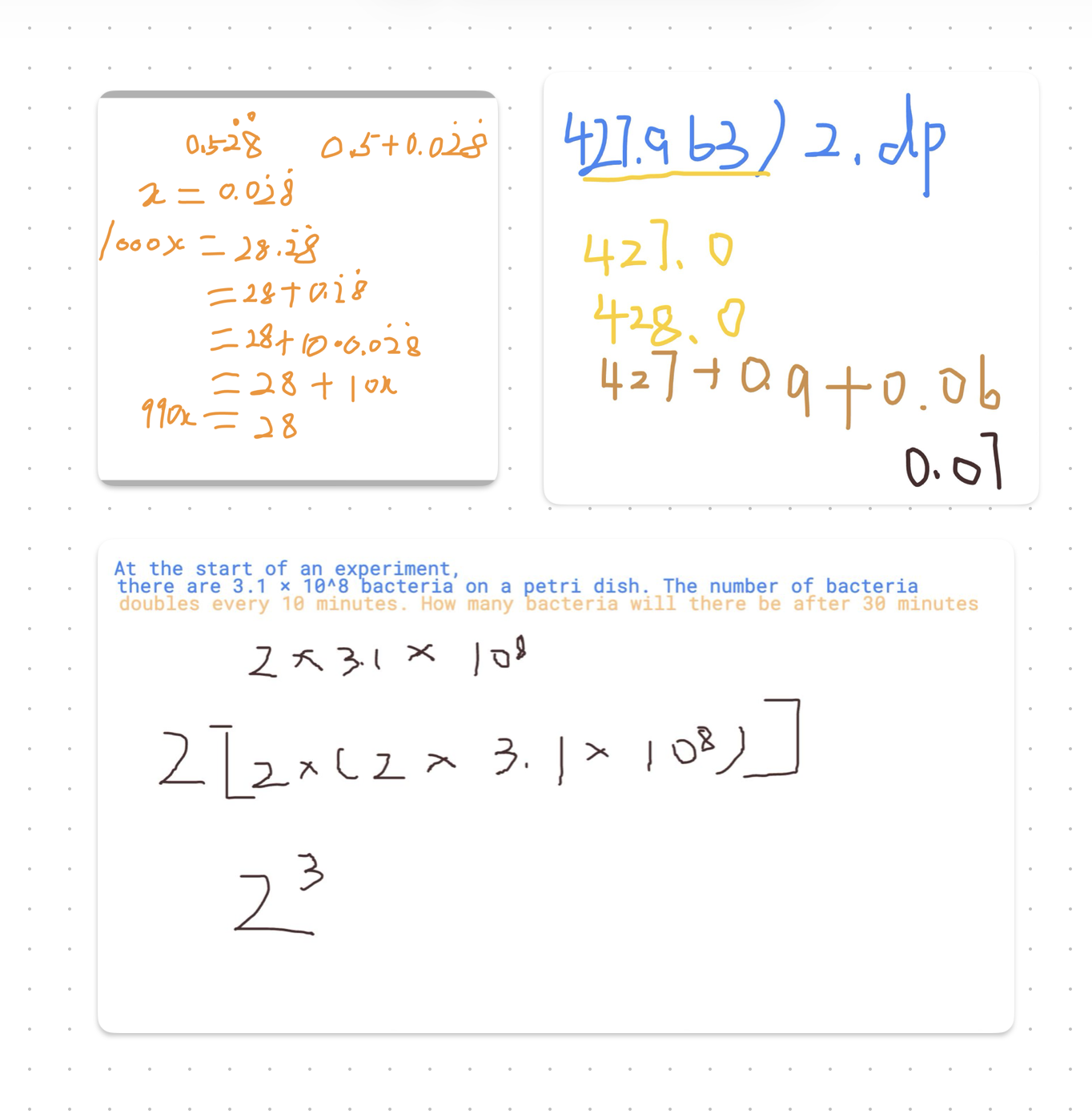
3.1 × 10⁸ bacteria doubled every 10 minutes.
Enning immediately multiplied the number by itself.
I stopped her.
“You have 3 apples. What’s the double?”
She said, “6.”
“Yes. 6, not 3 × 3 = 9.”
She laughed. Then I asked whether the word double itself was bothering her.
“Yes.”
So we talked about another word:
double → twice as much
triple → three times as much
Then I noticed something else. She was writing the repeated doubling as:
2 *
4 * 2 *
I stopped her again.
“Let’s write what the problem is trying to build.”
2 *
2 * 2 *
2 * 2 * 2 *
“After 30 minutes, the number is 8 times the original,” I said.
The expanded multiplication made the structure visible:
2 × 2 × 2 = 8
The exponent could come later. First, she needed to see the repeated doubling.
Turning Point
Then came a completely different-looking question from her math book:
Round 427.963 to 1 decimal place.
Enning became stuck.
“I know 9 changes to 0. But I don't know if 7 should become 8 or not.”
She had somehow decided that the 7 was fixed.
Almost untouchable.
She explained her concern:
“If 7, 427.0 is too smaller.”
Her reasoning was actually good. She could feel that 427.0 was nowhere near the original number.
So I laughed:
“Your reasoning is good. But who told you 7 was fixed? Did you lock your mind by yourself?”
She laughed too.
The “7” was not a saint.
It could move.
But I didn't want her to simply memorize the rounding rule, so we went deeper.
I asked her to write:
427 + 0.9 + 0.06
“You are handling 0.06 → 0.1,” I said.
Then I asked her to put nearby numbers underneath:
0.06
0.07
0.08
Now she could see what was happening.
0.06 belongs to the next tenth when we represent the number to one decimal place.
So:
427 + 0.9 + 0.1
= 428.0
The answer was no longer a rule somebody had handed her.
She could see why it had to be 428.0.
Emergence
The interesting thing about these lessons is that Enning's mistakes are rarely just mistakes.
They often reveal an assumption hiding underneath her thinking.
With double, she had attached the wrong mathematical meaning to an English word.
With repeated doubling, she wanted to jump straight to the result instead of seeing the structure:
2
2 × 2
2 × 2 × 2
With the recurring decimal problem, she was searching for the literal x, even though x was already sitting there disguised as a decimal expression.
And with rounding, she had silently created a rule:
The 7 cannot move.
Nobody had told her that.
She had told herself.
That was the interesting part.
Once the invisible assumption was exposed, the mathematics became much easier.
Learning
Enning is learning something more valuable than individual procedures.
She is learning to ask:
What exactly does this symbol or word mean?
What is changing?
What is staying the same?
Did someone actually tell me this rule, or did I invent it myself?
That habit appeared again in her 3D bike project.
We had previously missed a size relationship in the pedal.
When we tried using 0.7 for the disc because the pedal was scaled to 0.7, Enning immediately shouted:
“It becomes smaller!”
She was right.
The disc needed to remain at its original relative size.
So we arrived at:
0.7 / 0.7 = 1
and the code became:
drawDisc(q / 0.7)
The number 1 / 0.7 was not pulled out of a formula book.
It emerged because the geometry demanded it.
That is becoming a pattern in Enning's learning.
Don't memorize the rule first. Find the relationship.
Theme
Question the invisible rule.
What Is Possible
A student who once hesitated over a single digit can learn to challenge the assumptions behind the problem—and then use mathematics to test those assumptions.
How Does It Happen
By turning abstract rules into things she can see: apples for “double,” repeated multiplication for exponential growth, decomposed decimals for rounding, and actual 3D geometry for scale.
Why Does It Matter
Because mathematics is not only about getting the answer.
It is also about noticing when your own mind has quietly invented a rule—and having the courage to ask:
“Who told me?”