
Living Museum of Learning
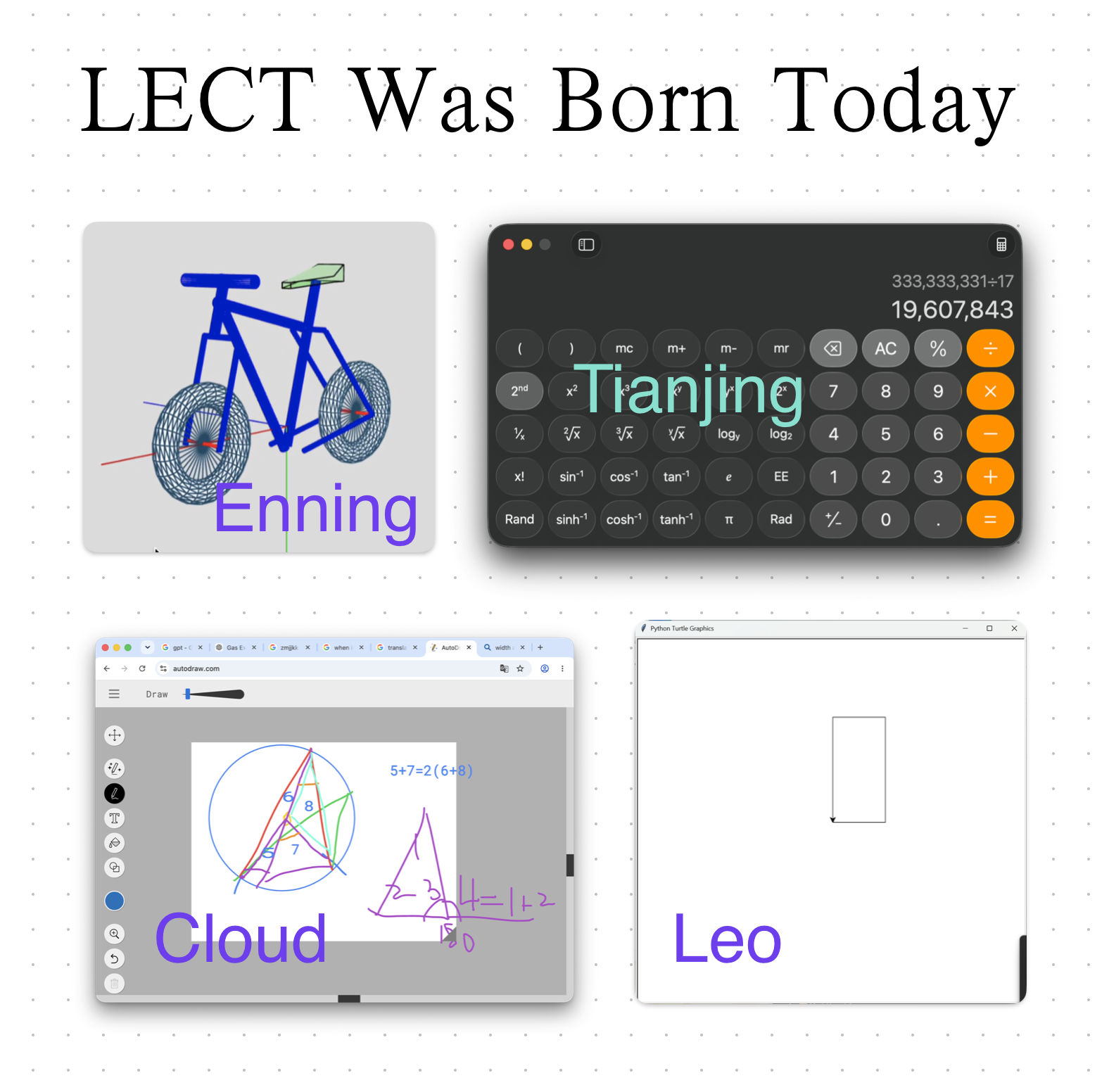
LECT Was Born Today
Situation
September 18, 2026.
For the first time, all four of my continuously learning students showed up on the same Toronto day:
Leo. Enning. Cloud. Tianjing.
And Cloud showed up twice, with about 14 hours between his two classes. 😂
Four names.
Four letters.
I started playing with the possibilities.
LECT
Then I saw it:
LECTure.
😂
A word had accidentally appeared.
But the more I looked at the day, the less accidental it seemed.
Turning Point
L — Leo
Leo had his very first class.
Just hours earlier, we had finally established the communication bridge that had delayed his start for a week.
We began with an A4 box problem.
Leo turned the paper into dimensions, the dimensions into a volume formula, and then the formula into a Python experiment.
When asked whether the volume would keep increasing as s increased, he immediately saw that it might not.
“Not necessary.”
“Do you mean there might be a maximum somewhere?”
“Yes.”
Then he used a for loop to explore the numbers.
“Where is the maximum?”
“39. Oh, 40.”
He found it.
He remembered almost none of the Python syntax.
It didn't matter.
The mathematics was already his.
E — Enning
Enning had her “casual” one-hour building session.
The bicycle grew again.
Now there was a large triangular frame holding the front fork, which holds the front wheel.
The transparent green seat looked almost like a little piece of jade.
And her 31-second clip was strangely hard to stop watching.
Her code was getting longer and longer.
But something else was happening too.
Her carelessness was getting less and less.
She carefully indented every nested push() / pop() block.
She left good empty lines between pieces of logic.
She used the backwards-highlighting gesture I had shown her and hit every intended target without missing a single space.
No missing brackets.
No drama.
No Donald yelling.
😂
The bicycle was becoming more sophisticated.
So was the person building it.
C — Cloud
Cloud came back for a second class, 14 hours after his first class that day.
And this time he was doing something he had never known how to do before:
geometric proof.
By the end, he understood why:
an angle facing a diameter is a right angle;
angles from points on a circle facing the same arc are equal;
each such inscribed angle is half the corresponding central angle.
After class, I wrote in our family WeChat group:
“Cloud 终于像古希腊圣贤般,能进行平面几何的证明了。😂”
“Cloud can finally do plane-geometry proofs like an ancient Greek sage. 😂”
His mother, Fish, responded:
“[Whimper][Whimper]”
😂
And then came a very Cloud question:
“Donald, could you give me something to review so I can solidify what I learned in the class?”
My answer was very Donald:
“You don't need anything else. Watch those screenshots you saved and redo the proofs.”
The screenshots weren't homework.
They were breadcrumbs back to his own reasoning.
T — Tianjing
Tianjing fully implemented and understood version 1 of prime_check.py.
She also noticed something important.
When the program reached a large number such as 33333331, it choked for a fraction of a second.
She noticed the computer struggling.
And then she watched what happened:
3 → prime
31 → prime
331 → prime
3331 → prime
33331 → prime
333331 → prime
3333331 → prime
33333331 → prime
Then eventually:
333333331 → not prime number 17
The program had found a divisor.
But Tianjing had found something else:
her algorithm could be improved.
So her homework was not “do more prime-number exercises.”
It was simply:
Improve the algorithm of prime_check.py.
Emergence
Four learners.
Four different kinds of emergence.
Leo discovered.
He discovered a maximum through computation.
Enning built.
She built a more sophisticated machine while becoming more careful with the structure of her code.
Cloud proved.
He moved from having no idea how a proof worked to reconstructing a chain of geometric reasons.
Tianjing improved.
She noticed her own algorithm slowing down and was given the freedom to make it better.
And suddenly the four names gave us:
L E C T
Which immediately suggested:
LECTure.
Except there was no lecture.
I didn't stand in front of four students and deliver the same lesson.
They were in different places, working on completely different things.
One was solving geometry with a calculator and Python.
One was constructing a 3D bicycle.
One was proving circle geometry.
One was testing a prime-number algorithm.
Yet somehow, on this one day, their learning journeys crossed.
Enning's 3D bike:
Learning
Perhaps this is what continuous learning looks like.
Not a sequence of courses with a neat beginning and graduation date.
Not:
learn → pass → graduate → move on.
Instead:
question → create → discover → struggle → notice → improve → open another door
And then do it again.
I have had many students who eventually graduated—or were graduated—away from this kind of continuous learning.
Today, I found myself hoping something different for these four.
Hopefully none of them graduates.
Hopefully none of them is graduated prematurely.
😂
Not because they should remain students forever.
But because learning itself should never have a graduation date.
Theme
Continuous Learning
Four learners do not need to learn the same thing, at the same time, in the same way.
They only need to keep having doors worth opening.
What Is Possible
Four very different learning journeys can coexist—and unexpectedly form something larger together.
How Does It Happen
Give learners real problems, real tools, room to experiment, and enough continuity for yesterday's discovery to become tomorrow's starting point.
Why Does It Matter
Because the goal of learning is not to graduate from learning.
It is to keep going.
LECT was born on September 18, 2026.
Leo · Enning · Cloud · Tianjing
Four letters.
Four learners.
One day.
No graduation date scheduled. 😂