
Living Museum of Learning
Cloud Cuts His Way Into Calculus
Situation
Cloud had recently said that he wanted to learn more mathematics, especially high-school mathematics, and less programming. He even believed that programming was not really mathematics.
Donald thought Cloud had a different problem: too many gaps in his mathematical thinking, and perhaps not enough experience discovering mathematics for himself.
So instead of starting with a calculus textbook, Donald started with an A4 sheet of paper.
The challenge was simple:
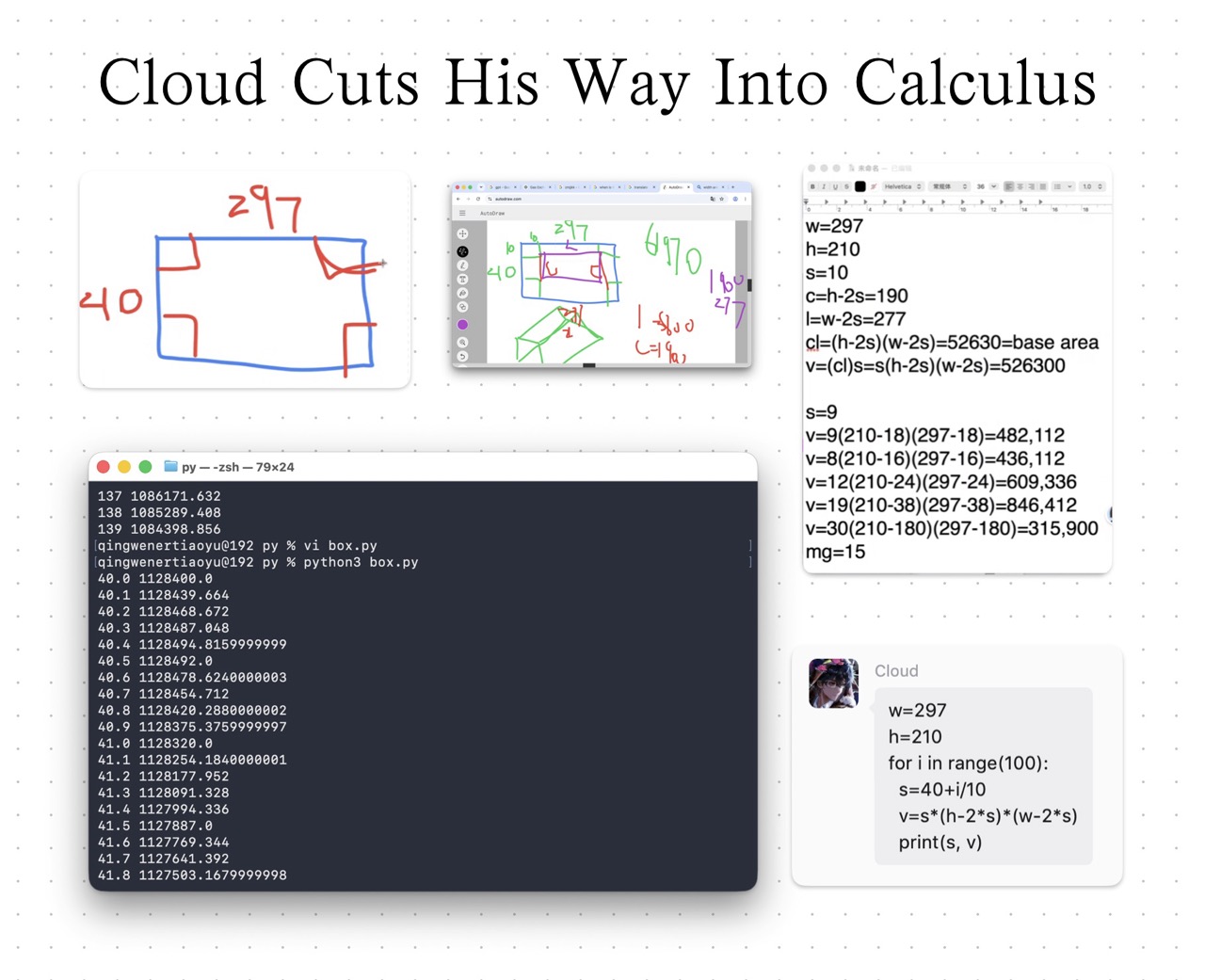
Cut four small squares from the corners of an A4 sheet, fold up the sides, and make an open box. What size should the squares be so that the box has the largest possible volume?
Cloud immediately got his hands involved.
At one point he said:
“Wait, no rush, let me make different cuts to compare the volume of them.”
He was no longer simply following instructions. He was experimenting.
Turning Point
Before touching Python, Donald asked:
“Give your best guess of s.”
Cloud wrote:
mg (my guess) = 15
Then they began with integer values:
s = 8, 9, 10, ...
Python calculated the corresponding volumes.
Cloud watched the numbers.
And then he discovered that his guess of 15 was nowhere near the maximum.
Around 40 was much better.
LOL.
But finding 40 created a new question:
Was 40 really the best, or had they simply searched too coarsely?
Donald suggested making the steps thinner:
“Why don't we start from 40 and try 40 - 0.1, -0.2, ... and +0.1, +0.2, ...?”
Cloud understood the mathematical idea immediately.
The remaining problem was Python.
Emergence
Donald brought back an old programming trick.
He asked Cloud to write one column:
i: 0, 1, 2, 3, ...
Then another:
s: 0, 0.1, 0.2, 0.3, ...
Cloud immediately saw the relationship.
The second column was simply the first column divided by 10.
So the search could be written as:
for i in range(100):
s = 40 + i/10
v = s * (h - 2*s) * (w - 2*s)
print(s, v)
The computer then narrowed the search.
The best value they found was around:
s = 40.4
Near the end of class, Donald himself momentarily forgot the number:
“Cloud, what's the best value we were looking for? 40 something?”
Cloud patiently pulled up the evidence and showed him:
“Let me show you again. Here you are, 40.4 is the place we got the max volume.”
The student was now reminding the teacher what they had discovered.
At the end of the lesson, Cloud shared his screenshot and his program.
Then came perhaps the funniest sentence of the morning:
“This is the simplest code I ever wrote.”
Technically, Cloud has written simpler code.
But he had never written simpler code that carried so much mathematics.
Learning
Cloud did not begin by learning a definition of calculus.
He experienced several ideas that lead naturally toward calculus:
physical measurement
variables
mathematical modeling
prediction
experimentation
numerical search
optimization
approximation
making the search finer
recognizing a numerical pattern
translating that pattern into code
Most importantly, Cloud discovered that mathematics does not have to arrive as a collection of formulas.
You can build something, make a guess, test it, discover that you are wrong, zoom in, and ask a better question.
That is mathematics.
And programming can be one of the tools that lets you see it.
Theme
Mathematics becomes much less mysterious when you are allowed to discover it.
What Is Possible
Can an ordinary sheet of A4 paper become an introduction to calculus?
How Does It Happen
Cut, build, measure, guess, calculate, compare, refine—and keep looking.
Why Does It Matter
Because a student who once said “programming isn't mathematics” may discover that a few lines of code can become a microscope for mathematical thinking.