Living Museum of Learning
The Geometry Problem That Needed Two Proofs—and a Reset
Situation
Enning came home with a geometry problem she described as “rather difficult” and probably an 8th-grade problem.
She had learned circles, tangents, secants, angles facing the same arc, angles facing the diameter, and related geometry last year—but, as she admitted, she had forgotten a lot.
So we started from the diagram.
Or, more accurately, we started by questioning the diagram.
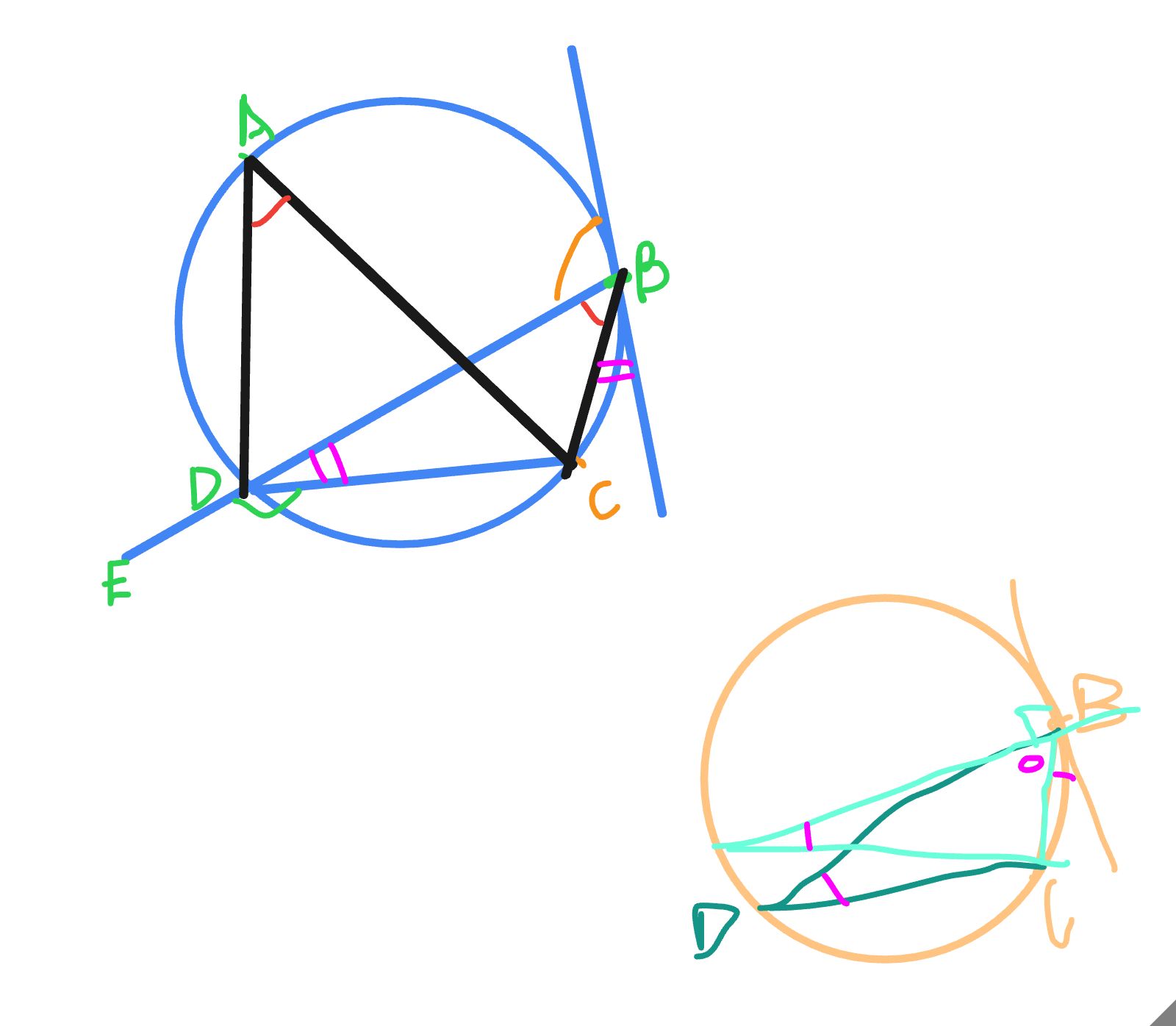
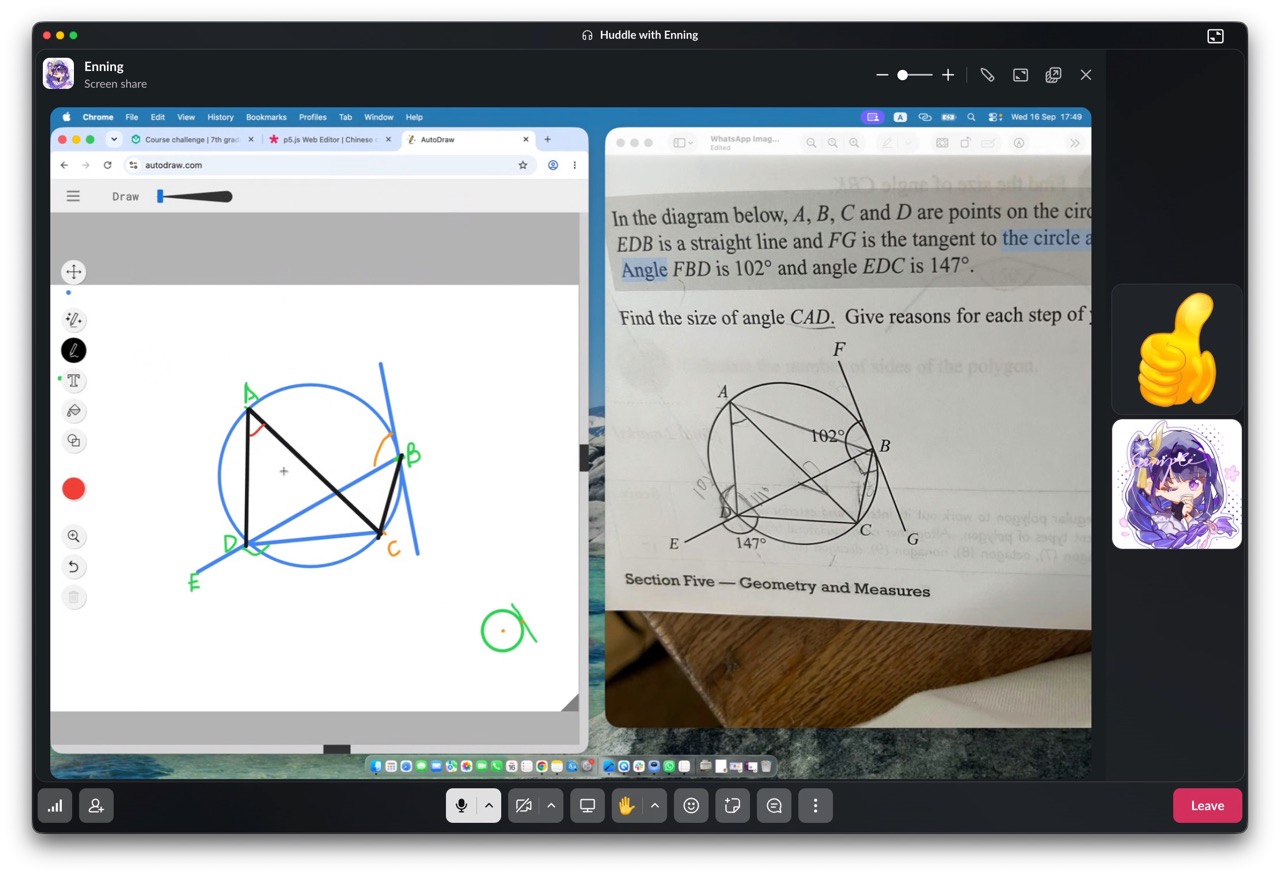
There was a line connecting A and B in the screenshot she sent me.
The problem had never mentioned that line.
“Was there a line here?” I asked.
“I drew it!” Enning answered, with a loud laugh.
😂
Fine.
We would redraw everything.
Turning Point
I told her:
“Follow the problem line by line. Draw the diagram little by little. Understand what we have so far. Collect information. When the diagram is simple, understanding the conditions so far is easier.”
This sounds like a small drawing instruction, but it is actually a way of thinking.
A geometry diagram should not secretly give us information that the problem never gave us.
Don't draw two segments with exactly the same length if nobody said they were equal.
Don't make something look perpendicular unless there is a reason.
Don't create a special case and then accidentally use your own drawing as evidence.
Even tiny details matter. If a point lies on a line or an arc, a short perpendicular-looking mark can help represent it clearly without making the diagram look as if some additional geometric relationship has been given.
The picture should be honest.
Emergence
Then came the dangerous word.
Enning casually said:
“Oh, I made this line slant.”
I stopped.
“Say it again. Which line is slant?”
And Drama Queen returned immediately:
“That line should be perpendicular to the tangent.”
I nearly fainted.
😂
Perpendicular to what?
For a moment, perpendicular had become a free-floating geometry adjective—something that could potentially belong to an egg, the sun, the moon, a river, a flower, or a fly.
So I cut it off completely:
“Nothing here is perpendicular. We have a circle and a tangent only!”
We moved to something else.
How many common points can a circle and a line have?
One point: tangent.
Two points: secant.
No points: a line outside the circle.
Only after Enning was thinking about actual objects and relationships again did I return to the forbidden word:
“But there is something perpendicular with the tangent. What's that?”
Slowly, her mind returned to the center of the circle.
The radius.
Now perpendicular had a home.
The Proof
The real challenge was recognizing that the angle made by the secant and the tangent equals the angle facing the same arc.
I wasn't completely sure of the proof myself. I had learned this geometry long, long ago—not last year.
So I didn't pretend.
I started with observation.
“This angle looks about the same size as that one. Do you agree?”
“I don't know,” Enning said.
She thought I was challenging her mathematics.
I wasn't.
I was asking her to look.
“They look very close, right?”
“Ah, yes.”
Now she was observing.
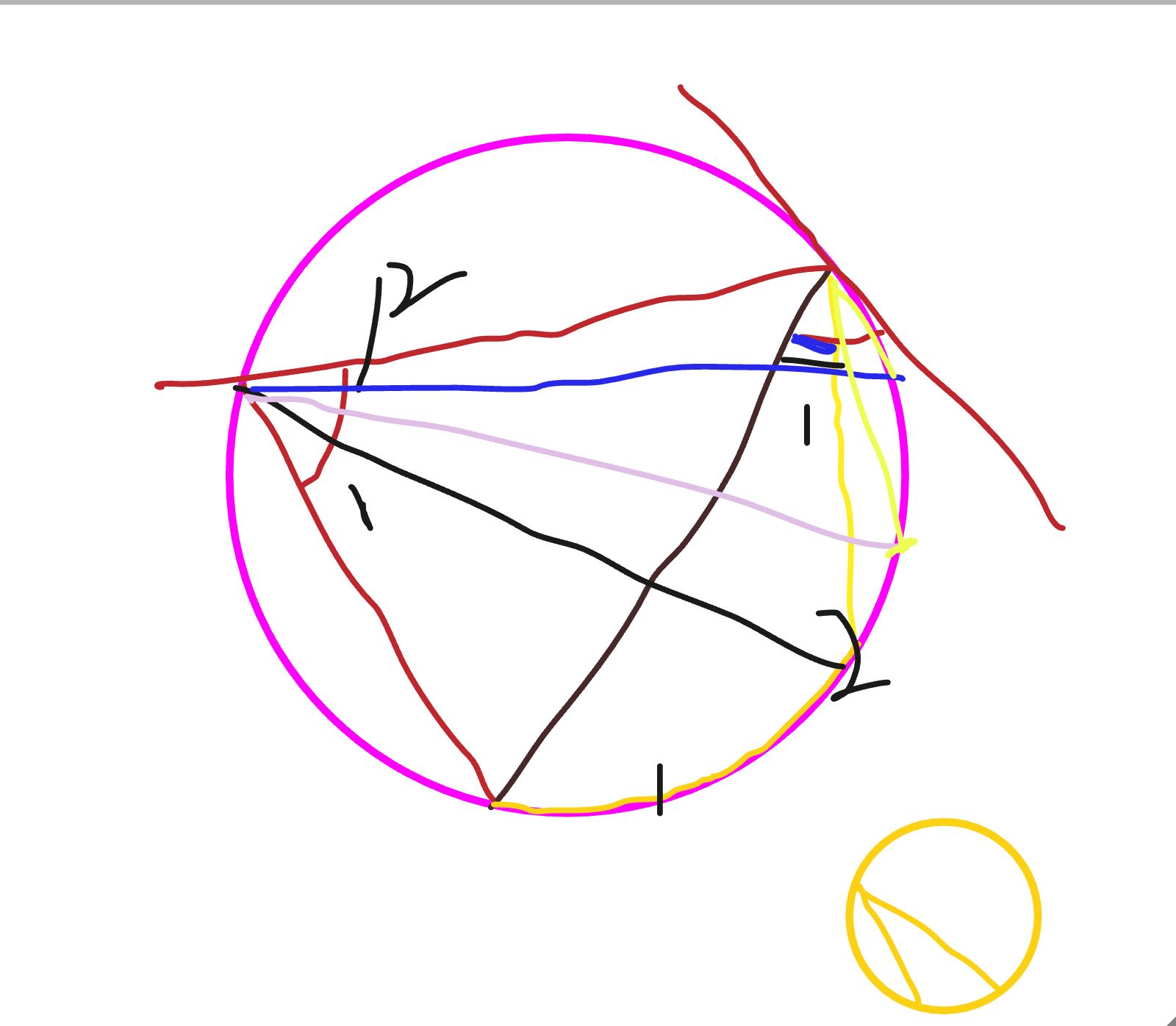
That gave me the attacking path: draw the perpendicular diameter.
And, fortunately, the previous half hour had already repaired the meaning of perpendicular.
This time Enning could follow the proof.
We reached the final answer.
“Done, right?” I said.
She was very happy.
The answer was now only about 1 mm away from her hands.
But Donald Had Another Idea
Unfortunately for Enning, I had another “magic way.”
😂
We saved the two beautiful diagrams and then removed them from the digital whiteboard.
Enning drew another big circle, a secant, and a tangent.
Then we introduced another nearby secant between the original secant and the tangent.
Move it closer.
And closer.
And closer.
As the new secant approaches the tangent point, it becomes more and more parallel in appearance to the tangent. One angle gets closer and closer to the other.
Eventually, the picture gives us an intuitive feeling for why the two angles can become equal.
Enning probably caught about 80% of this idea.
That's perfectly fine.
I wasn't trying to make her reproduce a rigorous limiting argument immediately.
I wanted her to meet the idea.
As I often tell students:
“Don't worry if you don't get it. 先混个脸熟.”
Just get acquainted with it first.
Maybe next time she meets something similar, she won't have to start from zero.
Learning
This “hard” geometry problem turned out to contain much more than one answer.
Enning practiced separating:
What the problem gives us
from
what our drawing happens to suggest.
She practiced rebuilding a complicated diagram from simple information.
She practiced observing before naming.
She learned that perpendicular is not a magic word attached to a tangent. It describes a relationship between specific lines.
She saw one theorem through a constructive proof.
Then she saw the same relationship through motion and approaching angles.
And perhaps most importantly, she experienced something that happens constantly in real mathematics:
Neither of us had the entire path sitting in memory.
We looked.
We questioned.
We tried.
We found a construction.
We followed it.
And then we found another way to see the same thing.
Theme
A diagram should tell the truth. A mathematical word should have a home. And understanding does not always arrive in one visit.
A forgotten geometry theorem can be rediscovered rather than simply memorized.
By rebuilding the diagram honestly, observing relationships, making deliberate constructions, and revisiting ideas from different directions.
Because mathematical thinking is not the ability to remember every theorem. It is the ability to reconstruct meaning when memory is incomplete.
And sometimes the first step is simply:
先混个脸熟.
Meet the idea today.
Let it recognize you tomorrow.