
Living Museum of Learning
No A4 Paper Wasted
Situation
A child doesn't need to start calculus with a textbook.
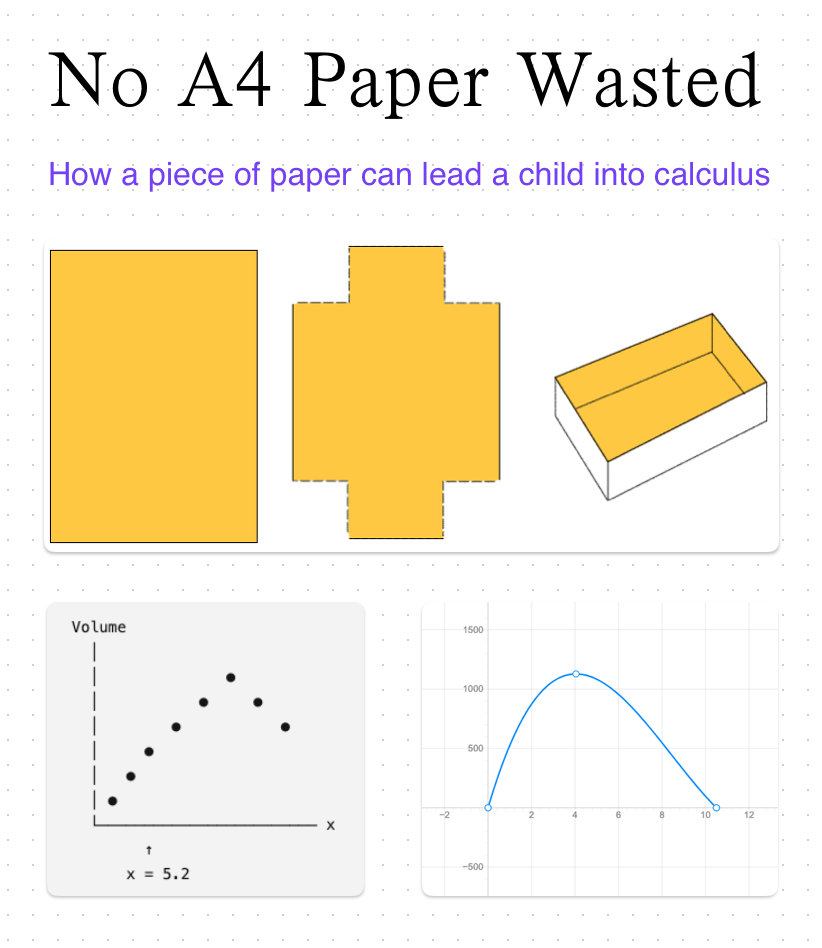
Give them one real A4 sheet of paper: 210 mm × 297 mm.
Ask them to cut four equal squares from the corners and fold up the sides. Now they have a box.
The question is simple:
How big can we make the volume of the box?
Start with 1 × 1 cm², then 2 × 2, 3 × 3, and so on.
The child can physically make each one, measure it, and calculate its volume.
Turning Point
But then comes the beautiful problem.
How do you physically cut a 1.1 × 1.1 cm² square?
What about 1.17 × 1.17?
Or 5.263 × 5.263?
We don't want to waste dozens of A4 sheets just to investigate numbers between the numbers.
So we stop cutting paper.
We start coding.
Python can test hundreds or thousands of possible cut sizes.
P5.js can draw the A4 sheet, fold it virtually into a box, and let the child drag a slider continuously.
One slider changes x.
The virtual box changes.
Its volume changes.
A dot moves along the volume curve.
Suddenly the child can see the mystery:
Somewhere, there must be a maximum.
Emergence
The derivative has not been introduced yet.
It doesn't need to be.
The child already has a question:
"Where exactly is the highest point?"
Brute-force Python can get close.
A slider can let us explore.
A graph can show the whole landscape.
And then calculus arrives naturally:
V(x) = x(29.7 - 2x)(21 - 2x)
The derivative becomes a tool for answering a question the child already owns.
This is how we want mathematics to enter learning—not as a formula to memorize, but as something that becomes necessary.
And the same idea extends far beyond calculus.
With P5.js, Enning and Tianjing can put sliders on their Chinese chess board drawings: cellSide, star length, star offset, line width, and other parameters. Visitors to the Living Museum can later drag those same sliders and experiment with the children's creations.
With Swift, a learner can build the same kind of interactive experiment into a real iOS or iPad app.
Learning
Our teaching strength is not simply that children learn Python, P5.js, or Swift.
It is that they can use all three as experimental instruments.
Python lets them search a mathematical space.
P5.js lets them see mathematics move.
Swift lets them turn their ideas into interactive creations.
A child can experiment with thousands of possibilities without wasting a single A4 sheet of paper.
LOL.
More importantly, the computer does not replace the physical experiment.
The real A4 box creates the question.
The code expands the child's ability to investigate it.
The mathematics explains what the child has discovered.
Theme
Learning by Experiment
A single sheet of A4 paper can become an entry point into geometry, functions, graphs, optimization, derivatives, programming, and eventually much deeper mathematics.
Start with something real. Let the child manipulate it. When the physical world becomes too coarse or too expensive to explore, move the experiment into code. Let Python, P5.js, or Swift become instruments for asking better questions.
The goal is not to teach children more formulas.
The goal is to make them curious enough to need the formulas.
A Living Museum exhibit should not merely tell visitors what a child learned.
It should let them do the experiment themselves.
And the journey doesn't have to stop at calculus.
Once children become comfortable moving points and lines on interactive curves, we can give them stranger playgrounds: elliptic curves. Let them drag two points, draw the line through them, watch where the line meets the curve again, reflect that point, and discover that this strange geometric game behaves like addition. They don't need to begin with abstract algebra or cryptography. They can simply play: "What happens if I move this point?" And then we can reveal another delicious mystery: we are all curious about the curve behind today's famously expensive Bitcoin — y² = x³ + 7. Suddenly the strange curve on the screen is no longer "advanced mathematics." It is connected to something the kids have actually heard about in the real world. A child who started by folding an A4 sheet into a box may eventually be dragging points around that curve and asking, "Why does this weird thing work?" That is exactly the kind of question our teaching is designed to create—and exactly the kind of question the curator must not forget from this morning. 😂