
Living Museum of Learning
The Brave 3 and 4
Situation
Enning told me beforehand:
“I need some help on recurring decimal to fraction.”
So we played.
I wanted her to save every example we tried, because I didn't know where the lesson would lead.
We started much more simply than recurring decimals.
She wrote:
312 = 300 + 10 + 2
= 3 × 100 + 1 × 10 + 2 × 1
Then she wrote 3 × 100 + 1 × 10 + 1 × 2.
I spent several minutes trying to make her see what had changed. I even told her:
“If she dresses a skirt, you too. If she dresses a pair of trousers, you too.”
She still didn't see the problem.
Drama queen.
We moved to 0.312. She wasn't as fluent, so I suggested that she write down part of the decimal and simply verify it. That worked.
Then came the classic:
x = 0.333...
I made her write every step.
10x = 3.333...
10x = 3 + 0.333...
10x = 3 + x
I particularly wanted her to understand the middle steps. They weren't decoration. We needed to turn an equation containing ... into a clean equation.
She got x = 1/3 easily.
I also corrected her handwriting: lowercase x should be curved and written in one stroke so that it doesn't look like × or uppercase X. I had given Tianjing the same advice, although Tianjing's two-stroke version was perfectly fine as long as it didn't look like a cross.
Then we tried:
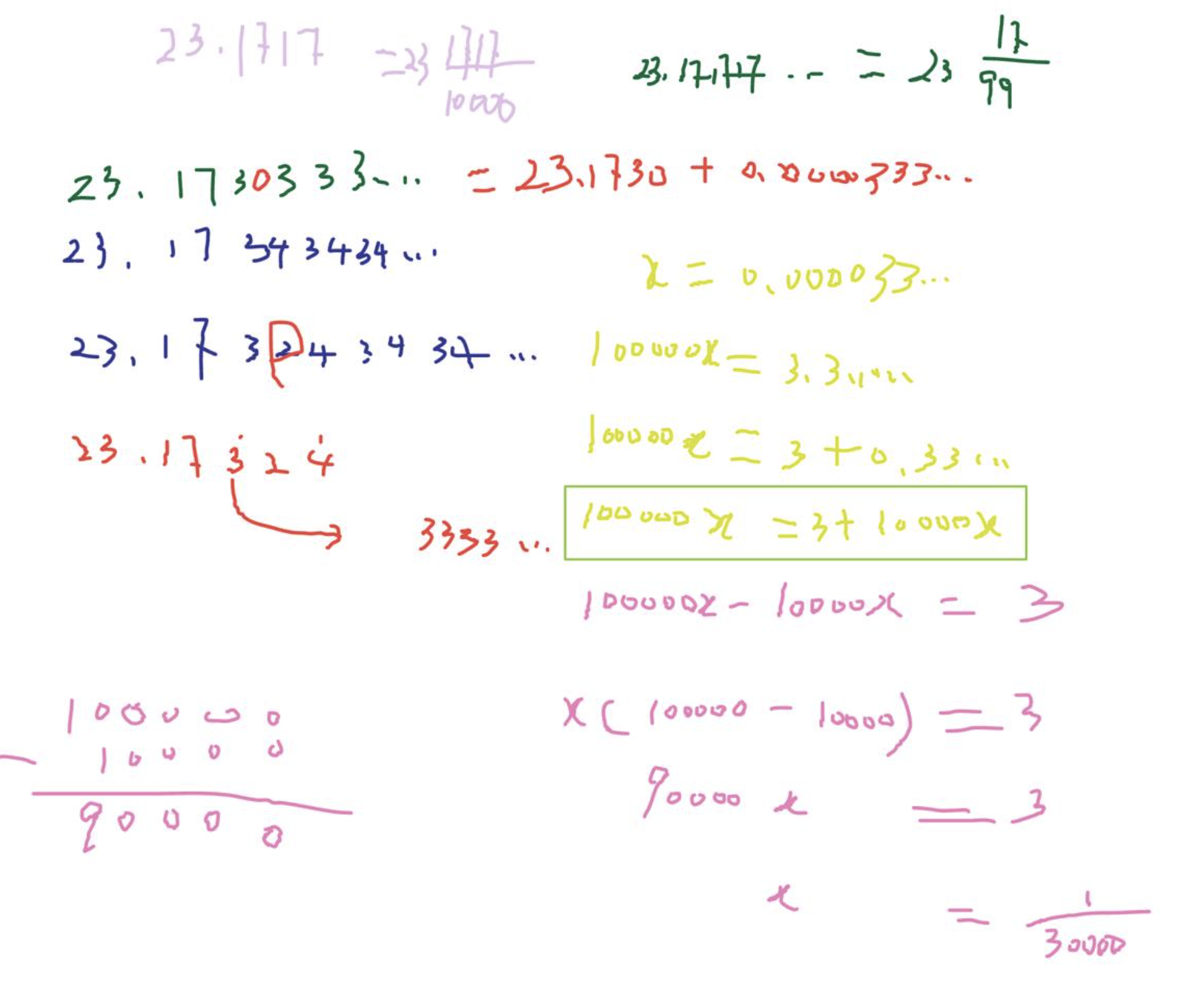
x = 0.1717...
Enning wondered why people always used 100.
“Try 10, 100, and 1000,” I told her.
She discovered that 10 and 1000 didn't solve the problem cleanly and eventually got:
99x = 17
She skipped the equation that should have led there.
I thought she was fluent.
She was actually playing games with herself.
Then I wondered:
“What about 10000?”
Neither of us had planned that one. I had never tried it myself.
She got:
10000x = 1717.1717...
and then:
9999x = 1717
Again, she skipped the important equation:
10000x = 1717 + 0.1717...
10000x = 1717 + x
The whole point was to get rid of the ....
She reached:
x = 1717/9999
and paused.
That fraction had to equal the earlier 17/99, because the same x could not have two different values.
She eventually noticed:
1717 = 101 × 17
and we verified:
101 × 99 = 9999
rather than making the division harder than necessary.
I also kept reminding her to draw the horizontal fraction bar first. It made it much easier to keep the numerator and denominator organized.
Then I brought her back to a deceptively simple distinction:
23.1717
versus
23.1717...
One is finite. The other continues forever.
We explored more unusual cases:
23.173333...
23.17343434...
And then Enning invented her own:
23.173243434...
Turning Point
This was where our ordinary recurring-decimal lesson exploded.
Enning wrote:
23.17324
and put a dot over the 3 and another dot over the 4, intending to represent:
23.17324343434...
It was a brave piece of notation.
It was also useless.
The 3 and 4 in 324 had nothing to do with the later 34 34 34....
Her notation made it look as if those digits were somehow connected, when the actual structure was:
23.17 | 324 | 34 34 34 34...
The 2 was a finite digit between the non-repeating prefix and the repeating block.
She had created a notation that conflicted with the number she was trying to express.
And this was exactly why I had become worried about her habit of skipping steps.
As long as the examples looked like the familiar textbook patterns, she could imitate the procedure.
But when the structure changed, the skipped reasoning became dangerous.
Emergence
We found an even nastier example:
23.1730333...
I asked her to separate the obvious finite part:
23.1730 + 0.0000333...
Then I told her to forget 23.1730 for a moment and focus only on:
0.0000333...
She was distracted by the first part for a while, but eventually came back.
Then she got stuck at:
100000x = 3 + ?x
She naturally expected ? = 1, because that had worked with 0.333....
But it didn't.
After struggling with it, our drama queen finally found 10000.
So we wrote every little step on the whiteboard:
100000x = 3 + 10000x
100000x - 10000x = 3
x(100000 - 10000) = 3
90000x = 3
x = 1/30000
This was exactly why I didn't want her skipping the small steps.
The small steps contained the meaning.
Learning
Enning began by saying she needed help with recurring decimals.
She ended up inventing a strange recurring decimal, inventing notation for it, discovering that her notation didn't actually work, questioning whether identical digits in different positions were somehow the same digits, and forcing us to deal with cases where the repeating part begins far from the decimal point.
Her confusion was real.
So was her courage.
I think those two things belong together.
A student who is too afraid of being wrong might never invent 23.173243434....
Enning did.
She was willing to write something weird, discover that it didn't work, get stuck, try again, and keep going.
At the same time, she still has many fundamentals that are not secure: place value, positional meaning, notation, the exact purpose of multiplying a recurring decimal, and the danger of silently skipping the reasoning between two equations.
That combination is Enning.
Brave enough to make a mess.
Curious enough to investigate the mess.
Still confused enough to need someone beside her.
And perhaps that explains her first sentence better than we realized:
“I need some help on recurring decimal to fraction.”
Maybe she already knew, at some level, that this wasn't going to be a worksheet she could simply imitate.
Theme: Bravery before fluency.
A confused learner can produce a mathematical question that is more interesting than the original textbook problem.
Give the learner room to experiment, insist on visible reasoning, and don't punish the wrong turns.
Being unafraid of being wrong may be more valuable than being temporarily right.