Living Museum of Learning
The 20% Confidence Learning Machine
Five weeks ago, someone might have looked at Enning and called her a “hopeless” learner—or simply “careless.”
Today, the evidence looks rather different.
At 4:48 in the morning, Enning noticed that she had no class scheduled and sent a message:
“Good morning. I don't have classes this morning. Can you arrange something for me when it's convenient for you?”
A class was arranged for 10:20.
Donald quietly dragged the bottom of the calendar block down by another hour.
Two hours it became. LOL.
The first half of the class was mathematics.
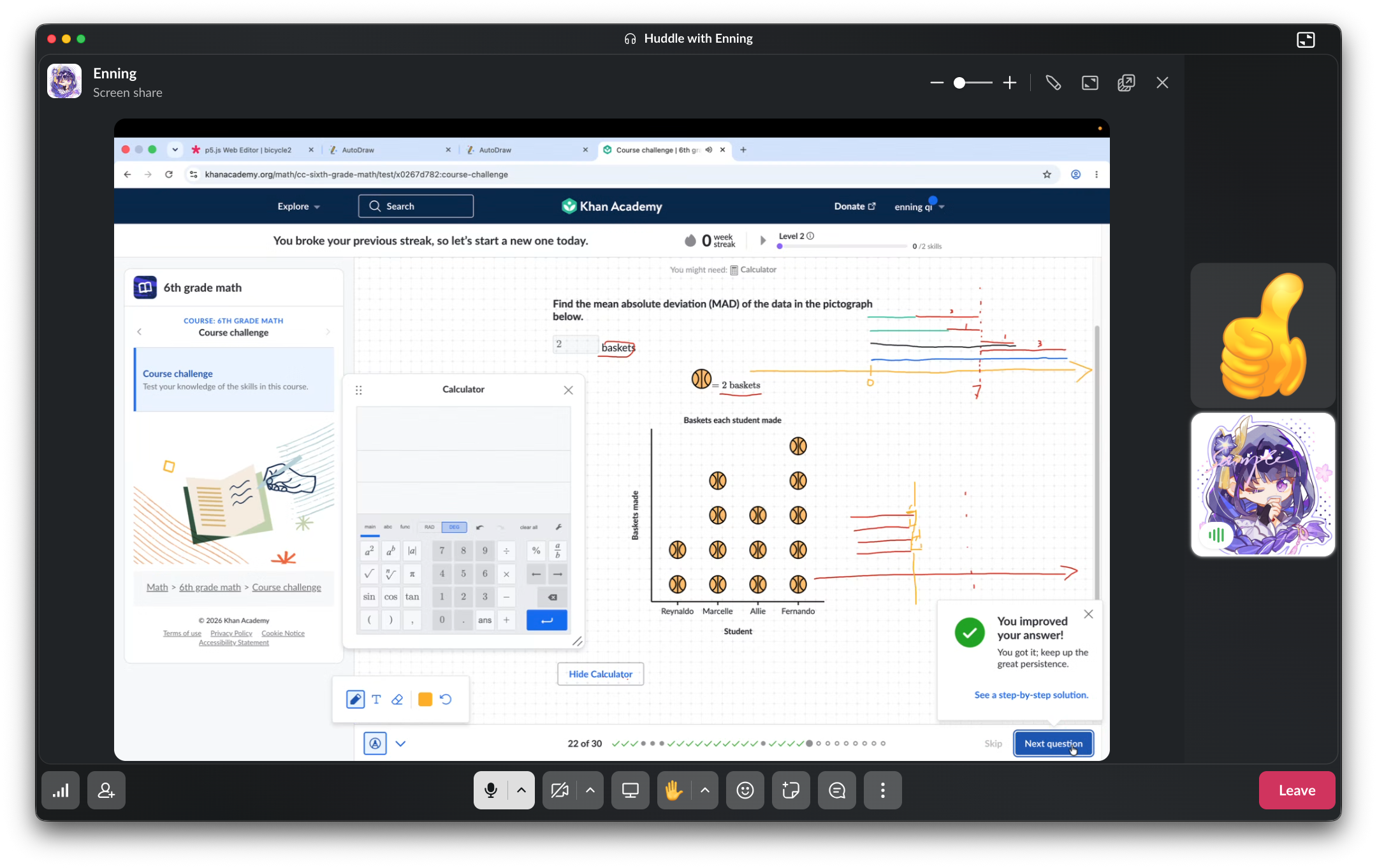
Enning encountered mean absolute deviation (MAD), an unfamiliar concept. There was no rush. Step by step, with carefully drawn diagrams, she learned what the distance from the mean meant and how those distances become MAD.
Then came the traps.
Four people all score 80.
“What is the average?”
“80!” she answered loudly.
She had initially drawn the mean line near 90.
“Oops.”
Then four scores were arranged symmetrically around the mean: two one unit below and two one unit above.
“What is the MAD?”
“0.”
The drama queen had fallen into the trap again. 😂
But now the mistake was useful. She was learning the difference between deviations canceling out and absolute deviations remaining positive.
The concept was becoming hers.
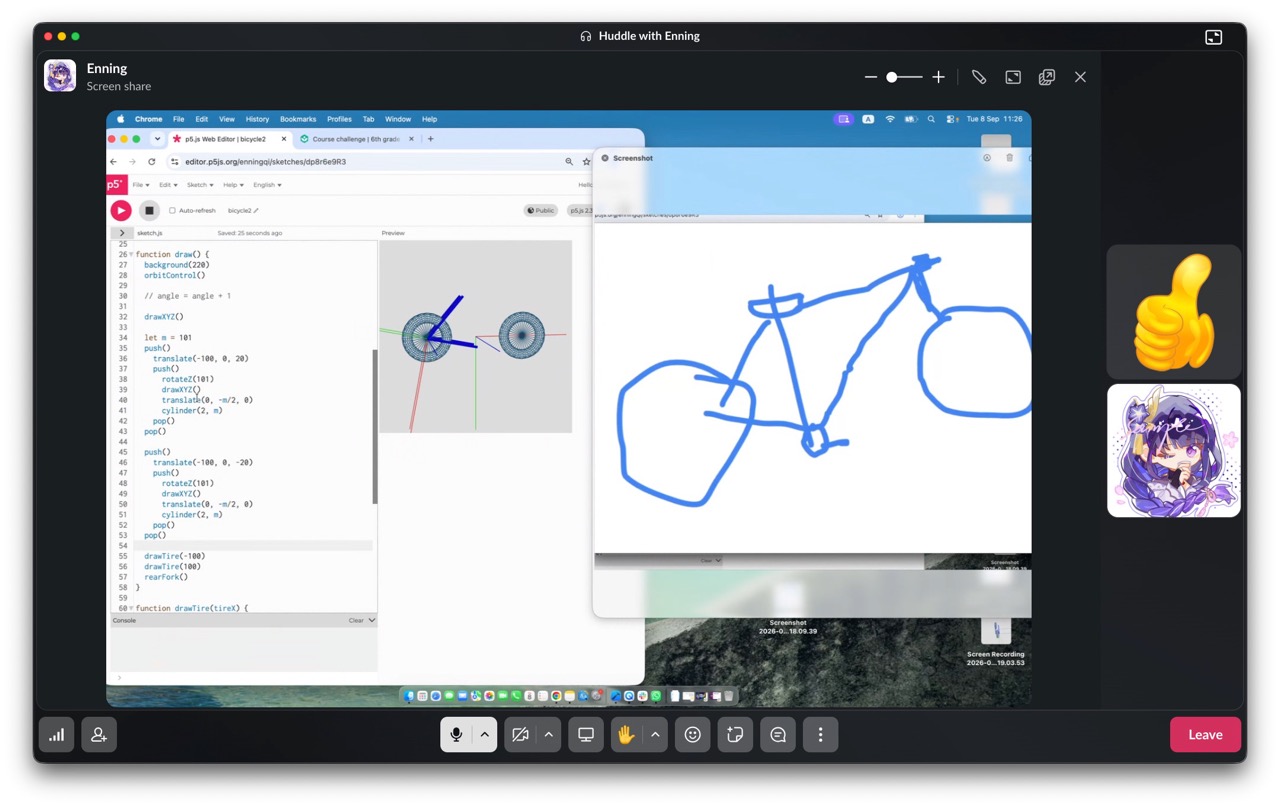
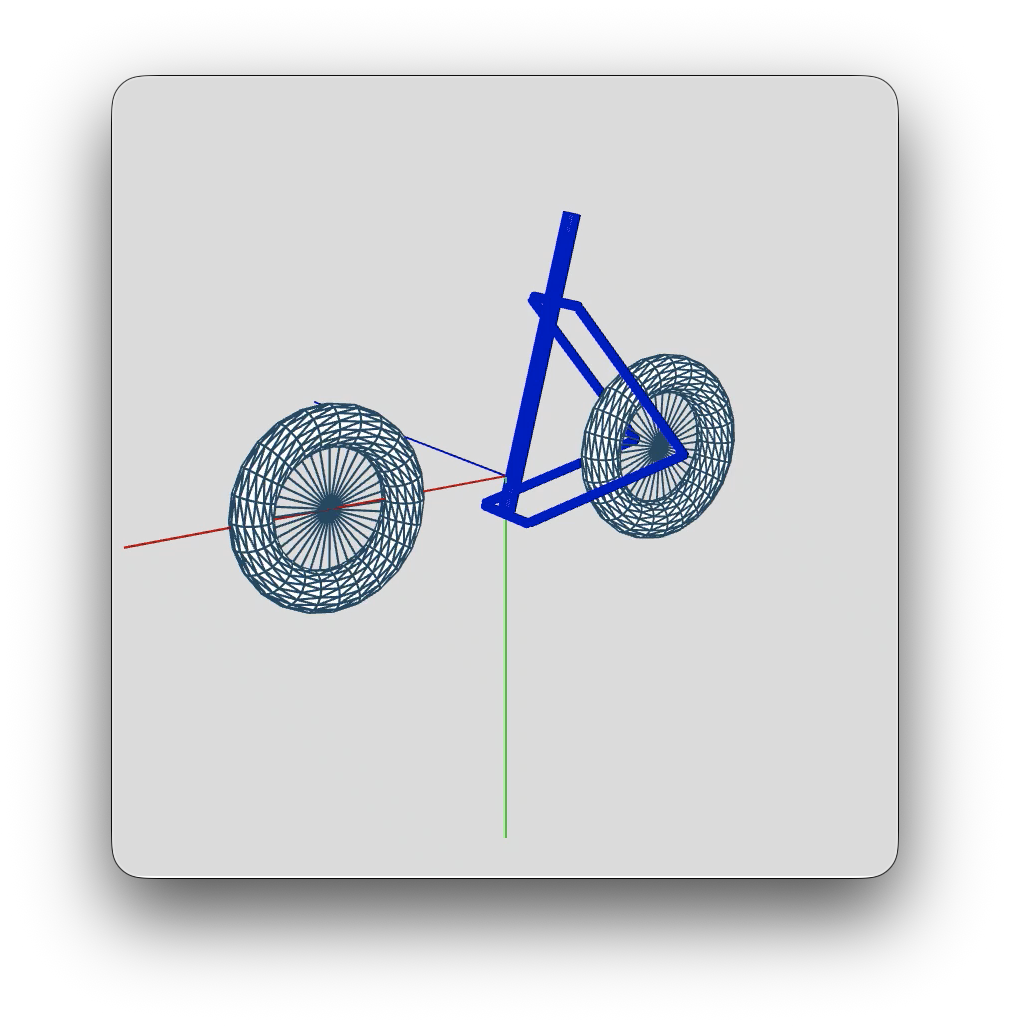
The second half moved into her 3D spinning bike.
Enning could now identify two different XYZ coordinate systems on the same canvas, even when some axes visually overlapped.
Then she faced something new: the short connection bar needed a transformation she had not used for that part before.
This time, it was rotateX() instead of rotateZ().
She got it right on her own.
Donald teased her:
“How much confidence do you have to put this connection bar in place—80%, 60%, or 40%?”
Enning immediately fired back:
“20%.”
😂
Twenty percent confidence.
Correct answer.
Beautiful bar.
And then the animation returned.
The line
angle = angle + 1
had been commented out while other parts of the bike were being developed.
At the end of class, Donald noticed it.
“Let's uncomment this line.”
Then he remembered:
“Oh, it lets the two wheels spin.”
“Why not?” Enning replied.
They agreed that every demonstration video should let the finished bike actually move.
The bike spun.
And when Donald said,
“When I watch the demo, I am 心花怒放. What about you?”
Enning simply answered:
“心花怒放.”
The most important thing Enning learned today was not MAD, rotateX(), or 3D transformations.
She learned something about herself:
Difficult and unfamiliar does not mean impossible.
She can slow down and learn a new mathematical idea.
She can reason about coordinate systems that initially look confusing.
She can discover how a new rotation works.
She can turn several simple geometric pieces into a coherent object.
She can make the object move.
And she can look at what she made and feel 心花怒放.
There is still a funny little “carefulness” problem.
At 8:03, Donald saw a new one-second demo clip in Slack.
“I saw the new one. So great!”
Enning:
“弄错了.”
😂
Apparently, the gorgeous finished homework had been accompanied by the wrong clip.
The product was excellent.
The submission workflow still needs work.
That's okay.
Craftsmanship is not the absence of mistakes. It is caring enough to notice them and improve the work.
A learner who once looked “hopeless” can learn unfamiliar mathematics, master new 3D transformations, build a beautiful animated object, and become increasingly willing to challenge herself.
Slow down. Draw it. Ask questions. Let mistakes surface. Don't trust apparent understanding too quickly. Give her ownership. Let her try. Let her correct herself. And, importantly, let her have fun.
Because the goal isn't merely to produce correct answers.
It is to help a young person enter a new country, a new school chapter, and a new life with the growing belief:
“I can learn.”
And perhaps even better:
“I like learning.”
Curator's Note
Five weeks ago, the label might have been “hopeless.”
Today, at 4:48 a.m., the supposedly hopeless learner asked for a class.
By tea time, she had learned MAD, survived several traps, solved a new 3D transformation, finished a gorgeous bike, and watched it spin.
Then she and her tutor looked at the result and independently arrived at the same word:
心花怒放.
The calendar says two hours.
The exhibit says something much larger.