
Living Museum of Learning
Albert Went Looking for the Hidden Hexagon
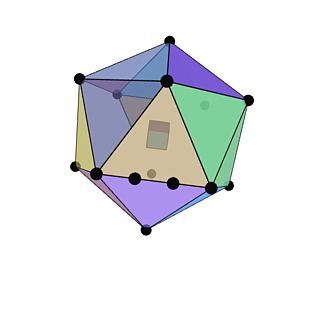
Albert had been working on a colorful icosahedron in p5.js.
It had taken him quite a journey.
He had struggled with assigning colors to the 20 faces. He suspected that his color array might be the problem. Later, when some triangles looked darker than others, he didn't just accept the mystery. He commented out code, traced the vertices, and finally exclaimed:
“Aha, I drew that face 3 times.”
When Donald asked for evidence, Albert pointed directly to the repeated face:
1, 8, 10
He had found the bug himself.
Near the end of the hour, his colorful icosahedron was finally spinning beautifully.
And then Donald gave him a new question:
What is the connection between this solid and a soccer ball?
Albert was supposed to think—or guess.
Instead, he started searching online.
Donald wanted to stop him.
Albert knew exactly why:
“I just wanted to see the image.”
😂
Unfortunately, the internet did not cooperate with his carefully limited request.
The page showed him the answer he might otherwise have discovered himself.
“Oops.”
Too late.
Albert had seen it.
But Donald didn't turn that into a failure.
“That's OK. Now let's figure out where do those pentagons and hexagons come from.”
The pentagon was easy.
Albert had just seen the answer. 😂
But then came the interesting question:
Where is the hexagon?
It wasn't obvious.
The hexagon was hiding inside the original icosahedron.
Albert thought for several minutes.
Donald gave him one small hint:
“If you make your pentagon smaller you might be able to find the other shape easier.”
Albert checked the soccer-ball image one more time.
And there it was.
The missing shape.
Now seeing the answer was no longer enough. He had to figure out how to construct it from the icosahedron he had already built.
The class was extended so he could calculate and plot the first new point.
Except Albert didn't make one.
He made two.
push();
translate((p[1][0]+2*p[2][0])/3,
(p[1][1]+2*p[2][1])/3,
(p[1][2]+2*p[2][2])/3);
sphere(5);
pop();
push();
translate((2*p[1][0]+p[2][0])/3,
(2*p[1][1]+p[2][1])/3,
(2*p[2][0]+p[2][1])/3);
sphere(5);
pop();
Very Albert. 😂
He had gone from looking at a finished soccer ball to calculating new points on the edges of his own icosahedron.
The internet had shown him the destination.
But it hadn't shown him the road.
There is a funny misconception about learning:
seeing an answer means you know the answer.
Albert's experience showed otherwise.
He saw the pentagon.
That was easy.
The hexagon was still hidden.
He saw it after changing his viewpoint.
Then came the harder question:
How do those new vertices actually arise from the old ones?
And that question brought him back to his own model.
The same Albert who had earlier traced a duplicated face, found evidence in his own code, and fixed his model was now beginning to reverse-engineer the geometry of the soccer ball from first principles.
Even the optional semicolons he added later belong to this story.
The program already worked.
He came back anyway to make the code cleaner.
That tiny act said something important:
The code was becoming his.
By the end of the hour, Albert hadn't simply copied a soccer-ball model from the internet.
He had:
built an icosahedron → debugged it → colored it → owned it → glimpsed the answer → found the hidden hexagon → started constructing its new vertices.
The spinning object on his screen was no longer just an assignment.
It had become something he wanted to understand.
A finished object can become the starting point for discovering the structure underneath it.
Build, test, trace, look again, and turn visual clues into your own construction.
Even when curiosity takes a shortcut, genuine understanding can still begin where the shortcut ends.