
Living Museum of Learning
Enning Is Back
Today I let Enning watch Sal teach fraction addition with beautiful section diagrams and lots of details. I wanted her not only to understand the mathematics, but also to see how a good mathematical diagram is constructed.
Then came something very strange.
In the follow-up practice, the problems contained fractions such as 2/6 and 1/7. But when Enning started drawing her diagrams, she sometimes divided one of the sections into 5 parts. Another time she used 4 parts.
There was no 5. There was no 4. Nothing in the problem called for either number.
I couldn't understand where they had come from.
I stopped her and asked what she was doing. She wasn't sure.
I asked, “Are you sleepy? Or tired?”
“No.”
“Maybe sleepy?”
She wasn't sure.
So I asked, “When did you go to sleep? And when did you get up?”
“10 and 8.”
“10 hours is enough for even babies,” I said.
She laughed and agreed: “Right, no, I am not sleepy.”
“OK, good. Let's focus on our problems then.”
I made her run around the table to wake herself up before continuing. Whatever had happened, her brain had apparently started executing the drawing procedure without checking what the actual problem said.
But there was another, much bigger problem.
Her diagrams were careless.
When she drew two wholes, they were not even the same length. The sections were uneven. She could produce something that looked approximately right and move on.
I simply said:
“Redraw please.”
She didn't.
“No, redraw.”
Still no.
“No, no, redraw!”
This time I made her change it.
I also showed her a more convenient way to divide a whole into sevenths: instead of struggling to place all the 1/7 marks independently, draw the 3/7 line first and use the structure to make the remaining divisions easier.
For the 1/3 line, she redrew it at least ten times.
Again.
And again.
And again.
About ten minutes later, something changed.
The drawings were becoming genuinely good.
Her hand drawing was no longer worse than Sal's.
I looked at them and said:
“Look at these. So elegant.”
And I suspect Enning admired them too.
This was not simply a matter of making a fraction diagram more accurate. She had just experienced something important: she could look at her own work and see quality in it.
I told her:
“Donald is trying his best to help you, but if you don't help yourself, no one would care either. You treated yourself poorly. Treat yourself better, OK?”
I wasn't asking her to be perfect.
I was asking her to care enough about herself and her own thinking to make her work better.
Then we moved on.
Her homework code was:
let x = 128 // x <= 135
function setup() {
createCanvas(500, 500);
frameRate(7)
}
function draw() {
background(220);
x = x+1 // x <= x+1
if(x > 250) {
x = -255
}
fill(x, 0, x)
circle(250 - x, 250 - x, 100);
circle(250 + x, 250 + x, 100);
line(50, 450, 250-x, 250-x);
line(50, 450, 250+x, 250+x);
}
Her task was to add another variable controlling the size of one of the circles.
She had some fun with it.
That mattered. After all the forced redrawing and careful fraction work, we were back to playing with an idea: a variable changes a property of an object, and the computer makes the change visible.
Then I decided it was time for Enning to meet 3D.
We opened Desmos, the best tool for this kind of first encounter.
Little by little, she became comfortable with X, Y, and Z and with the idea that a point in space needs three coordinates.
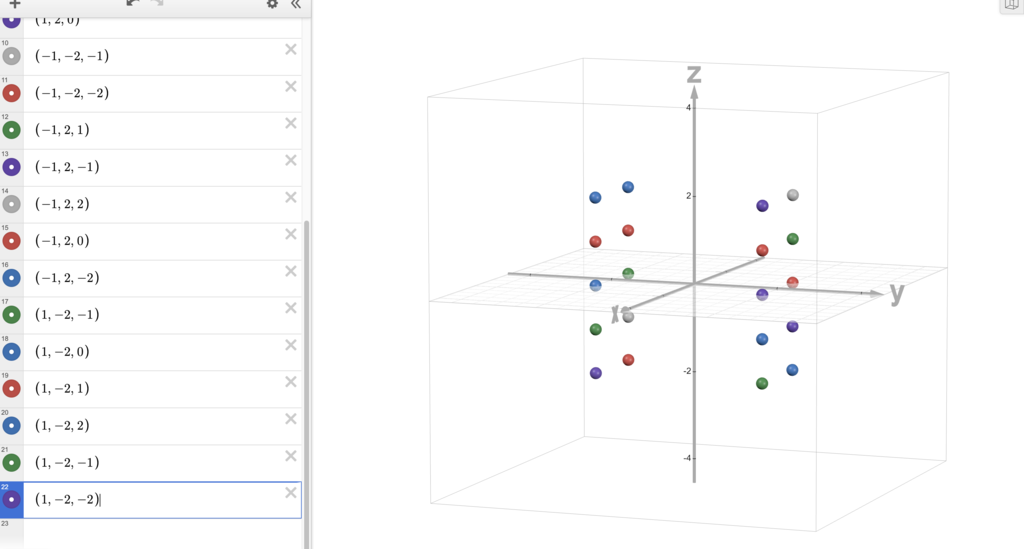
Soon she had created a gorgeous symmetric arrangement of colorful balls:
(1, 2, 1)
(1, 2, -1)
...
(-1, -2, 1)
I had given her a challenge, and she found the missing point (-1, -2, 1) herself. Very good.
Then we noticed something else.
We had missed the pair of points on the ground.
This time Enning didn't need me to tell her what to do.
She knew how to add them:
(-1, -2, 0), ...
The structure itself was beginning to tell her what was missing.
The class eventually extended about 30 minutes beyond the planned time.
For homework, I asked her to add another two poles in space, passing through the empty 2nd and 4th quadrants of the X-Y plane.
And then something wonderfully Enning happened.
Before I even had a chance to write the homework down for her family, she had already posted the finished result.
Four poles. Done.
Today's lesson was not really about one fraction technique, one coding trick, or one Desmos construction.
It was about recovering the connection between attention, effort, quality, and confidence.
At the beginning, Enning could mechanically reproduce part of what she had just seen without checking whether the numbers belonged to the problem at all. Five and four appeared from nowhere. She wasn't even sure why.
Then she learned that a diagram deserves another look.
If two wholes are supposed to represent the same whole, they should look the same.
If a whole is divided into sevenths, the seven sections should actually be seven equal sections.
If the line isn't good enough, redraw it.
If it still isn't good enough, redraw it again.
And after ten or more attempts, something wonderful happened: the quality became visible to her.
From there, the same student could move into code, play with variables, enter three-dimensional space, recognize symmetry, discover missing points, and finish a new spatial construction independently.
The deepest change was not that Enning became more careful because Donald told her to be careful.
It was that she experienced herself becoming better through her own effort.
Carefulness became something she could do, rather than a label attached to her personality.
And when she finished the four-pole homework completely on her own, I didn't give another lesson.
I simply had to send:
“Nice job! Enning.”
She replied with her huge smiley, like always.
That smiley said enough.
Enning is back.
More confident. More engaged. And, most importantly, happier to be learning again.