Living Museum of Learning
Three Weeks Later, She Went Looking for the Next Problem
Only three weeks ago, Tianjing was struggling with something surprisingly fundamental: she couldn't reliably do even the Grade 2 Khan Academy math challenge, largely because she couldn't read the English questions.
Donald began working with her every day, rebuilding her confidence and mathematical foundation rather than rushing ahead.
The progress quickly became visible.
She moved through Khan Academy one grade at a time.
She reached Grade 4 and got 27/30, then improved to 29/30.
She reached Grade 5 and got 26/30 on her first attempt.
Then Grade 6.
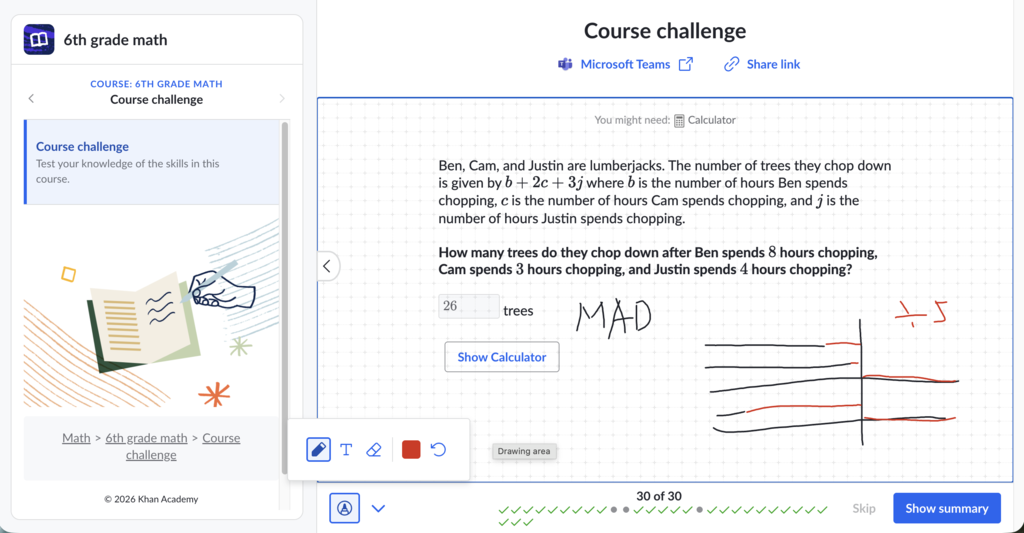
On August 25, after working carefully and patiently through all 30 problems—many of them substantially longer—she finished with 28/30.
The class lasted about 1 hour and 45 minutes, the longest class they had had so far.
She was tired.
Then, instead of simply asking whether class was over, she gently asked:
“homework?”
Donald asked whether she remembered the previous homework: find the maximum of an array.
“Yes.”
“Find the minimum?” she guessed.
“No,” Donald smiled. “That'll be too easy for you.”
Her new homework:
Find the 2nd largest number in an array of random numbers.
But the most interesting part of the day had already happened outside Khan.
The previous day's homework was the 3rd DMOJ problem.
Tianjing completed it.
Then she did something Donald hadn't asked her to do.
She kept going.
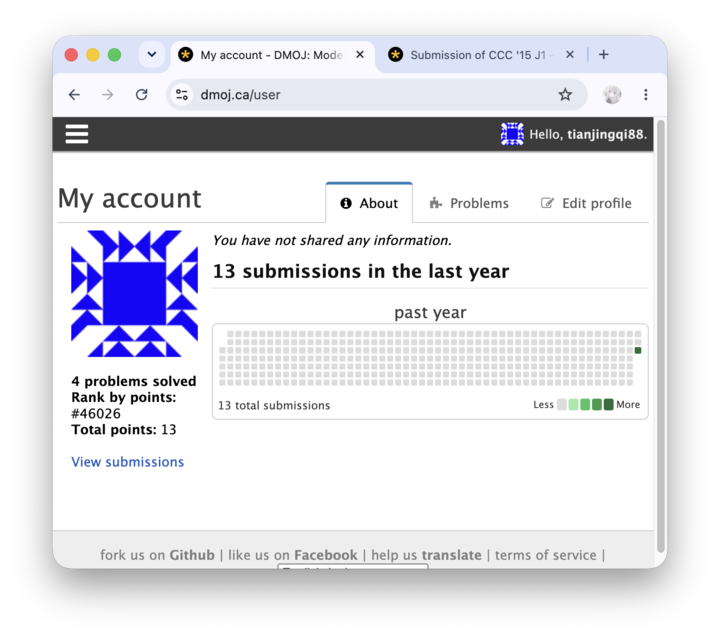
She independently attempted DMOJ Problem #4.
Her logic was correct.
The code, however, had small execution errors:
print("before") instead of print("Before")
and a typo such as:
mouth instead of month
The latter was essentially one letter flipped.
These were not conceptual failures.
The algorithmic thinking was there.
The computer was simply less forgiving than her brain.
And that distinction mattered.
Instead of needing someone to supply the logic, Tianjing had reached the stage where she could figure out the logic herself and debug the translation into code.
Her DMOJ ranking reflected the progress too.
In roughly one day, she moved from around 78,000 to nearly 49,000 after solving the fourth problem.
She was no longer merely completing assigned work.
She was starting to look for the next problem.
The DMOJ progress was only one part of a much larger pattern.
Tianjing encountered a completely new mathematical concept:
MAD — Mean Absolute Deviation.
She learned what it meant and how to work with it.
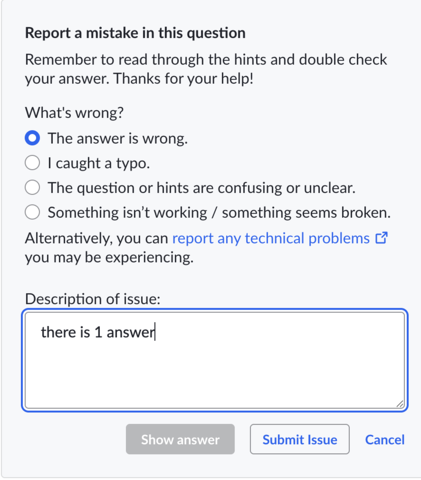
She also found a bug in Khan Academy.
That detail was especially interesting.
A student who is merely following a platform tends to assume:
“If Khan says it, it must be right.”
A student who is beginning to think independently can reach:
“Wait. This doesn't look right.”
And check.
Meanwhile, her mathematical English was changing just as rapidly as her mathematics.
Three weeks earlier, English itself was preventing her from accessing Grade 2 math.
Now she was reading longer Grade 6 questions, working through them carefully, learning new terminology, and finishing an entire 30-question challenge.
Her progress was no longer simply catching up.
It was becoming acceleration.
The most revealing contrast is between what Tianjing was asked to do and what she chose to do.
Her assigned DMOJ homework was Problem #3.
She solved #3.
Then she tried #4.
The fourth problem was not perfect.
But its imperfections were exactly the kind we want at this stage:
The thinking was ahead of the code.
A capitalization error.
A one-letter typo.
Broken syntax in places.
These are repairable.
What matters more is that the student had already constructed the solution in her head.
The same pattern appeared in mathematics.
She wasn't merely completing Khan questions. She was encountering new concepts, testing her understanding, noticing anomalies, and continuing after the assigned endpoint.
And after a long Grade 6 class, she still asked:
“homework?”
That tiny question may be the most important artifact of all.
Three weeks earlier:
“I can't read the question.”
Three weeks later:
“What's the next problem?”
A student who initially struggles with Grade 2 math because of English can, within three weeks, reach Grade 6, 28/30, learn new mathematical concepts, solve DMOJ problems, and begin working beyond the assigned task.
Rebuild the foundation, work every day, increase difficulty gradually, let the student encounter genuinely new ideas, and give her enough room to continue beyond the minimum when curiosity takes over.
The goal isn't simply to move a student from Grade 2 to Grade 6. The deeper transformation is from “Can I do this?” to “What else can I try?” Once a learner starts solving the next problem before being asked, education begins to become self-propelled.