
Living Museum of Learning
The Problem Is Not Math
2026.08.20.
Two weeks ago, Donald and Tianjing tried Grade 2 mathematics on Khan Academy.
They stopped shortly afterward.
Not because the mathematics was too difficult.
Tianjing simply couldn't understand the English sentences well enough. She didn't yet know how to use a dictionary efficiently, and even a Grade 2 math problem could become an English-language wall.
Yesterday, something very different happened.
Tianjing passed Grade 2 with 27/30.
Donald looked at the result and said:
“Not bad. The US coin problem doesn't count.” 😂
Tianjing looked at her own mistakes and said:
“The mistakes are too many.”
That was already a remarkable change.
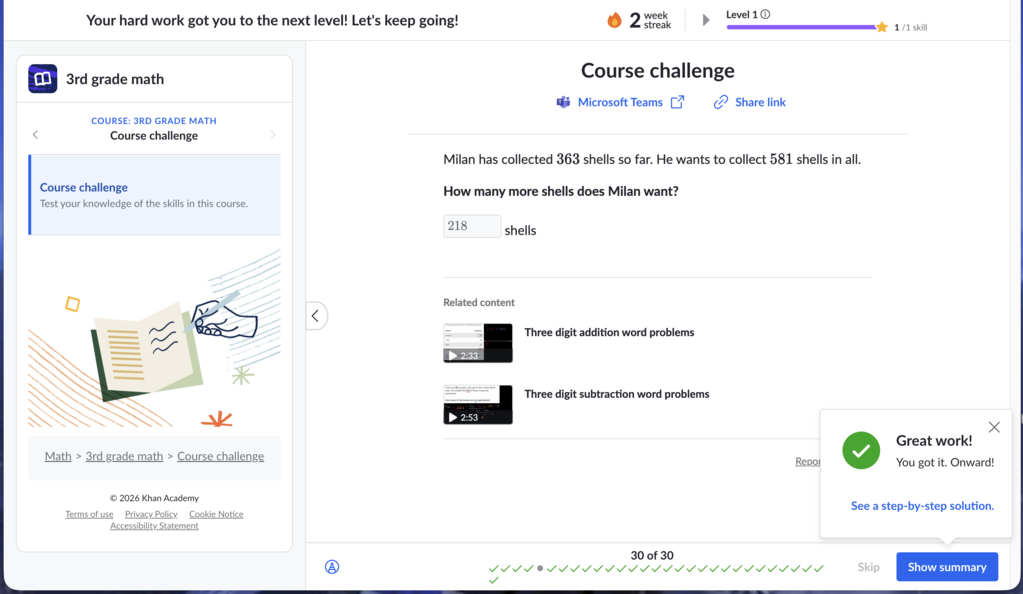
Today, Donald started Grade 3.
As usual, he said:
“Try to get 29 out of 30.”
Tianjing smiled.
Donald could read perhaps 80% confidence in that smile.
And then she actually got:
29/30
Donald said:
“It's not that easy, right?”
Tianjing:
“No, not easy.”
There was a little release in her voice.
She had just discovered something important:
29/30 doesn't mean the problems were easy.
It means she could handle problems that weren't easy.
Then Donald said:
“Let's try a bit of Grade 4 to see how hard it is. We'll move onto it anyway.”
And Tianjing said something that Donald will probably remember for a very long time:
“It shouldn't be a problem, if I understand the problems.”
This was the girl who couldn't get through Grade 2 math in English two weeks ago.
Now she was talking about Grade 4 mathematics with confidence.
Donald had told her before:
We are actually learning English through simple math.
So he replied:
“Then try to understand each problem.”
After several Grade 4 problems, Donald stopped the math.
It was time for something more fun.
Coding.
Tianjing had already drawn two full stars in her Chinese chessboard project, but the code was still a beautiful mess of repeated line(...) statements.
Sixteen lines of drawing instructions.
Then Donald created a tiny new p5.js project.
And deliberately removed:
createCanvas(...)
😂
The purpose was no longer to make a beautiful picture.
It was to learn functions.
They played with simple ideas:
printHello()
printMessage(...)
sumOf(n1, n2)
productOf(n1, n2)
A function became a little tool.
Then Donald said:
“Let's go back to create a tool function to draw stars.”
They took those complicated star-drawing instructions and put them inside:
function drawStar(col, row) {
...
}
Suddenly, the whole Chinese chessboard could say:
drawStar(1, 2);
drawStar(7, 2);
drawStar(2, 3);
drawStar(4, 3);
drawStar(6, 3);
drawStar(1, 7);
drawStar(7, 7);
drawStar(2, 6);
drawStar(4, 6);
drawStar(6, 6);
The third time Tianjing called drawStar(...), she couldn't help herself.
She said:
“太厉害了。”
“That's so amazing.”
And that may have been the real highlight of the day.
Two weeks ago, Tianjing faced a Grade 2 math problem and couldn't get through the English sentence.
Today:
Grade 2 → 27/30
Grade 3 → 29/30
Grade 4 → “It shouldn't be a problem.”
English → becoming a tool instead of a wall
Coding → from zero experience to functions and reusable tools
But there is something deeper connecting all of this.
Donald isn't trying to make her memorize more mathematics.
He is helping her discover:
If I understand the structure of the problem, I can handle it.
That applies to English.
It applies to mathematics.
It applies to programming.
And perhaps most importantly, it applies to herself.
Two weeks ago, she didn't yet know what she could do.
Today, she is beginning to find out.
And I suspect “太厉害了” — “That's so amazing” — may stay with her for hours.
Maybe days.
Maybe much longer.
Because for the first time, she wasn't merely watching someone else do something amazing.
She had just made the computer do something amazing herself.