
Living Museum of Learning
The Message That Came From the Other Side of the World
Two weeks ago, Enning's father contacted Donald and asked if he could help her younger sister rebuild her confidence after coming to a new country.
Within three days, Donald saw the younger sister begin to change.
Then he learned that Enning, the older sister, had not been able to enter the local Grade 9 high school that her younger sister had entered. Donald gently asked her father:
“Can I also give the older sister some help?”
At that moment, Donald didn't even know her name.
When Enning's first lesson began, her first words to Donald were:
“I'm not good at logical reasoning.”
It was a heartbreaking label for a young person to carry.
But over the following days, something began to change.
Enning didn't simply start doing schoolwork.
She started doing things she had not believed she could do.
She cracked difficult 24 puzzles.
She built her first iOS app, 24 Game.
She created surprising p5.js code and artwork.
She began practicing typing on TypingClub.
She started learning mathematics on Khan Academy.
Most importantly, she began to recover something deeper than a skill:
confidence in herself.
Then came an unexpected moment.
Enning's p5.js work was posted on LinkedIn, where Joe DeNavas, a code artist whose p5.js artwork has been exhibited around the world, noticed it.
He left a message specifically for her:
“Please tell Enning ... amazing job on her sketch, figuring things out what to do, and to never stop believing in herself!”
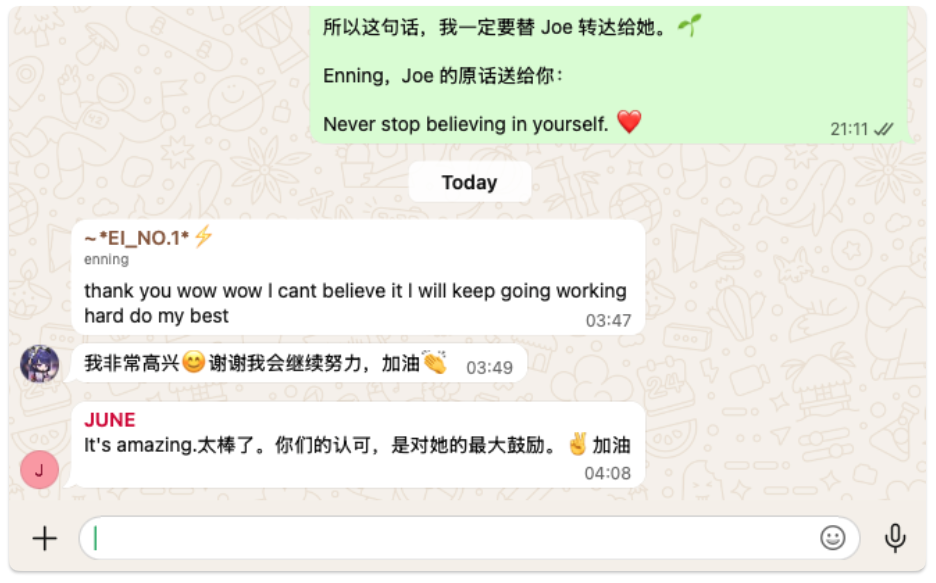
Donald translated Joe's message and sent it to Enning.
Her reaction was immediate:
“thank you wow wow l cant believe it l will keep going working hard do my best”
A few minutes later, she wrote:
“我非常高兴😊谢谢我会继续努力,加油👏”
Two weeks earlier, Enning had introduced herself with:
“I'm not good at logical reasoning.”
Now she was saying:
“I will keep going.”
The transformation is not that she suddenly became a different person.
Perhaps she was always capable.
What changed was that she began to see her own capability.
And then, unexpectedly, someone from the wider world saw it too.
Confidence is not rebuilt by telling someone, “You are smart.”
It is rebuilt through experience:
Try → struggle → figure something out → succeed → try something harder.
Then, occasionally, another person comes along and says:
“I saw what you did.”
Joe's message mattered because he recognized exactly the part of Enning's work that mattered most—not merely the finished picture, but her figuring things out for herself.
A young person can change dramatically when she begins experiencing her own ability to learn.
Through small challenges, persistence, independent discovery, and meaningful recognition—not through empty praise.
Because sometimes the most important thing education can give back to a learner is not another answer, but the belief: “I can figure this out.”