
Living Museum of Learning
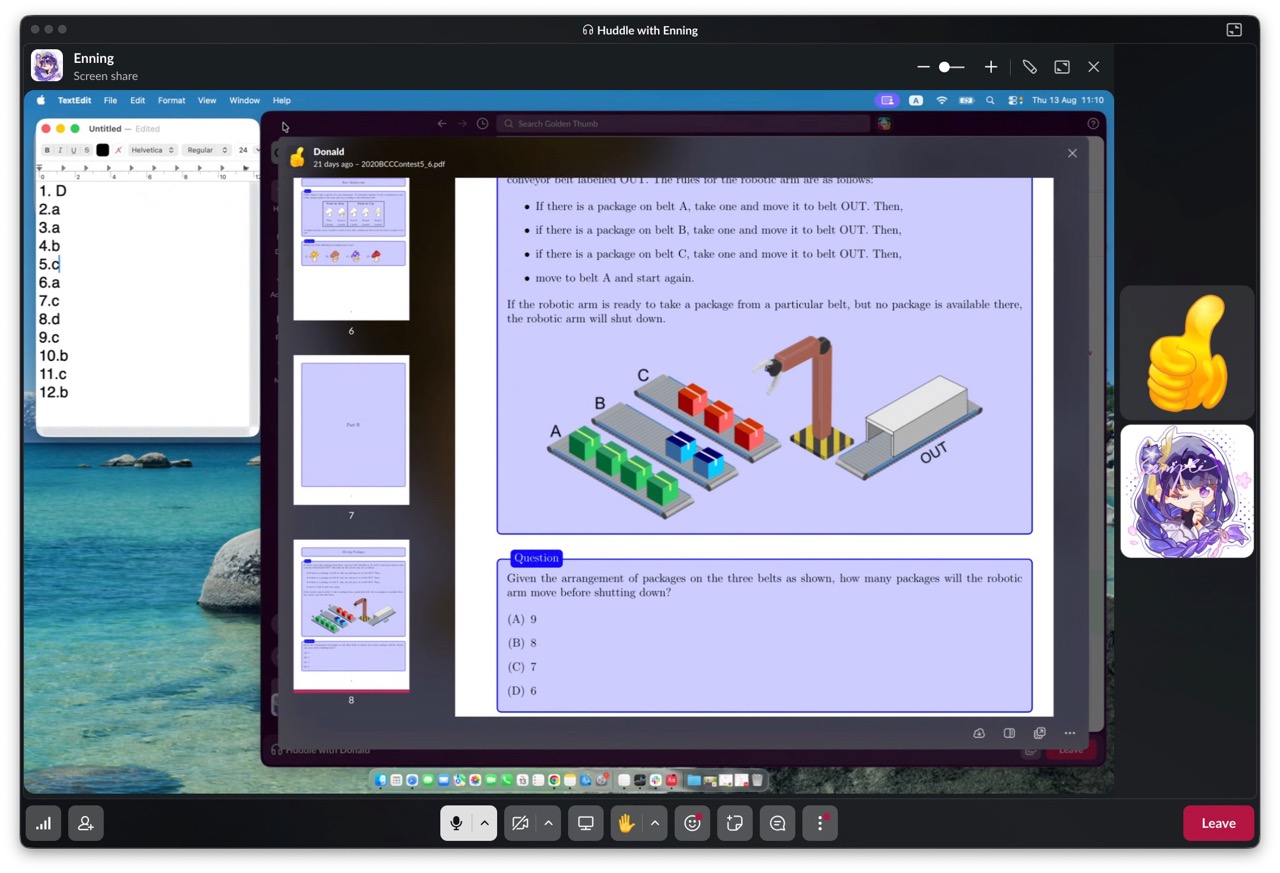
8/12 — Then 12/12
Enning had never done the Waterloo Beaver Computer Challenge before.
Her educational journey had been interrupted, and she had only spent about two months in an English-speaking local school.
English was still a significant obstacle.
But Donald wanted to see what would happen if she simply tried.
So he gave her the 2020 Beaver Computer Challenge for Grades 5–6: twelve problems involving reading, reasoning, patterns, algorithms, and problem solving.
No special preparation.
Just try.
On her first round, Enning got:
8 / 12
Not bad at all.
But the score wasn't the most interesting part.
She went back and reviewed her work.
She corrected three of her four mistakes herself.
Only one remained.
And that last problem turned out to be genuinely tricky.
It involved a robotic arm moving between conveyor belts.
Enning understood when the middle belt became empty: when the arm took the last package.
But the question was asking something subtly different:
When does the arm next arrive and find the belt empty?
The state changed at one moment.
The robot observed that state at a later moment.
Donald didn't simply give her the answer.
He told her:
“Go to the first one in Part B. Take your time.”
They eventually worked through the last one together.
8/12 became 12/12.
But this was not really a story about getting a perfect score.
It was a story about what happened between the two numbers:
8 → review → self-correction → careful rereading → reasoning together → 12
And Enning did it happily, lightly, without treating mistakes as something embarrassing.
That matters.
A week earlier, she had told Donald:
“I'm not good at logical reasoning …”
Now she had concrete evidence from her own experience that the statement was not a very good description of herself.
A score can measure an answer.
The process reveals a learner.
Enning demonstrated:
curiosity
persistence
reasoning
careful rereading
self-correction
willingness to ask for help
willingness to keep going despite English difficulties
And there was another small but important lesson.
When an unfamiliar English word such as “piles” appeared, Donald didn't translate the whole problem for her.
He showed her how to think about the word:
piles → pile + s
Look up the useful base word.
Keep going.
The English obstacle did not have to become a reasoning obstacle.
Why This Matters
For a student who has only recently returned to an English-speaking school, 8/12 on the first round is meaningful.
But 12/12 after reviewing and reasoning through the mistakes is even more meaningful.
Not because 12 is better than 8.
Because Enning discovered something about herself:
“I can do this.”
And perhaps that is the real result of the Beaver challenge.
Not a score.
A new estimate of the learner.