Living Museum of Learning
Oh, Yeah! — From Golden Rectangles to an Icosahedron
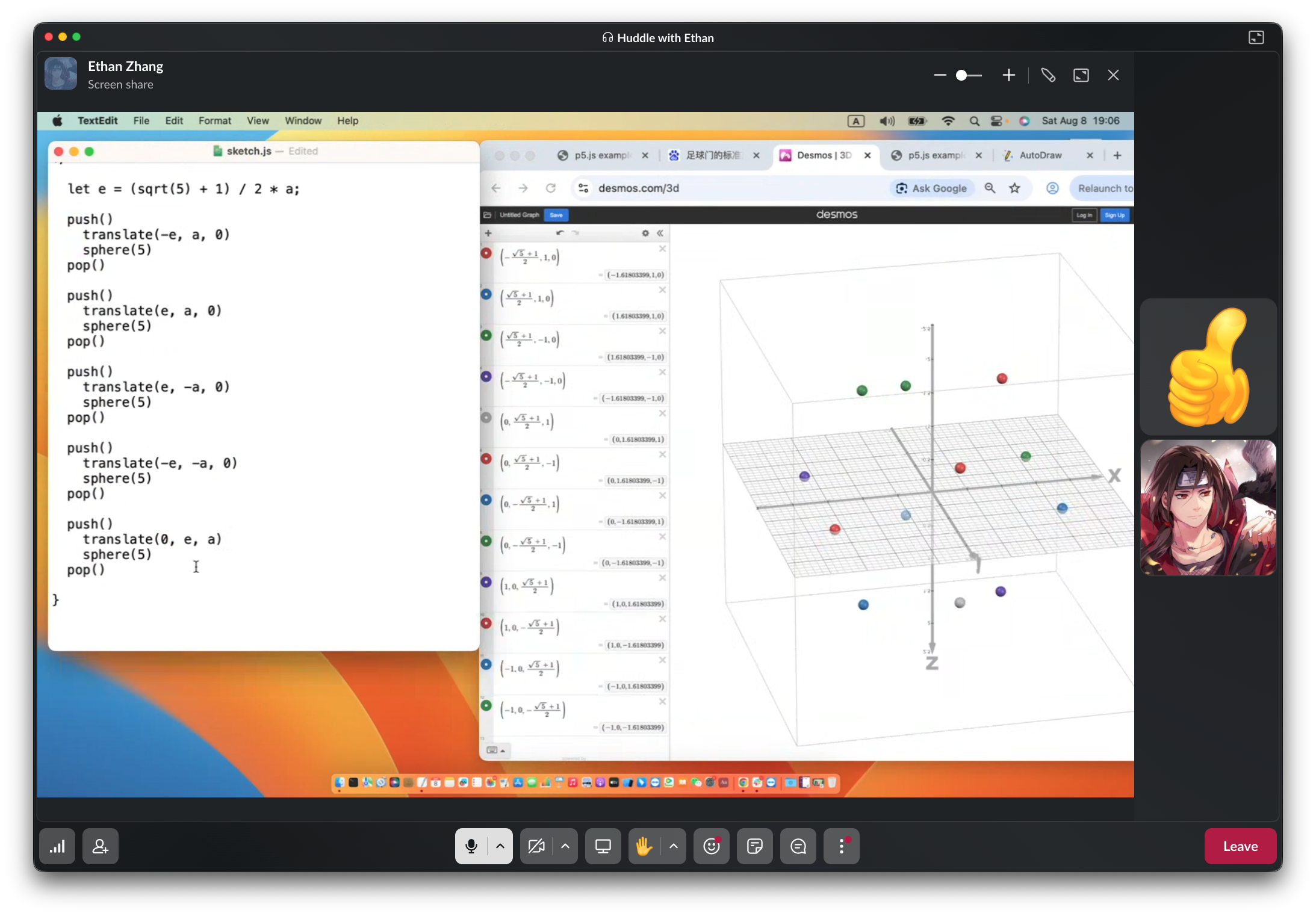
Last time, Ethan used three golden rectangles in Desmos to visualize the 12 vertices of an icosahedron. Today, he migrated those same mathematical coordinates into his own p5.js program, turning geometry into executable code.
Donald suddenly asked: “What if we connect them with lines? Do we get an icosahedron?”
Ethan immediately lit up:
“Oh, yeah!”
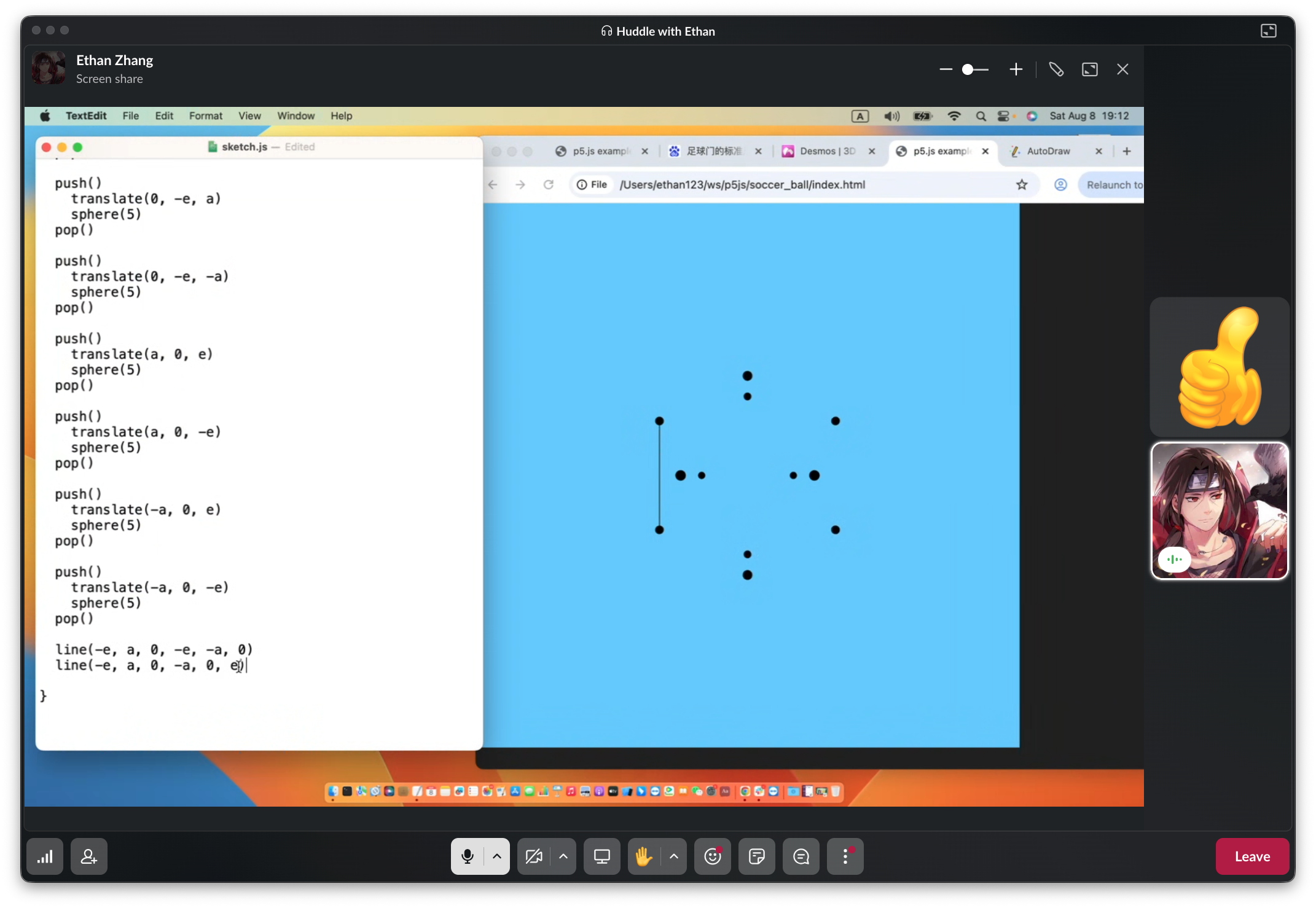
The question transformed twelve isolated points into a network of relationships. Ethan began explicitly connecting the vertices with lines, reconstructing the edges of the solid himself.
The 12 vertices, generated from the golden-ratio geometry, became a rotating 3D icosahedron in p5.js. Ethan could now see, manipulate, and program the mathematical object he had previously explored in Desmos.
Near the end of class, Ethan received an unexpected message from school: two days of classes were cancelled because of a hurricane broadcast.
His reaction was not simply excitement about having no school.
“Uncle, a good news! I just got a msg from school that I have 2 free days because of the hurricane broadcast. So I can keep playing with this.”
The icosahedron had become something he wanted to keep exploring on his own.
Mathematics can move through representations: from golden rectangles, to coordinates, to points, to edges, to a three-dimensional object, and finally to an interactive program.
The deeper shift is from seeing a mathematical object to constructing one.
When students begin saying, “I can keep playing with this,” learning has escaped the classroom.
A learner can turn abstract coordinates and the golden ratio into a living, rotating 3D mathematical object.
Move between representations, ask one powerful question, and let the learner discover the connection between points, edges, geometry, and code.
The ultimate goal is not merely to reproduce an icosahedron. It is to reach the moment when a student wants to keep exploring the idea without being asked.