
Living Museum of Learning
The Smile Behind the Code
I met Tianjing only two days ago.
I still don't know what she looks like.
But I know her smile.
For sixty-five minutes during our 2nd lesson, I heard it again and again.
She had no programming experience. She had never learned touch typing. Every command-line tool was new to her.
She had to cross one unfamiliar doorway after another:
pwd
ls -l
cd
the mysterious vi editor
python3
Python turtle
Xcode
the iOS Simulator
To an experienced programmer, these are ordinary tools.
To her, each one was an unexplored world.
Her first project was a pentagram.
She completed it herself.
After class, I suggested another challenge:
"Can you try drawing a regular pentagon?"
"And a regular hexagon."
The next morning she proudly replied:
"我五边形和六边形做好了。"
Then she shared her work in our Slack group with the other children.
That simple act transformed the meaning of the project.
She was no longer completing an assignment.
She was sharing something she had created.
Around the same time, she also completed her very first iOS drawing program using Swift and UIKit. A few lines of code became a square on the screen.
To most programmers, it was a tiny program.
To a beginner, it was a new universe opening.
Discovery
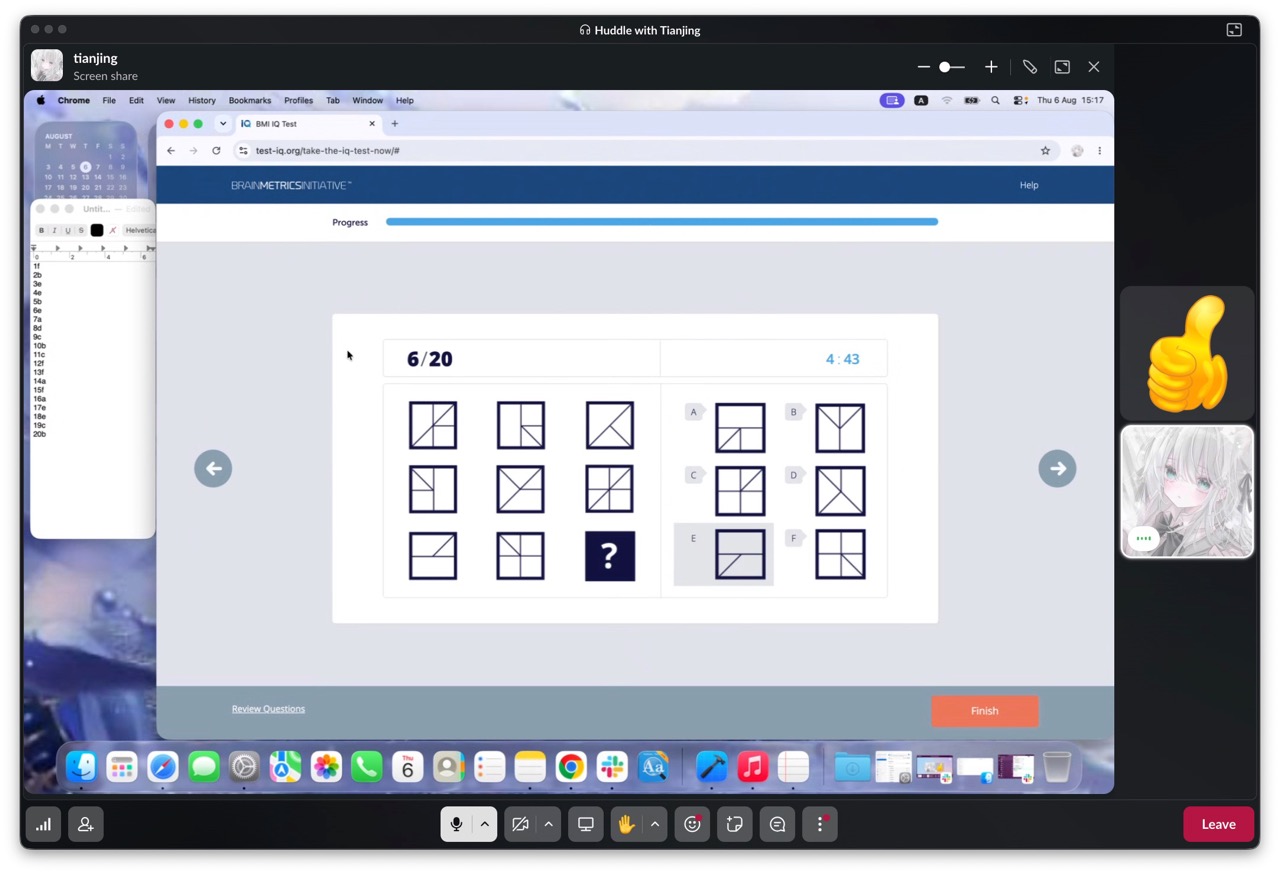
After class, I watched her take a widely respected twenty-question reasoning assessment.
I watched every second of her thinking.
She solved nineteen problems smoothly.
One question remained.
It was an XOR reasoning problem.
She returned to it twice.
During the final five minutes, she stared at it quietly, searching for the hidden pattern.
She never saw through it.
Final score:
19 out of 20.
The score impressed me.
Her thinking impressed me even more.
She did not rush.
She did not panic.
She stayed with the hardest problem until the very end.
That persistence told me more than the result itself.
Understanding
Only later did I learn more about her story.
Her family had moved to the new country less than a year earlier.
She had attended school there for only about two months.
She still struggled to read even elementary mathematical word problems in English because the academic vocabulary was unfamiliar.
When I heard that, everything made sense.
Years ago, my own daughter immigrated to Toronto after finishing Grade 1 in China.
During her first six months, she could barely speak English at school.
Then everything changed.
I have seen this journey before.
That is why I told her family:
"The least worrying thing about living in an English-speaking country is English itself. The fastest way to learn is to use it every day."
Language catches up.
Curiosity is much harder to teach.
The greatest surprise was not her IQ.
It was her joy.
She smiled while solving problems.
She laughed when something finally worked.
When the internet connection failed, the lesson continued using her mother's mobile data.
Later she asked me for help downloading the iOS Simulator because she wanted to keep exploring.
Everything was new.
Nothing frightened her.
At the end of the lesson, I encouraged her to keep creating:
rectangles,
triangles,
parallelograms,
trapezoids—
whatever she could imagine.
She nodded happily.
That smile told me she had already started teaching herself.
People often ask how to identify talent.
Grades help.
Tests help.
But they are not the first things I look for.
I trust my own eyes.
I look for children who become happier after solving something difficult.
I look for children who voluntarily return to the hardest problem.
I look for children who proudly share their creations with others.
Those are the signs of a lifelong learner.
Tianjing's first pentagram, her pentagon, her hexagon, and her first iOS app were not impressive because of their complexity.
They were beautiful because they marked the birth of confidence.
A child entering a new language, a new country, and a new world of programming can quickly discover the joy of creating.
Through curiosity, persistence, and the freedom to explore one new door after another.
Knowledge can be taught.
Confidence earned through creation can shape an entire lifetime.