Living Museum of Learning
The Key Was Waiting Inside Mathematics
Ten days earlier, Cloud had two complaints:
"Donald keeps letting me play Sudoku instead of teaching me math."
"Killer Sudoku hard mode is really too hard."
At that time, he did not know the 45 trick. Sudoku and mathematics seemed unrelated to him: one was a puzzle, the other was a school subject.
On this day, Donald opened TextEdit and did not mention Sudoku at all.
He gave a simple instruction:
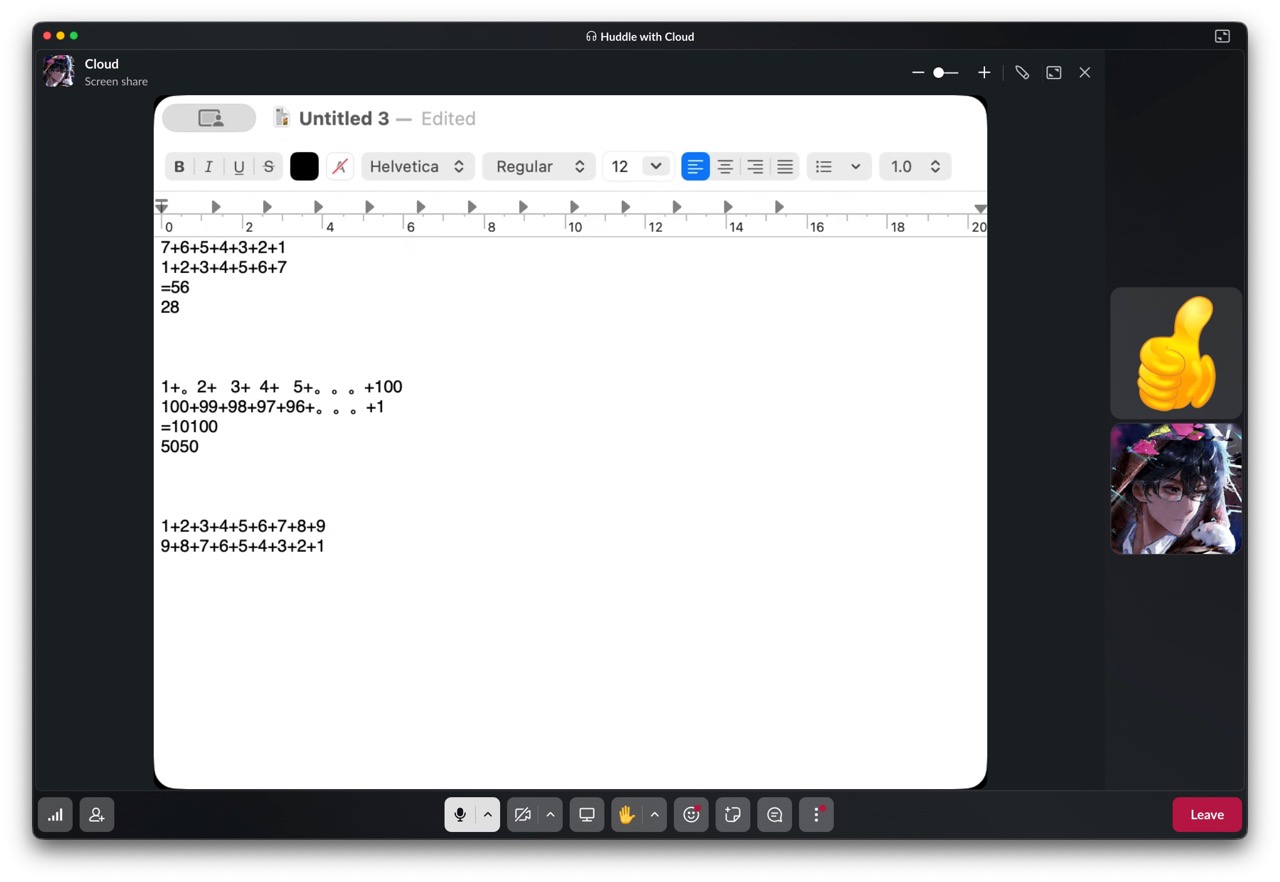
"Write 1 + 2 + ... + 7 and find a better way than your current one."
Cloud began adding normally and did not know where to go next. Donald asked him to write the second line in reverse order.
Cloud was still unconvinced.
Donald continued:
"What if it is not 7, but 17, or 100, or even bigger?"
Only after Cloud accepted that the paired structure was genuinely more powerful did Donald reveal the next step:
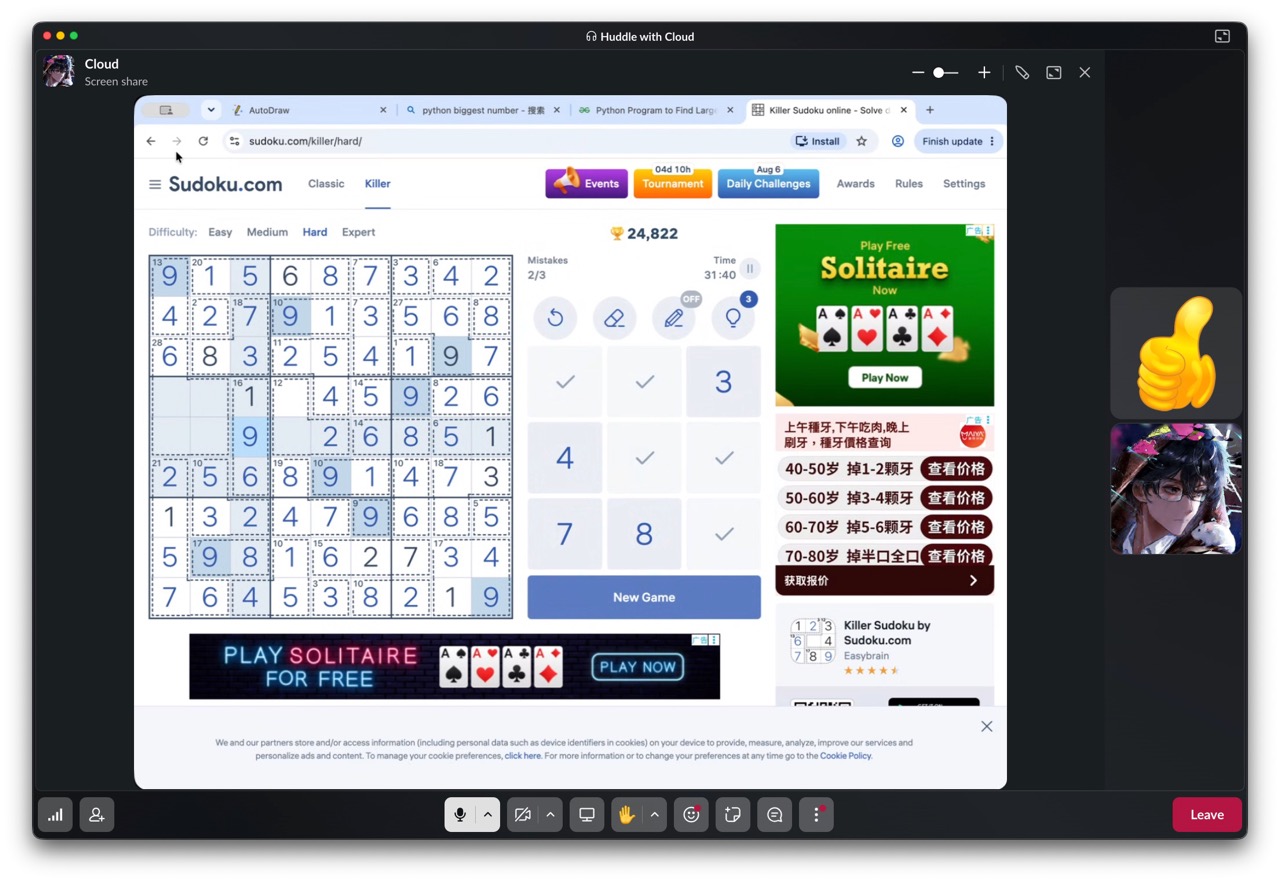
"Now go to sudoku.com and challenge the game you thought was too hard."
Cloud discovered that
1 + 2 + ... + 9 = 45
was not just a calculation. It was a tool.
During Killer Sudoku hard mode, Donald showed how a cage total could be handled by using 45 or 90 as anchors, plus one extra cell that could be found by simple arithmetic.
In another cage totaling 21, Cloud first placed an 8, then noticed a 6 that he had overlooked and immediately started recalculating from scratch. Donald stopped him:
"Can we reuse the calculation you already did instead of starting over?"
After a moment of confusion, Cloud suddenly saw it: the previous work still contained useful information. The solution could be updated, not rebuilt.
The impossible puzzle changed its identity.
Cloud independently solved Killer Sudoku hard mode twice.
The excitement was visible in his voice. When Donald casually used 95 as an arbitrary example while explaining the 45/90 idea, Cloud checked the numbers, found that they really summed to 95, and shouted:
"Wow, you are a calculator!"
Donald tried to explain that 95 was only a hypothetical example, but the excitement had already taken over the moment.
Later, a screenshot of Cloud computing 1 + 2 + ... + 100 = 5050 using the Gauss pairing method was shared in the family WeChat group with the caption:
Cloud 首遇让小高斯出名的 5050。
The important thing was not that Cloud memorized a famous formula. It was that he met the idea at the exact moment it solved a problem he cared about.
This class connected three powerful ideas:
Find structure instead of repeating work.
Build tools before revealing their applications.
Reuse previous reasoning instead of restarting from zero.
Before class ended, Cloud received a new homework challenge:
Generate five random integers, find the greatest one, and print it.
He did not yet know the "current largest" strategy. Another hidden pattern was waiting for him to discover.
The same question would return in a new form:
Can you find a better way than starting over?