
Living Museum of Learning
So Oliver
Oliver is my nephew—my wife Cindy's younger brother's son. I teach him one hour every week, free of charge. I even offered twice a week, but his mom cut it back to once so he could spend more time on other activities.
Teaching Oliver has tested my patience more than any other student. If we weren't family, I often joke that I would have "fired" him a million times already.
The funny thing is that he's anything but incapable. He's a local SanDa champion. Within just a handful of Sudoku games, he climbed almost all the way to the highest difficulty, and for months he would begin class by asking,
"What about Sudoku today?"
Programming, however, was a completely different story.
Even after drawing an entire Chinese chess board with dozens of tiny line segments, I still couldn't find the switch that would make him want to program.
That day, we started with one simple goal:
Draw a pentagram with Python Turtle.
I showed Oliver a turtle graphics video made years earlier by Lucas, another student.
He quietly opened a new file.
Nothing happened.
The cursor blinked.
For a long time.
We even paused just to look up the spelling of pentagram in his dictionary before naming the file.
Then he finally began.
He drew a triangle.
Then another shape.
Then a flower.
Then a spiral.
He knew a pentagram had something to do with 72 degrees, but he couldn't remember how.
I knew.
I never said it.
Instead, I watched him search.
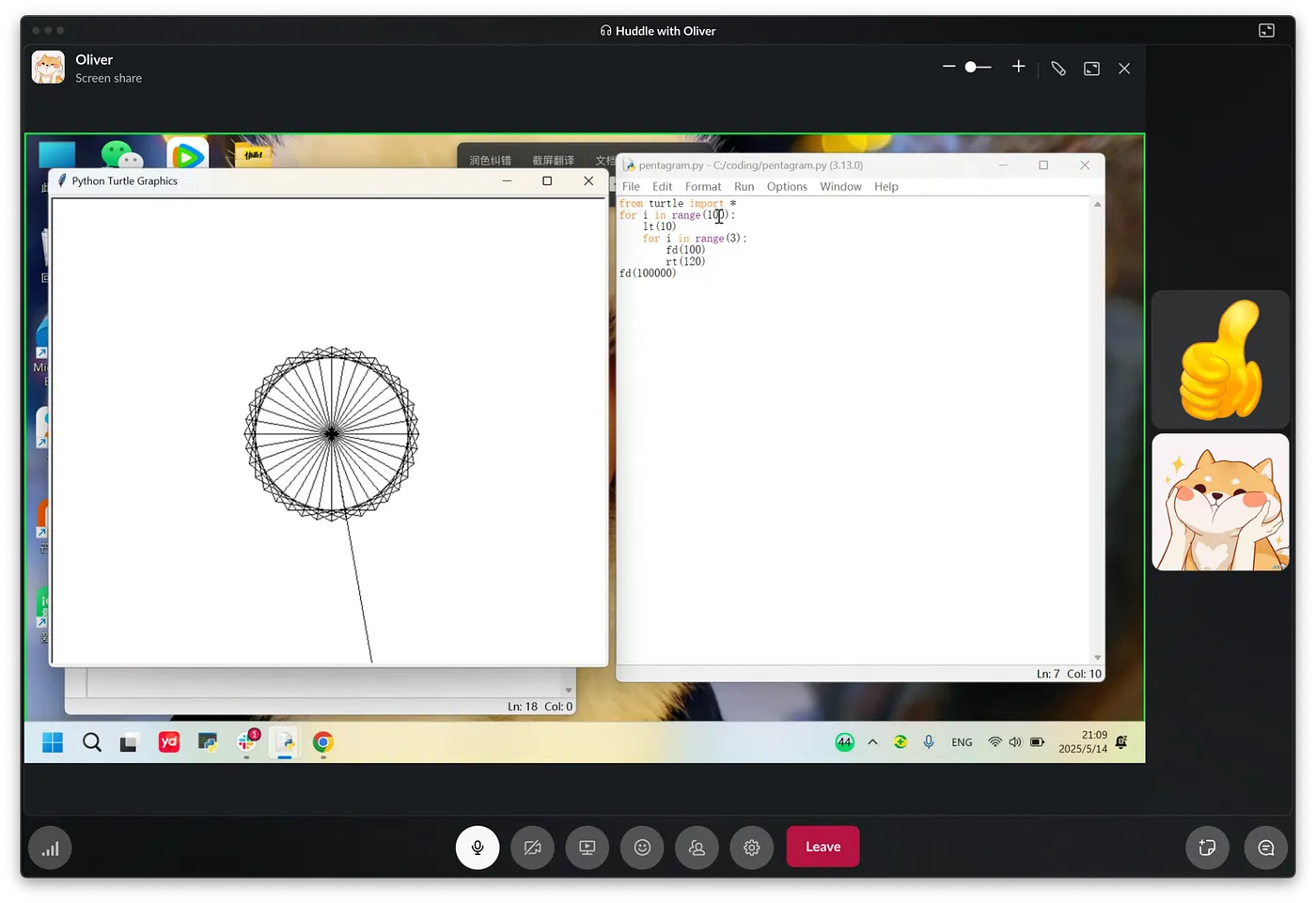
When he changed the program to run 500 loops, the turtle drew hypnotic patterns across the screen.
I joked,
"So Oliver... when will it stop?"
Without looking away, he answered,
"Wait for it to stop."
That tiny sentence told me more than any finished pentagram could.
Later, after the drawing was finished, he typed:
fd(100000)
The turtle shot off the screen like a missile, dragging an ugly line behind it because we had forgotten to lift the pen.
We both burst out laughing.
Oliver never found 72° that day.
He didn't need to.
For the first time, programming stopped being something he endured and became something he explored.
He wasn't asking me what to type.
He was asking the turtle,
"What happens if...?"
The lesson produced no perfect pentagram.
It produced something much rarer:
A child who stayed curious.
Looking back a year later, I realize this class wasn't really about geometry.
It was about searching for Oliver's door.
Some children race toward every new challenge.
Oliver doesn't.
He can happily spend an hour solving top-level Sudoku, then need twenty minutes just to begin writing a simple program.
The answer was never to push harder.
The answer was to wait until programming became his playground instead of my assignment.
A child can leave without the "correct answer" yet become more deeply engaged than if the teacher had explained everything.
Activation isn't created by giving answers. It grows through patience, trust, well-timed silence, and playful experimentation—even when progress feels painfully slow.
Every child has a different ignition switch. Oliver reminded me that the teacher's real work isn't delivering knowledge. It's patiently discovering the door that makes this particular child want to keep learning.