
Living Museum of Learning
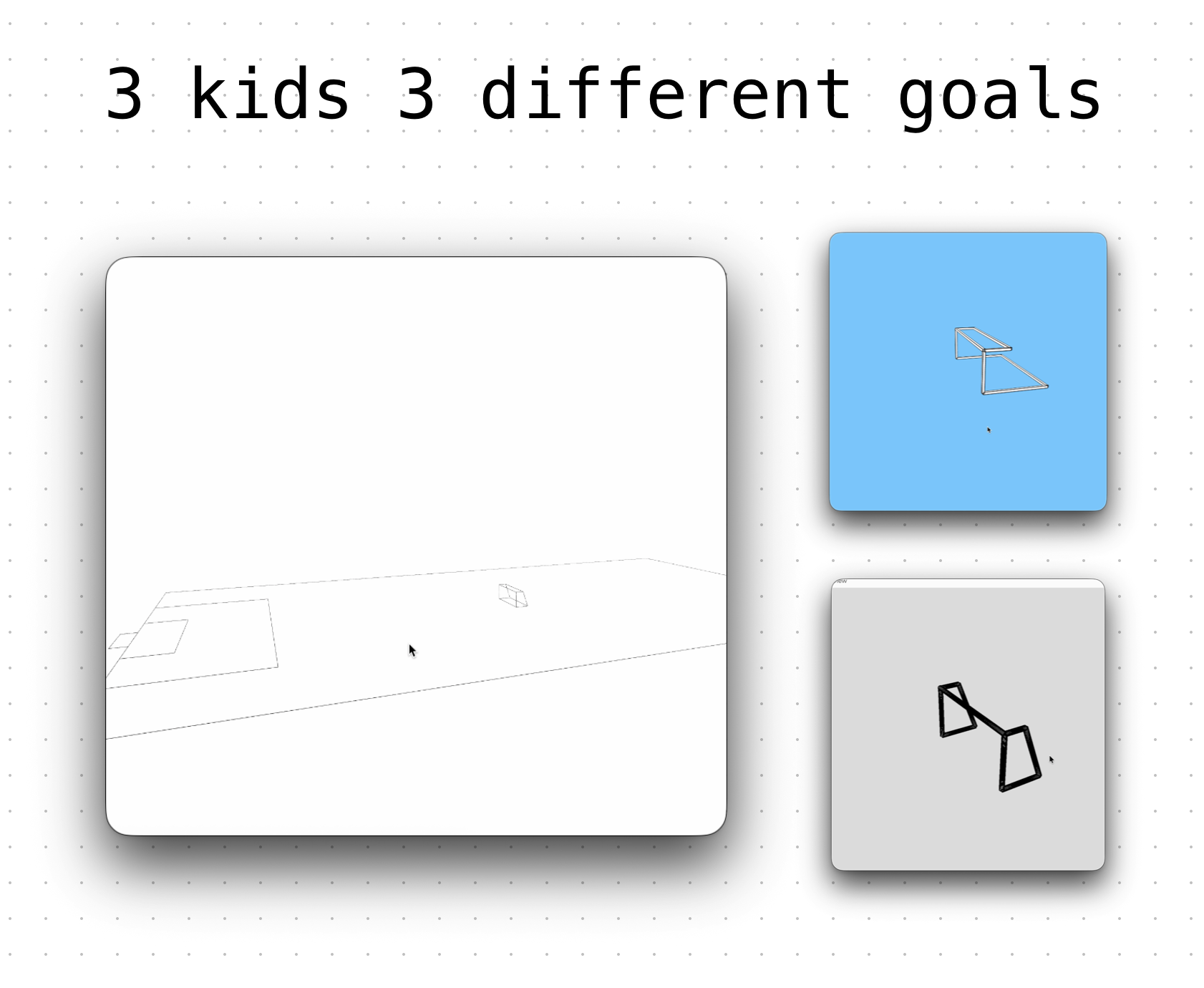
Three Goals, Three Journeys
Today's challenge was deceptively simple: build a realistic 3D soccer goal in p5.js.
The rectangular frame was straightforward.
The real challenge was the trapezoidal side frame.
Each student faced the same engineering problem, but each arrived at a very different solution.
Jayden had never learned trigonometry.
Within thirty minutes, he had to understand tangent and inverse tangent well enough to compute the slanted support.
Ethan correctly recognized the missing diagonal, but chose to leave it unfinished rather than fake the geometry.
Albert quietly avoided the trigonometric calculation altogether by redesigning the construction of the trapezoid.
The assignment unexpectedly became a lesson in mathematical thinking, not programming.
The same destination can be reached through different ways of thinking.
Jayden demonstrated courage by learning unfamiliar mathematics on demand.
Ethan demonstrated engineering honesty by leaving an unsolved component instead of pretending it was solved.
Albert demonstrated mathematical creativity by eliminating an unnecessary calculation through a better geometric design.
Programming became a window into three different problem-solving styles.
Great programmers do more than write code.
They simplify.
They reuse.
Sometimes the most elegant solution is not a faster calculation, but finding a representation that makes the calculation unnecessary.
Teaching programming is ultimately teaching how to think.
The same problem can inspire completely different—and equally valuable—ways of thinking.
By encouraging exploration instead of expecting every student to follow the same path.
Because creativity in mathematics and programming often begins with asking, "Is there another way?"