
Living Museum of Learning
He Didn't Learn cd. He Discovered a New World.
Cloud was an eighth-grade boy who had spent years using a computer, mostly to play games. Yet he had 0 hour of programming experience when we met for our first lesson.
We opened Terminal and learned one simple command: cd.
Instead of treating it as something to memorize, Cloud immediately began asking questions. What does this folder mean? Where are we now? Can we go back? What happens if we go here instead?
Together we wandered through his computer: his home directory, the root /, ~/ws, and ~/ws/py. To explain what a directory is, I first compared it to traveling from Earth to Asia, China, Guangdong, and Shenzhen. When that wasn't quite enough, I tried another analogy: a building, its floors, and individual rooms. Even then, I felt he was only about eighty percent satisfied. There was still something he wanted to understand.
At one moment, ls -l displayed English folder names while Finder showed Chinese. Cloud wanted to know why.
Rather than skipping the question, we changed the macOS language, rebooted the computer, and he calmly rejoined our Slack huddle so we could continue exploring. The interruption didn't break his concentration. It simply became another step in the journey.
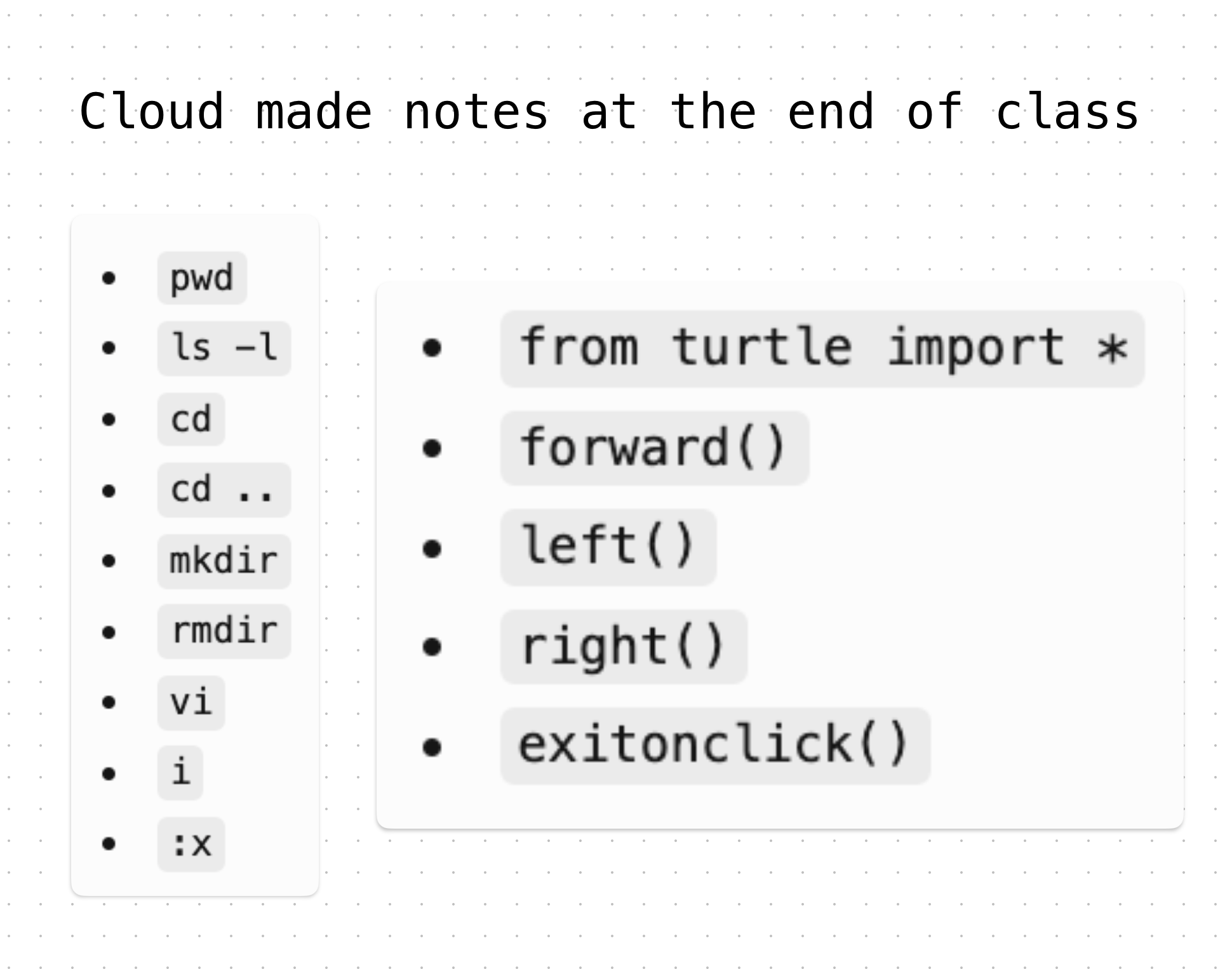
Near the end of the lesson, when it was almost time to say goodbye, I noticed something that stayed with me. Sensing that our connection was about to end, Cloud hurried to write down every new command and function we had touched:
pwd
ls -l
cd
cd ..
mkdir
rmdir
vi
i
:x
Then he added his very first Python Turtle notes:
from turtle import *
forward()
left()
right()
exitonclick()
He seemed determined not to let a single new idea slip away. Even the final minute of the lesson mattered to him.
That was when I realized Cloud wasn't simply learning commands. He was constructing a mental map of a computer.
Every path we explored answered another question. Every command became a way to navigate rather than something to memorize. The terminal was no longer a mysterious black window. It had become a landscape that he could begin to understand.
Children often surprise us when we follow their questions instead of rushing through a lesson plan.
A command like cd is easy to teach. Curiosity is not.
When a learner is given time to explore, a filesystem becomes a map, commands become tools for discovery, and programming becomes an invitation to understand how computers really work.
We can never know exactly why a child falls in love with learning. That evening, Cloud told his mother that he wished he could have two hours of class every day and that he couldn't wait to learn more mathematics. I don't know what sparked those words. But somewhere between cd, .., and a page of carefully handwritten notes, a new world had begun to open.
☑ What Is Possible — A first programming lesson can become a journey of discovery rather than a lesson in memorization.
☑ How Does It Happen — By following a learner's questions, using analogies, and allowing time to explore instead of rushing to the next topic.
☑ Why Does It Matter — The deepest learning begins when students stop asking, "What command should I type?" and start asking, "How does this world work?"