
Living Museum of Learning
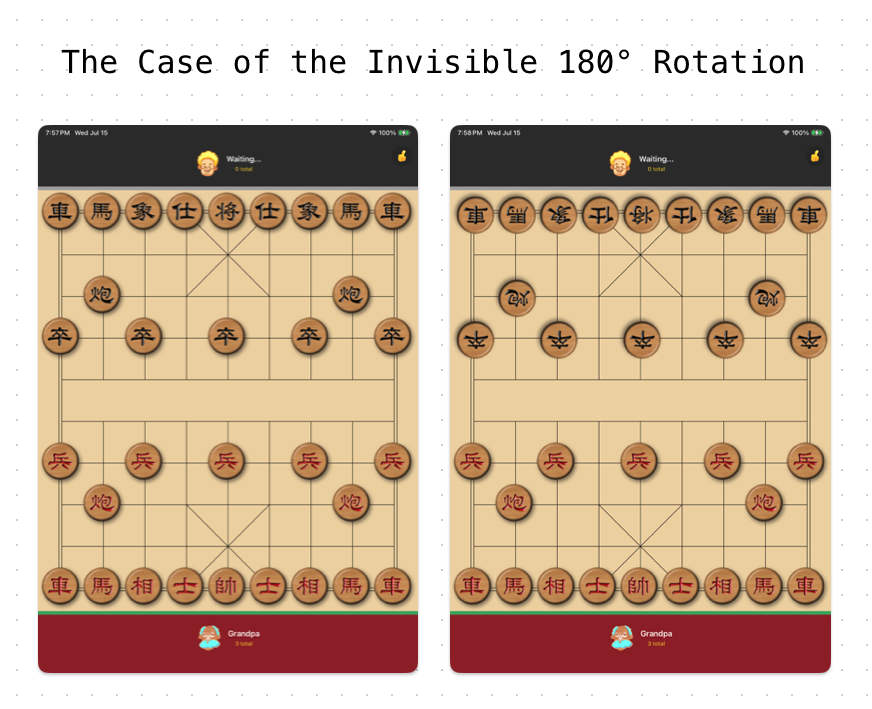
The Case of the Invisible 180° Rotation
While upgrading Golden Xiangqi from its old UIKit architecture to the new Golden Platform structure, we noticed a tiny feature had disappeared.
The original app had a "Flip" option: when Xiangqi was used as a physical board shared by two players, the pieces on the opposite side could be displayed upside down so both players could read them naturally.
But after months of refactoring, the feature seemed gone.
A search through the code found nothing obvious:
no "flip"
no "rotate"
no "rotation"
no "180"
no ".pi"
Had this small human-centered detail been accidentally deleted?
Instead of searching the current code, we went backward.
Git became the detective.
Following the history of the old BoardUIView.swift, we traced the evolution of the Xiangqi board through dozens of commits.
The breakthrough came when we discovered the old implementation was never using words like "rotate" or "flip."
The feature was hiding inside image loading:
UIImage.Orientation.down
A 180° rotation was achieved simply by changing the image orientation.
The feature had not disappeared.
It had been silently preserved.
A forgotten implementation detail revealed a bigger design idea:
The board is not only a game surface.
It is also a physical tabletop experience.
The "Flip" feature was not about graphics. It was about empathy:
How can both players comfortably see the board from their own perspective?
A tiny image orientation setting carried a surprisingly human idea across years of code evolution.
Good software preserves more than functionality.
It preserves decisions, intentions, and moments of creativity.
Git is not only a version control system. It is a memory system for ideas.
Sometimes the most valuable discoveries are not new features—but old ideas waiting to be rediscovered.
A tiny image setting can create a more natural two-player experience.
Explore how Git history, refactoring, and careful investigation reveal forgotten design decisions.
Great software is not only about code—it preserves human thoughts, creativity, and empathy.