Living Museum of Learning
When Geometry Moves — and the Invariant Stays
Some mathematical discoveries begin with a proof.
Others begin with curiosity.
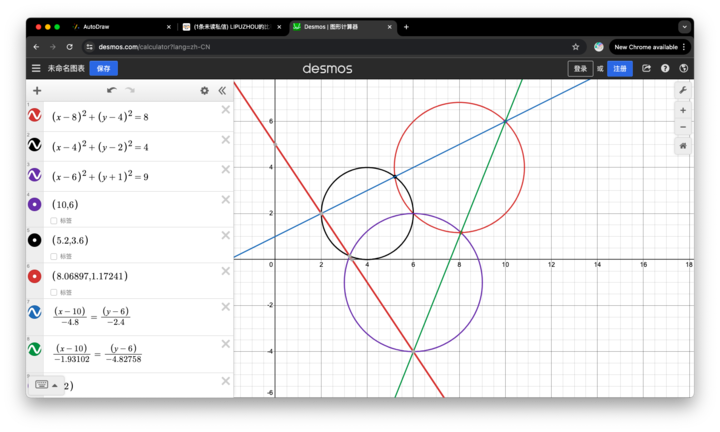
Before creating his animation, Grade 8 student Marius opened Desmos and started with three circles:
(x − 8)² + (y − 4)² = 8
(x − 4)² + (y − 2)² = 4
(x − 6)² + (y + 1)² = 9
Rather than rushing toward a formal proof, he explored.
He measured.
He dragged points.
He checked relationships again and again.
After watching him patiently verify the construction, I told him:
"Even though you haven't proved it yet, your persistence in verifying it in Desmos is remarkable. True learning lives in this spirit of patient persistence."
That persistence became the foundation for everything that followed.
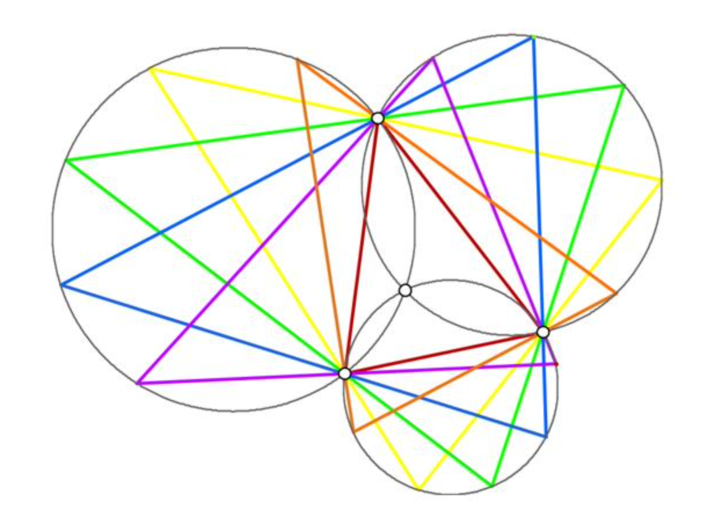
Marius transformed the construction into a dynamic model.
Three circles shared a common point.
Each pair of circles determined another point—A, B, and C.
Then he created a triangle whose vertices could glide along the three circles.
The triangle kept changing.
Yet the geometric relationship he was investigating remained unchanged.
The picture moved.
The mathematics stayed.
Mathematics is often introduced as a collection of fixed diagrams.
Interactive geometry reveals something deeper.
Objects move.
Patterns survive.
Invariants are what give geometry its lasting structure.
Sometimes understanding begins not with a proof, but with careful experimentation and the patience to keep asking, "Does it still hold?"
A middle school student can build an interactive geometric investigation from scratch.
Exploration, verification, and visualization gradually lead toward mathematical proof.
One of mathematics' deepest ideas is that beneath continuous change, some truths remain unchanged.
The picture moved. The mathematics stayed.