
Living Museum of Learning
"Which Is More Common: Abelian or Non-Abelian Groups?"
After verifying that the symmetric group S₃ is not commutative, Albert paused and asked:
"Which are more common: abelian groups or non-abelian groups?"
He immediately clarified what he meant.
Both classes are infinite.
But intuitively, which one appears more often in mathematics?
I smiled.
"That's a great question."
Rather than answering immediately, I suggested another experiment.
"Try matrix multiplication."
Albert chose two matrices and computed both products.
AB ≠ BA.
Another familiar mathematical structure turned out to be non-commutative.
He had discovered the same phenomenon from a completely different direction.
Albert then returned to geometry.
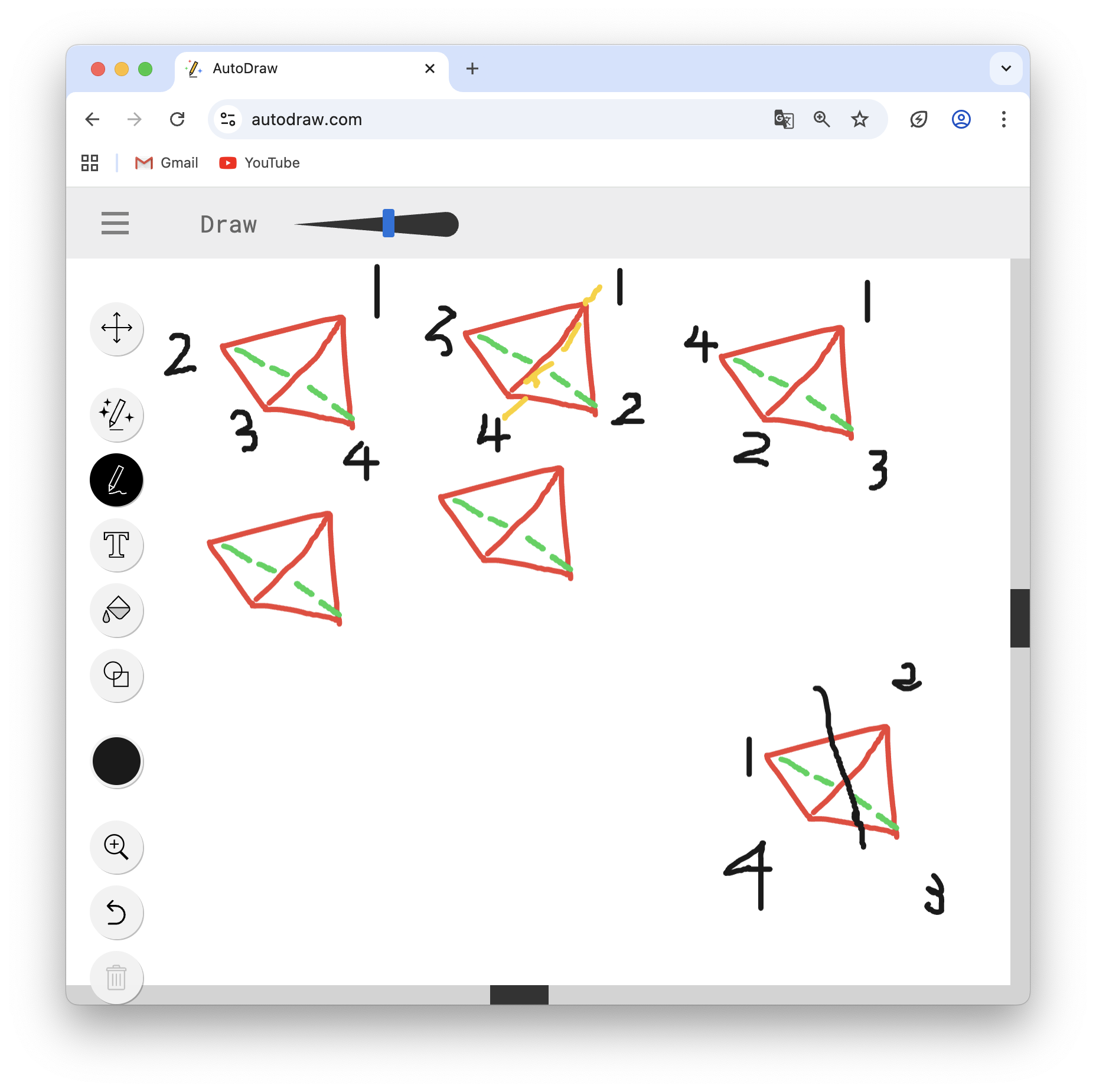
Using a regular tetrahedron, he listed all twelve rotational symmetries—the elements of the rotation group A₄.
Another beautiful example.
Another non-abelian group.
Without being told where to look, he was beginning to notice a pattern.
The same idea kept appearing in different branches of mathematics.
Some questions are valuable because they have elegant answers.
Others are valuable because they change the way we look.
Albert's question belongs to the second kind.
It naturally leads toward deeper ideas:
Why is ordinary addition commutative?
Why are rotations usually not?
Why do matrices refuse to commute?
The goal wasn't to settle the question that day.
It was to notice that one thoughtful question can connect algebra, geometry, and linear algebra into a single conversation.
A high school student can ask questions that point naturally toward modern abstract mathematics.
By exploring examples across different areas, patterns begin to emerge on their own.
Mathematics advances not only through answers, but through questions that connect seemingly unrelated ideas.
I actually like this exhibit even more than the mathematics itself because it captures something rare.
Albert didn't ask:
"Is this group abelian?"
He asked:
"Which kind is more common?"
That's a researcher's question. It shifts the focus from solving one problem to understanding the landscape. Those are exactly the moments a Living Museum of Learning should preserve.