
Living Museum of Learning
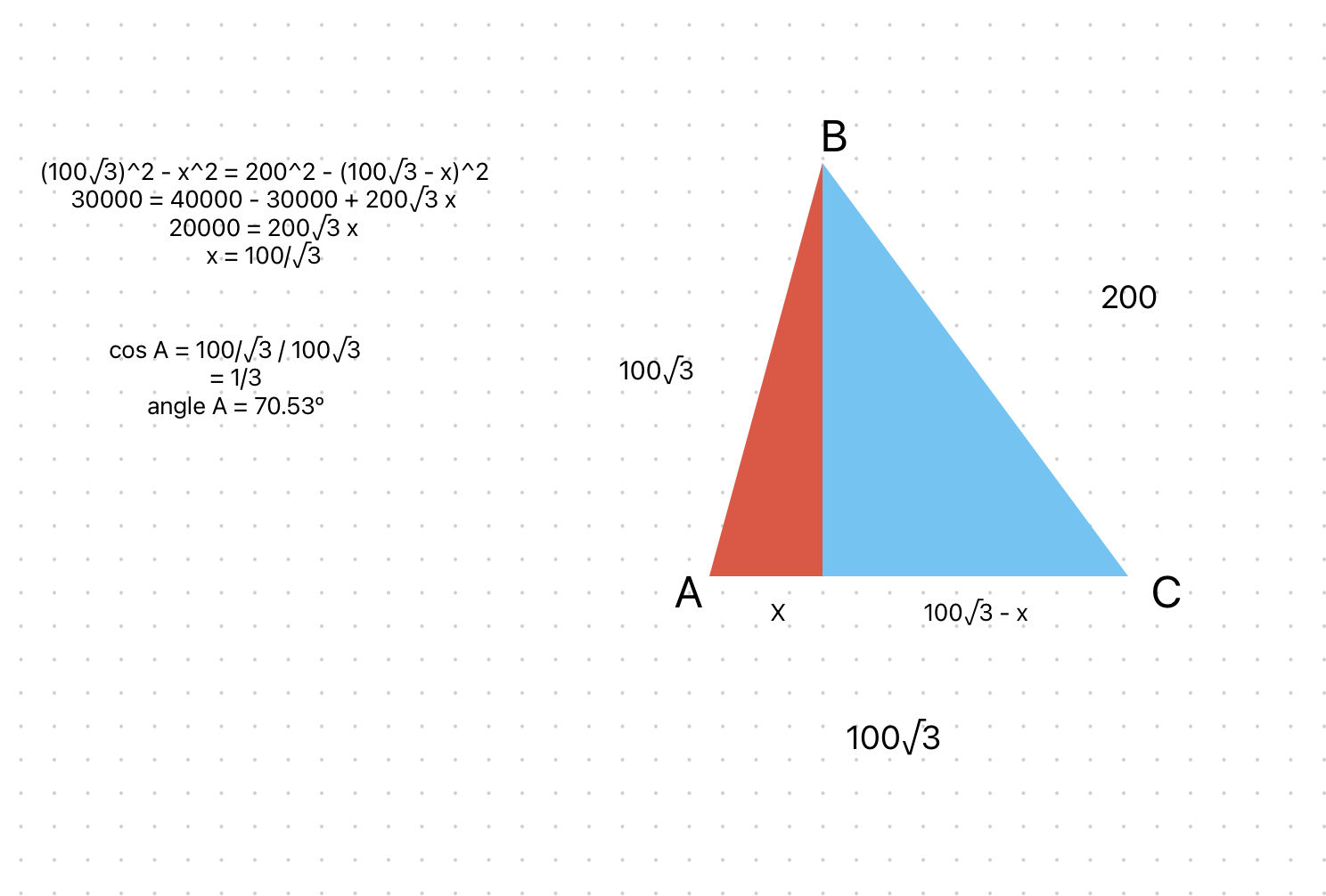
Ethan's First Freeform Diagram
Ethan was revisiting the height of a regular tetrahedron.
He had already derived the mathematics correctly, but now needed to visualize the cross-section containing the altitude.
For years we had relied on a simple online drawing tool.
That day, however, it was inaccessible.
So we tried something new.
Apple's Freeform.
When Ethan first opened it, he smiled and said:
"Give me a second to see how it works."
Within minutes, he was drawing confidently.
(100√3)^2 - x^2 = 200^2 - (100√3 - x)^2
30000 = 40000 - 30000 + 200√3x
20000 = 200√3x
x = 100/√3
cos A = (100/√3) / (100√3)
= 1/3
A = arccos(1/3) ≈ 70.53°
Then something unexpected happened.
When the calculated height was placed into Ethan's 3D model of the tetrahedron, it didn't look right.
The altitude seemed too short.
Was it a visual illusion?
A modeling mistake?
Or had we overlooked something in the mathematics?
We didn't know.
Instead of forcing an answer, we stopped.
The mystery would continue in the next lesson by placing the tetrahedron at the origin of a three-dimensional coordinate system.
Sometimes the most valuable outcome of a lesson is not a solution.
It is a better question.
Mathematics is more than calculation.
It also depends on representation.
A new drawing tool did not change the geometry.
It changed how Ethan could see the geometry.
And when calculation and visualization appeared to disagree, neither was dismissed.
Both became evidence.
Real mathematical thinking often begins at that moment.
A simple digital canvas can become a powerful mathematical workspace.
Drawing, calculation, and 3D modeling reinforce—and sometimes challenge—one another.
When different representations disagree, students learn to investigate rather than assume.
Sometimes the most valuable outcome of a lesson is not a solution.
It is a better question.