
Living Museum of Learning
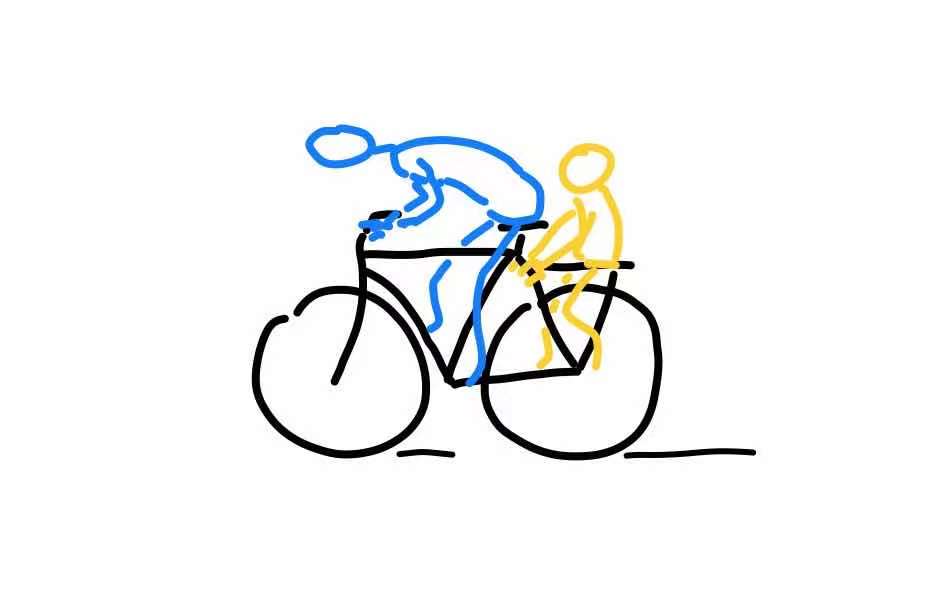
The Bicycle Kingdom
This was a simple drawing done in a few minutes.
At the time, I drew myself from my university years, carrying my younger brother—eight years younger—on a bicycle.
It was not meant to be anything special.
Just a small sketch.
But when my wife saw it, she paused and said:
“So vivid. This is the life of several generations in China.”
That reaction surprised me.
Because what I drew was personal.
But what she saw was collective.
Later, I realized why that interpretation emerged so naturally.
The drawing captured something deeply familiar:
older siblings carrying younger ones,
families moving through rural roads on bicycles,
summer trips between towns and villages,
long uphill climbs where effort was shared,
downhill stretches where speed turned into joy.
It wasn’t just a sketch of two boys.
It was a structure of life at that time.
The memory behind the drawing was very specific.
Every summer, I would take my younger brother from the county town to visit our grandparents in the mountainous region of northern Zhejiang.
The journey took nearly an hour by bicycle.
It included long uphill sections where my brother would encourage me from the back seat, doing his best to “help” even though there was nothing physical he could do except cheer.
And then there were the downhill stretches:
fast, effortless, almost flying.
We even had one unforgettable return trip where we managed to ride the entire way with our feet barely touching the ground.
That moment stayed with both of us for years.
Not because it was difficult.
But because it felt like victory shared.
Some sketches are not about drawing accuracy.
They are about compression.
A few lines can hold:
geography,
family structure,
transportation era,
childhood teamwork,
and shared memory.
The viewer then reconstructs the missing world behind the lines.
That is why my wife saw something broader than I intended.
She was not interpreting the sketch.
She was recognizing a life pattern.
A simple sketch can encode an entire social and generational experience.
Shared cultural memory allows different viewers to reconstruct meaning beyond the lines.
Drawings are not only artistic expressions—they are compressed narratives of lived experience.
What I drew was two people on a bicycle.
What she saw was an entire generation moving forward together.