
Living Museum of Learning
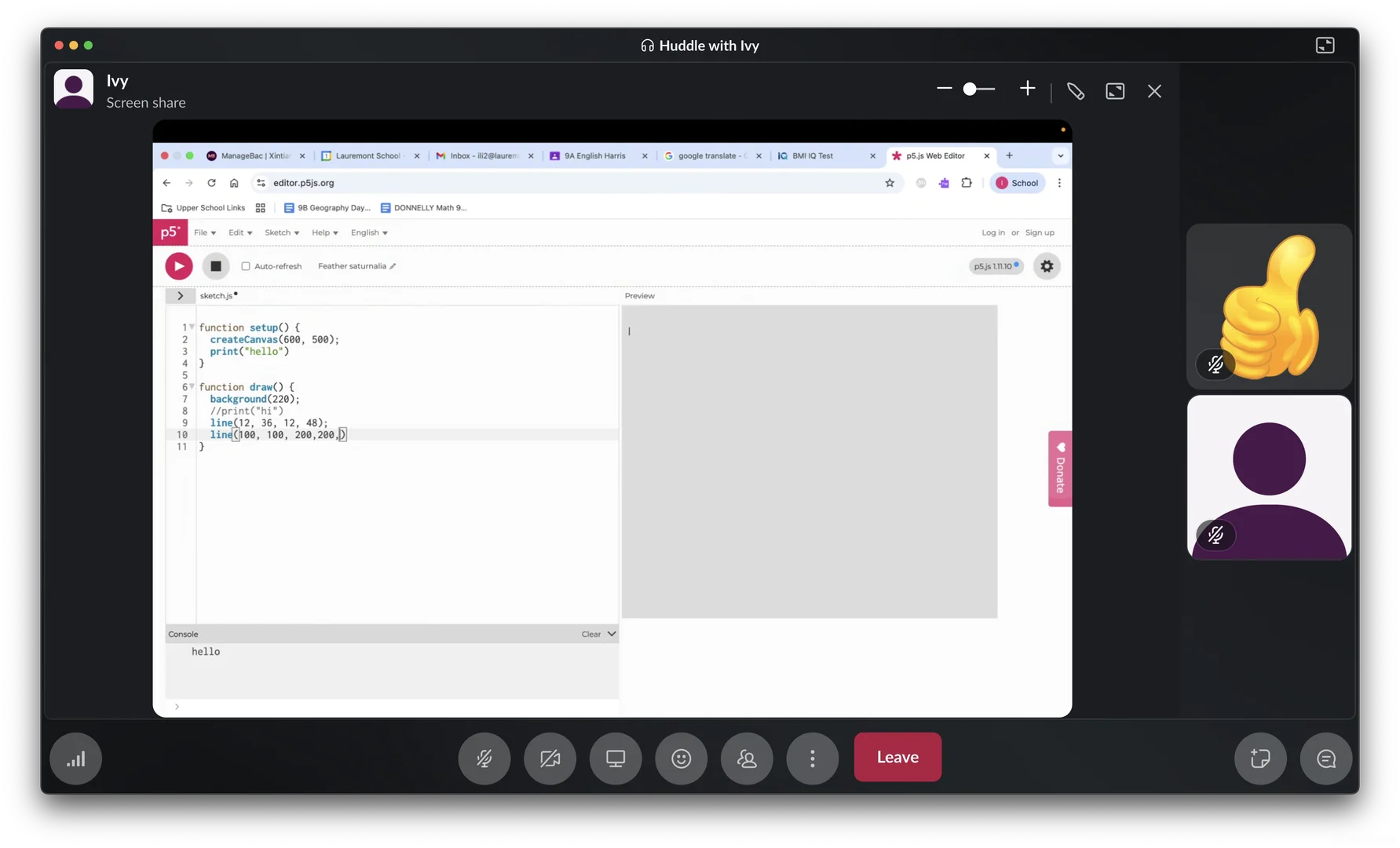
Ivy's First Line
It was the first day of November when I met Ivy, a Grade 9 student from Toronto.
Although we were sitting face to face, we decided to set up Slack for screen sharing and muted both microphones.
It felt strangely like a remote lesson conducted in the same room.
Before programming, Ivy completed a reasoning test that we have long used with our students.
Twenty questions.
Twenty minutes.
Ivy finished all twenty questions in roughly half the allotted time and answered every question correctly.
Only one other student in our Dream Team had previously achieved a perfect score.
Ivy told me that she hoped to attend one of the top universities in the United States.
We played several rounds of the 24 game.
She still remembered how to solve a Rubik's Cube from years earlier.
When I asked how she had learned it, she answered:
"I just used the most stupid way."
The answer was memorable.
Honest.
Unpretentious.
And surprisingly sharp.
She was clearly comfortable solving difficult problems without worrying whether her methods looked sophisticated.
Despite her strong reasoning skills, Ivy had never written a single line of code.
We opened the online P5JS editor.
Within minutes, her first program appeared on the screen.
It was only a short vertical line.
She could not immediately find it on the canvas.
After we located it together, she laughed.
Soon afterward, her first animated triangle began moving from left to right.
A student who had never programmed before had already created motion.
The first line had become the first animation.
Strong reasoning does not always arrive with prior experience.
Ivy entered the room with:
no programming background,
no typing habits,
no standard techniques.
But she brought curiosity, honesty, and the ability to think clearly.
The first line of code may have been small.
The canvas may have appeared empty.
Yet every programmer begins somewhere.
Sometimes the beginning is simply a tiny line that is difficult to see.
A student with no programming experience can create motion and animation on the very first day.
Reasoning, curiosity, and experimentation allow new ideas to emerge quickly.
The smallest first step—a single line on a canvas—can become the beginning of a much larger journey.
The first program was only a tiny vertical line.
She could not even see it at first.
But every programmer's journey begins with something almost invisible.