
Living Museum of Learning
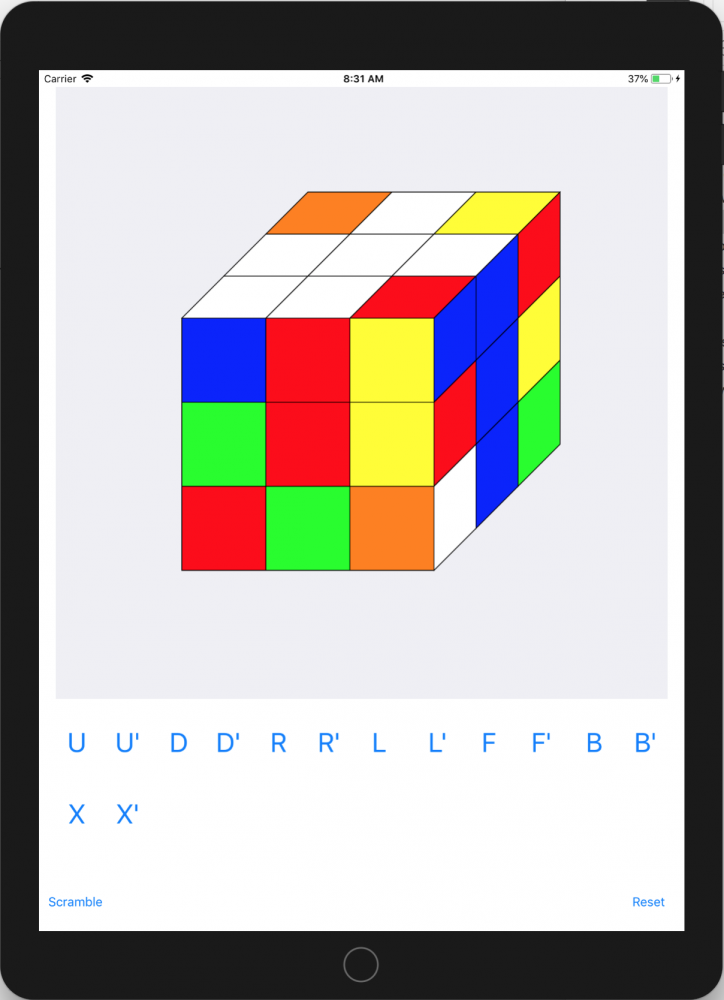
The Bug Hiding in Front
Peter set out to build a standard Rubik's Cube simulator.
The problem sounded straightforward.
A cube contains 54 colored stickers arranged on six faces. Every rotation moves multiple stickers simultaneously, and every movement must preserve the relationships between adjacent faces.
Peter numbered the stickers, established their positions, and began writing the twelve fundamental cube operations:
U, D, L, R, F, B
U', D', L', R', F', B'
Each move became a separate function.
The front face seemed especially easy.
Unlike the left, back, and bottom faces, the front face was fully visible and straightforward.
Peter quickly finished:
turnF()
Then the remaining eleven rotations followed.
Simple tests appeared to pass.
To stress-test the simulator, Peter added a shuffle button.
Each click performed 10,000 random moves.
The shuffle button became a detective.
Immediately, impossible states appeared.
Two adjacent stickers on the same cubelet sometimes showed the same color.
The cube was breaking.
For two weeks we investigated:
writing test cases
observing rotations by eye
coloring all 54 stickers the same except one
tracing individual stickers through sequences of moves
Some bugs were found and fixed.
Others remained.
Every time the cube shuffled, the impossible colors returned.
Eventually Peter sent a message:
there are still a few bugs in our actual app, but I cannot find them
One morning we tried a lazy strategy.
Instead of inspecting every move, we disabled one rotation at a time.
Shuffle with eleven moves.
Still broken.
Shuffle again.
Still broken.
When we commented out:
turnF()
the errors disappeared.
Neither of us wanted to believe it.
The front face had always seemed the least suspicious.
It was visible.
Simple.
Obvious.
Yet the final bug had been hiding there all along.
Peter reopened the function, examined it carefully, and fixed the error almost immediately.
The last impossible cube vanished.
Large systems often fail in unexpected places.
The most obvious component is not always the safest.
Eliminating possibilities can be more effective than searching directly.
Stress tests reveal bugs that small tests cannot.
Sometimes the best debugging strategy is subtraction.
After the final bug disappeared, I wrote four Chinese characters on Peter's screen:
大隐隐于市
I asked:
Do you know what these words mean?
The greatest things do not always hide in remote mountains.
Sometimes they live in the busiest streets.
Likewise, the most stubborn bug does not always hide in the complicated back face, the invisible bottom face, or the difficult corner cases.
Sometimes it hides directly in front of us.
The very function we trusted most.
The one called:
turnF()
And perhaps that is why I still remember those four characters years later.
大隐隐于市。