
Living Museum of Learning
Enigma Breakthrough: Ethan Decodes Leo’s First Cipher
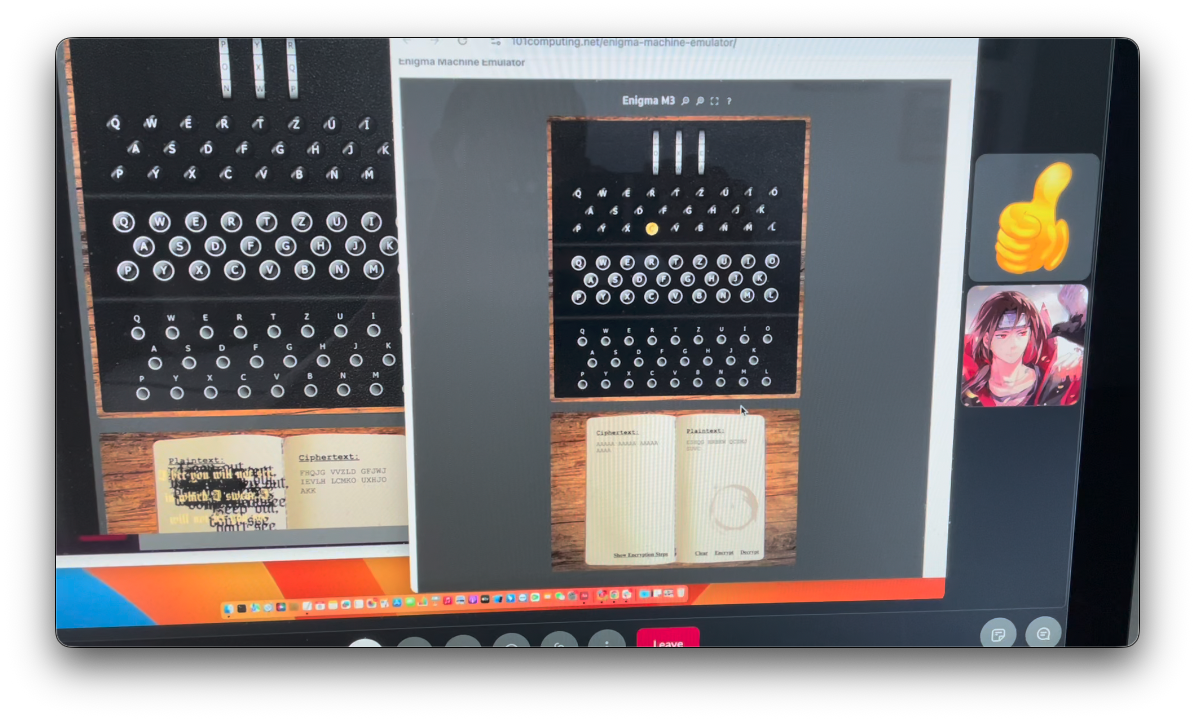
Leo published a student-designed Enigma cipher challenge based on the message “The truth about Kerbal space program: figure it out, and you will see!” along with a full screenshot of the machine settings (rotors, plugboard, initial positions). The task was to reconstruct the plaintext purely from the ciphertext and configuration.
After about 30 minutes of trial, error, and near-solutions, Ethan finally crossed the gap from partial recognition to full decoding. The decisive moment was when he confidently stated he was ready to type out the decrypted message—signaling that the system had “clicked” mentally, not just computationally.
The decoding process evolved from brute reasoning to structured inference: Ethan aligned cipher structure with Enigma settings, iterated through likely alignments, and gradually converged on the correct plaintext. However, a subtle spelling error in the original message (“DESAS” instead of “DISASTER”) introduced ambiguity that delayed full confidence and created an additional layer of interpretive challenge.
Cryptanalysis is as much about pattern stability as it is about computation
Small transcription errors can propagate large interpretive confusion
Near-correct solutions are cognitively more destabilizing than clearly wrong ones
Real decryption involves both mechanical reconstruction and linguistic expectation
Designing ciphers unintentionally teaches the importance of precision in language