Living Museum of Learning
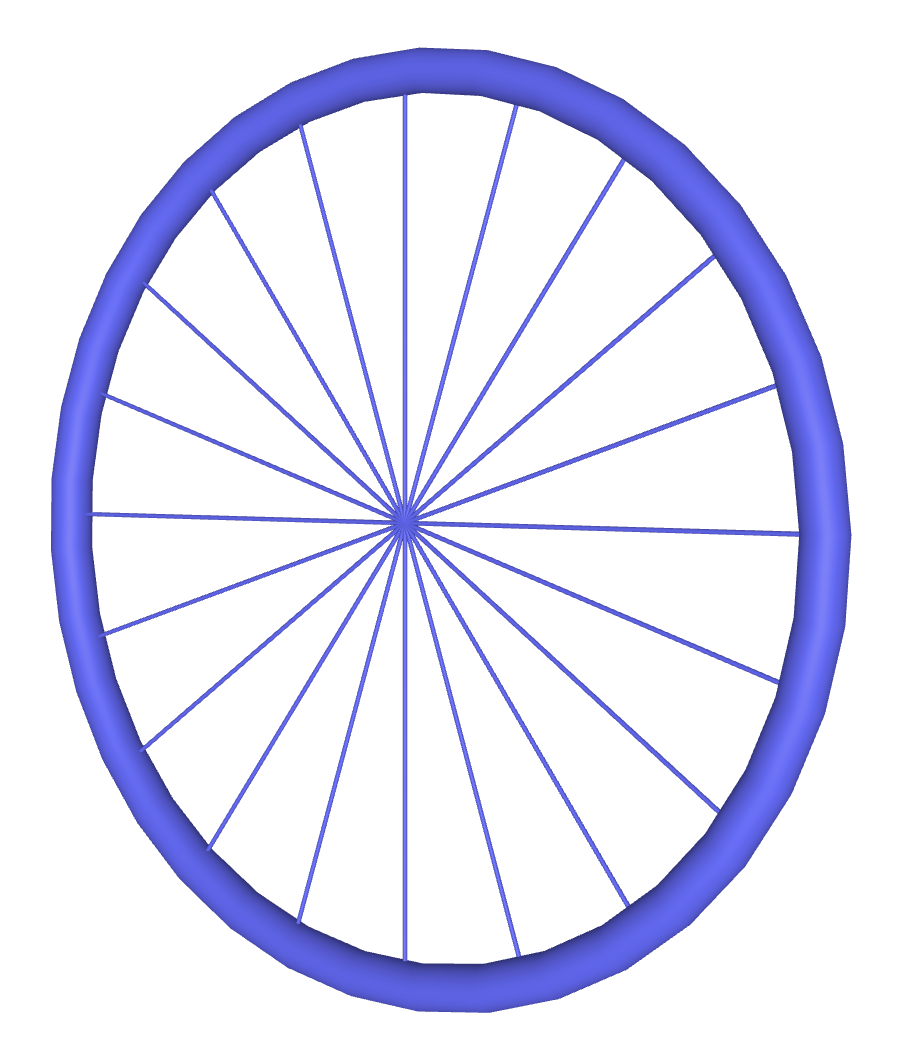
Everything Started from a Wheel
Felix was a Grade 7 student in Toronto when this work was created.
At the time, he was exploring how visual objects could be constructed directly through code, using P5.js as his medium.
There were no external 3D modeling tools involved—only geometric reasoning, rotation logic, and incremental programming.
The project evolved through multiple stages, including a black-and-white version and later a colored version.
The key shift was not the visual result, but the decision to treat motion itself as a constructible object.
Instead of drawing a carriage, Felix began to define:
wheels as independent rotating systems
the carriage body as a composite structure
3D rotation as a transformation layer applied to the entire scene
At this point, the problem stopped being “drawing an object” and became:
how to describe movement in a way that remains consistent under rotation.
As the system developed, individual components began to behave independently yet coherently.
Each wheel rotated on its own axis
The carriage maintained structural integrity under transformation
The entire scene rotated in 3D space as a single coordinated system
What appears as a visual animation is actually the result of layered mathematical relationships:
local motion inside global motion.
Across iterations, the work gradually shifted from structural clarity (black-and-white version) to perceptual richness (color version), while preserving the same underlying mechanics.
This work reflects a transition from visual intuition to structural construction.
Key ideas embedded in the process include:
decomposition of complex objects into independent parts
hierarchical motion systems
spatial transformation thinking
separation of structure and appearance
It is less about “drawing a carriage” and more about learning how to define one in motion.
Complex visual motion can be constructed entirely from code, without modeling tools, by composing simple geometric and rotational rules.
By decomposing a system into independent moving parts and defining consistent transformation rules that govern their interactions.
Understanding motion as structure is a foundational step toward computational thinking in graphics, simulation, and physical modeling.