
Living Museum of Learning
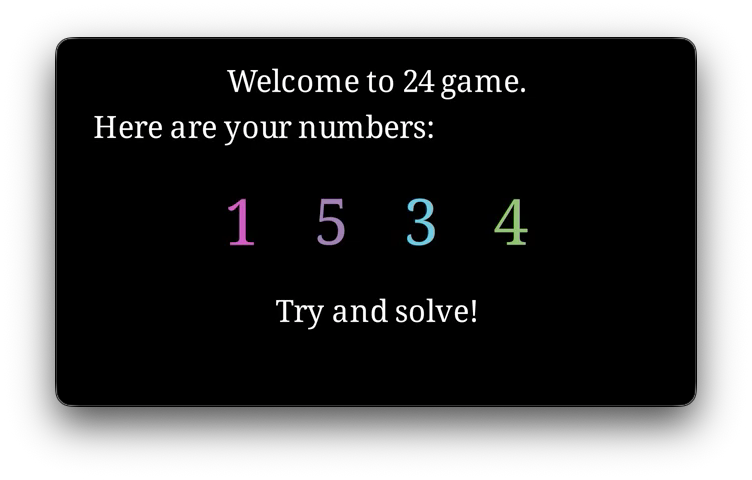
Nicole Brings the 24 Game to Life with Code and Animation
In class, Nicole begins building her first mathematical animation using Python and Manim: a “24 Game generator.” Her program randomly generates four numbers between 1 and 10, then animates them on screen. She assigns colors to each number and carefully adjusts their layout and motion. Although the final output is only about 14 seconds long, the project brings together multiple foundational ideas: randomness, text animation, coordinate positioning, and visual design.
After the animation is completed, a crucial observation is made. The generated set 1 5 3 4 is not just random — it is one digit away from a famous canonical 24-point configuration: 1 6 3 4 This is a classic structure in the 24 Game literature — a configuration so well-known that it appears in the preface of a well-known hacker-style problem-solving book. A single small change turns a neutral random output into a historically recognizable mathematical challenge.
Nicole begins to see that the program is not only generating numbers — it is generating structure-sensitive space. Randomness is no longer noise. It becomes a field where: tiny perturbations create known mathematical identities near-collisions reveal hidden canonical problems “random output” can land one step away from “textbook difficulty” Her animation is no longer just a visualization of 24 points — it is a generator of near-miss mathematical meaning.
When mathematics is made visible through code:
randomness becomes structured space small numeric changes become meaningful transformations “problem generation” is as important as “problem solving”
A difference of just one digit can separate:
an ordinary output from a historically recognized problem pattern
This is where computation becomes insight: in the neighborhood of structure, not just in final answers.
What Is Possible
☐ Generate mathematical problems through small perturbations ☐ Reveal hidden structure inside random outputs ☐ Turn number sets into recognizable problem families
How Does It Happen
☐ Python + Manim generate dynamic numeric visualization ☐ Random sampling creates a structured “problem space” ☐ Small delta changes reveal known mathematical configurations
Why Does It Matter
☐ Students see math as a landscape of nearby structures ☐ Randomness becomes a tool for discovery, not noise ☐ Learning shifts from solving problems to recognizing formations