
Living Museum of Learning
The Little Creature Started Walking
Albert's class was supposed to end. But neither of us wanted to stop. The lesson stretched naturally into the late evening as he continued working on Conway's Game of Life. His first challenge was technical: the program needed to preserve the current world while computing the next generation. He realized that the state of the world had to be copied. He wrote his own function to duplicate a two-dimensional array. The first version failed. Then another bug appeared. Then another.
The debugging became the lesson. Code was commented out. Sections were isolated. Rules were tested one by one. A blinking pattern was used to verify whether the rules themselves were correct. At one point Albert discovered that the same copy function he had written could also be used to copy the new world back into the old one. The tool he needed had already been sitting in front of him. Gradually the simulation began to work. But the evening still had one more surprise.
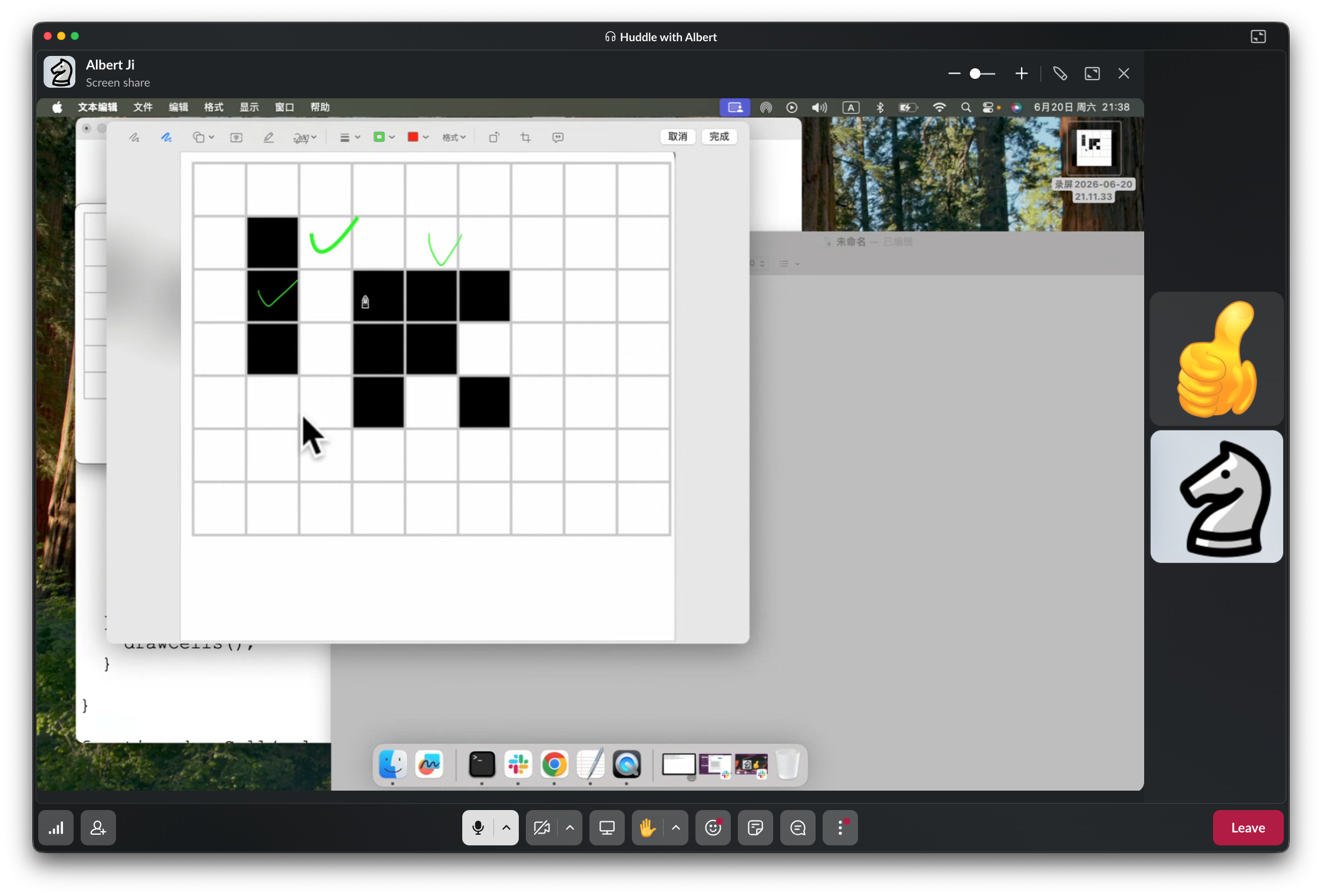
Somewhere in Albert's memory, a five-cell pattern had been waiting for years. Perhaps he had seen it in a book. Perhaps online. He did not know its name. He had never actually tried it. He placed the five cells onto the board. The small pattern began moving. The glider had come alive. Albert immediately expanded his world to give the tiny traveler more space. The little creature kept walking. He did not stop there. He built a larger ten-cell pattern, recorded eight or nine generations, and examined them frame by frame, cell by cell, applying the rules he had just mastered. Eventually only two stable blocks remained. When the pattern stopped changing, Albert decided that the simulation itself had earned a rest.
Real understanding often arrives after repeated failure.
Debugging narrows possibilities.
Verification builds confidence.
Rules become meaningful only when they explain something real.
The glider was not simply a famous pattern from Conway's Game of Life.
For Albert, it became evidence that a few simple rules could create unexpected behavior.
Something built from five squares could travel forever.