
Living Museum of Learning
When Complex Numbers Revealed a Simpler Problem
Leo is a Grade 4 homeschooler.
He's smart.
He's fast.
He's curious.
On his own, he has already explored parts of Grade 7 and Grade 8 mathematics.
So when we introduced complex numbers, it seemed like a natural next step.
And at first, everything looked fine.
Then something unexpected happened.
When Leo started multiplying complex numbers, his answers became unreliable.
Sometimes he got 0 out of 4 correct.
The surprising part was that the problem wasn't complex numbers.
He understood the new ideas.
The real issue was something much older.
Over time, speed had quietly encouraged him to skip steps.
Mental shortcuts worked often enough that the missing structure went unnoticed.
What mattered next was not the score.
It was Leo's response.
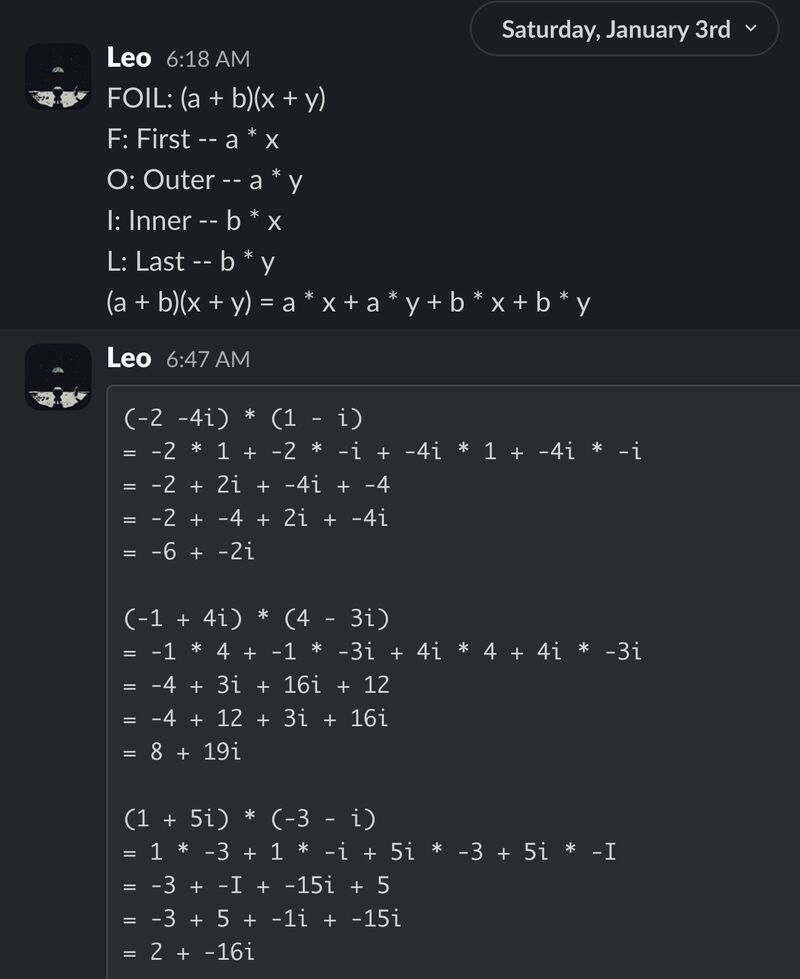
As soon as he recognized the pattern, he opened TextEdit and began writing every step down carefully.
No shortcuts.
No mental leaps.
No guessing.
First. Outer. Inner. Last.
He even shared his reminder in our Slack math channel:
FOIL: (a + b)(x + y)
First → a × x Outer → a × y Inner → b × x Last → b × y
Then he applied the process deliberately to each complex-number problem, expanding every term and simplifying one step at a time.
Slow.
Careful.
Deliberate.
The transformation was immediate.
This is what real learning often looks like.
Not racing ahead.
Not collecting advanced topics.
But noticing when a foundation has loosened and being willing to rebuild it.
Later I told Leo:
"Khan problems can be done again and again. Make sure you can confidently get 4 out of 4 next time. Fluency frees us to explore better ideas. Think of it as warming up your superpowers."
Strong students do not fear going back to fundamentals.
They use fundamentals to support bigger structures.
Sometimes the most valuable lesson is not learning something new.
It's learning how to slow down — on purpose.
🌱 πℯ𝜁𝝀 Dream Team Small circles. Big dreams.